Key takeaways
- Survival is improving across several major hematologic malignancies, although substantial unmet need remains, particularly in AML.
- CAR T-cell therapy is becoming increasingly important, and early referral matters most for patients with refractory or high-risk disease.
- Molecular profiling helps identify higher-risk patients and can guide decisions about treatment intensity and advanced therapies.
- Frontline combination strategies are producing deeper responses, including in DLBCL and multiple myeloma.
- As treatment becomes more effective, fixed-duration therapy may allow some patients to spend less time on treatment without losing benefit.
At the Community Oncology Global Congress (COGC 2026), organized by OncoDaily, Marc Braunstein, Associate Professor of Medicine at NYU Grossman Long Island School of Medicine and hematologist at Perlmutter Cancer Center, focused on how modern systemic therapy is changing the treatment of hematologic malignancies in community practice.
His presentation followed several major shifts happening at once: improving survival, expanding use of CAR T-cell therapy, molecular profiling for risk stratification, increasingly effective combination regimens, and a move toward fixed-duration treatment in diseases that have historically required prolonged or indefinite therapy.
Survival Is Improving as Treatment Evolves
“The good news is that we are doing well, and our patients are benefiting from the science that is being translated into clinical practice in both academic centers and community oncology settings.
Looking at the SEER data, mortality rates are going down for non-Hodgkin lymphoma, multiple myeloma, chronic lymphocytic leukemia, and to a lesser degree acute myeloid leukemia, where there remains substantial unmet need.
Five-year overall survival is approximately 74% for non-Hodgkin lymphoma, 64% for multiple myeloma, 90% for CLL, and 33% for AML.
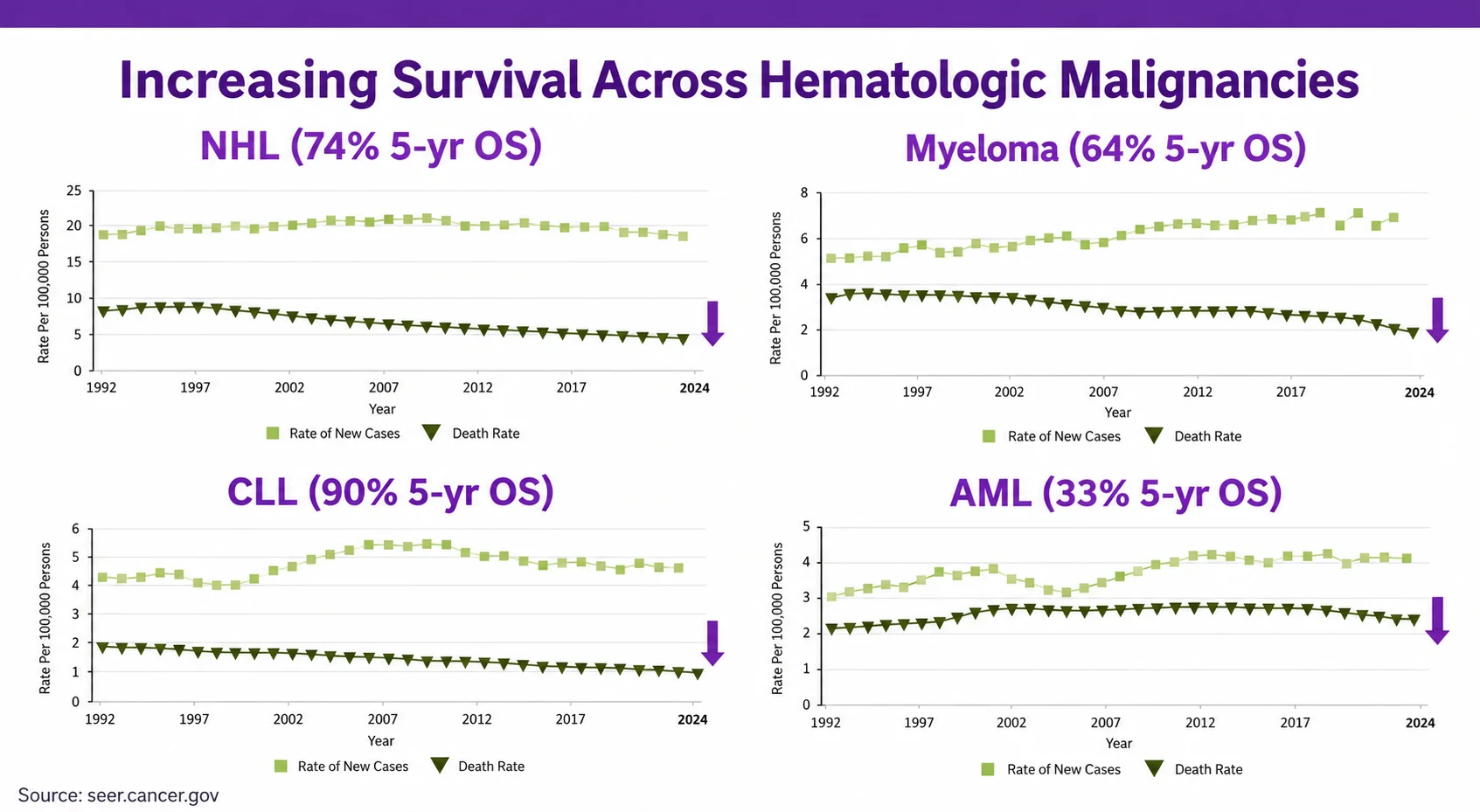
There is obviously still work to be done, but survival is improving because of novel therapies and the way we are increasingly using systemic treatment.
One major part of that evolution has been CAR T-cell therapy. CD19-directed CAR T cells were among the first CAR T-cell approaches to demonstrate an overall survival benefit in lymphoma, and the number of approvals for T-cell-redirecting therapies continues to increase.
These therapies may still be given more often in tertiary centers than in community practices because of the resources needed to manage patients, but as their use expands, we are going to encounter these patients and manage their complications in every practice setting.
In diffuse large B-cell lymphoma, for example, patients with primary refractory disease or relapse within 12 months have done better with CAR T-cell therapy than with the traditional approach of salvage chemotherapy followed by autologous stem-cell transplantation.
Access is also beginning to change. Reducing the amount of time patients need to remain close to a CAR T treatment center and shortening driving restrictions can be particularly meaningful because there are still major geographic disparities in access.
As these therapies become more common, we have to think about how to bring them closer to patients and, importantly, when to refer patients early enough for them to benefit.”
Who Needs More Intensive Treatment?
“We do not necessarily use CAR T-cell therapy up front. Patients are often coming to community oncology for their first-line treatment, and this is where molecular profiling and risk stratification become increasingly important.
Across hematologic malignancies, patients with a TP53 mutation or deletion are generally higher risk. This is particularly important in acute myeloid leukemia, where TP53 alterations tend to confer resistance to many treatments.
In diffuse large B-cell lymphoma, there are molecular features associated with a greater risk of treatment failure, and in multiple myeloma, patients with extramedullary disease also represent a higher-risk population.
These are the kinds of patients who may ultimately be more likely to move on to other therapies, including CAR T-cell therapy.
But at the same time, we are also doing better with the combinations we use up front.
In diffuse large B-cell lymphoma, recent studies have looked at adding additional immunotherapies to standard treatment. One example is the addition of tafasitamab and lenalidomide to R-CHOP, which showed an improvement in progression-free survival compared with R-CHOP alone.
There were also increased adverse events, including bone marrow suppression, so greater efficacy does not come without additional considerations.
But the direction is clear: we are increasingly using molecular information to identify higher-risk disease while also developing more effective combination strategies for those patients.”
Deeper Responses, Shorter Treatment
“Multiple myeloma is my particular area of specialization, and we are seeing important changes there.
In the CEPHEUS study, daratumumab was added to a standard backbone of bortezomib, lenalidomide, and dexamethasone. The quadruplet treatment produced better progression-free outcomes than the triplet and also improved minimal residual disease negativity.
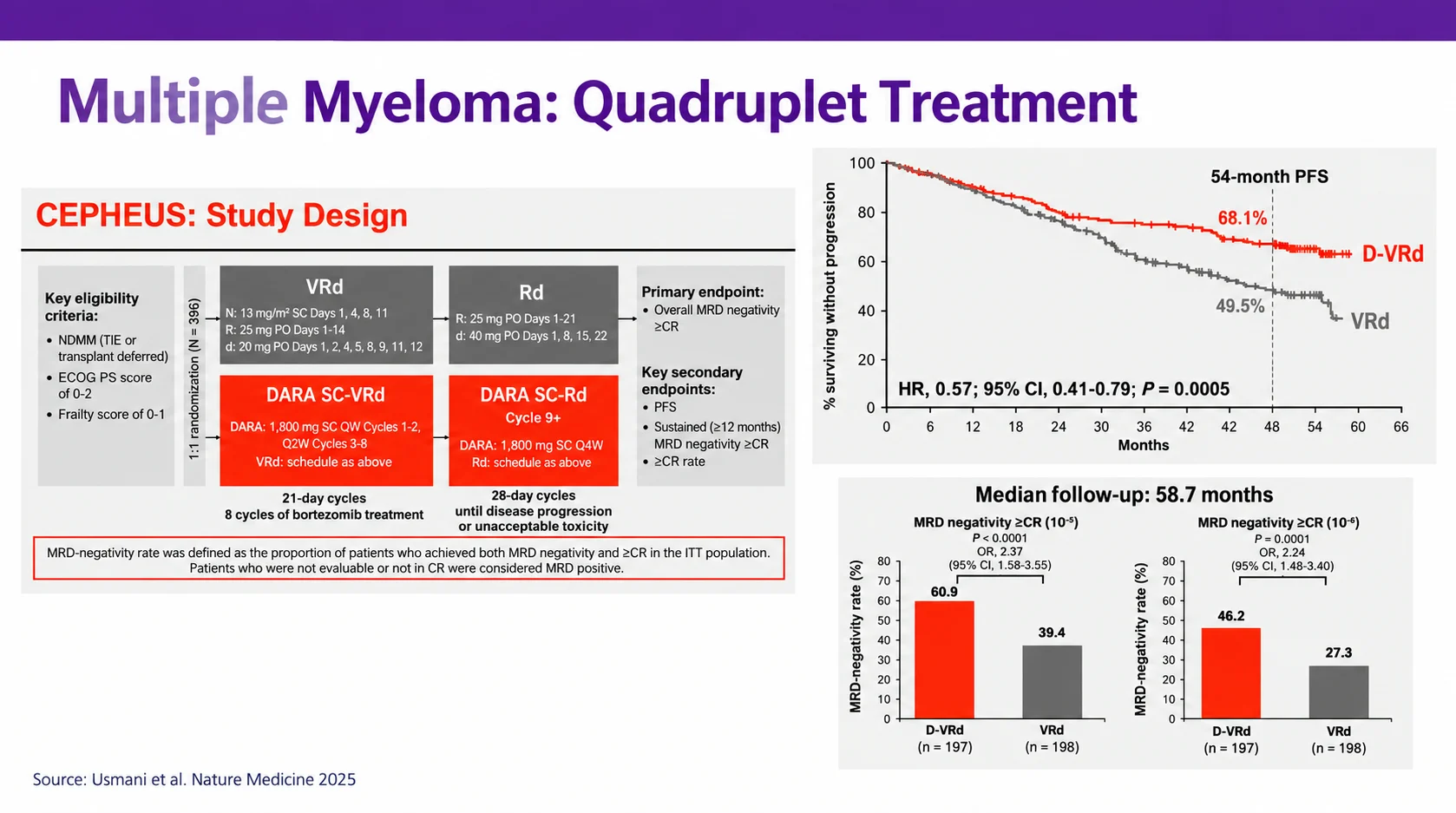
MRD is something that is increasingly being measured in the community setting because it provides important prognostic information.
We are therefore increasingly using quadruplet treatment in both fit and less-fit patients. This is part of a broader change across hematologic malignancies, where combination strategies are becoming standard in many frontline settings because they are producing deeper responses and improving outcomes.
But as those responses become deeper, another important question is how long patients actually need to remain on therapy.
Historically, we have often given treatment as maintenance indefinitely. Now we are increasingly asking whether fixed-duration therapy can preserve the benefit of treatment while reducing the time patients spend on it.
In treatment-naive CLL, the AMPLIFY study evaluated a fixed-duration combination of acalabrutinib and venetoclax, with or without obinutuzumab, compared with standard chemoimmunotherapy.
The study met its primary endpoint, with the acalabrutinib and venetoclax combinations improving progression-free survival compared with standard chemoimmunotherapy.
Importantly, this was treatment given for a defined period rather than indefinitely.
Increasingly, our goal is to limit the amount of time patients spend on treatment while preserving the benefit of that therapy and ideally improving quality of life.
We are seeing a similar question in multiple myeloma.
In long-term follow-up from the ENDURANCE study, patients receiving two years of lenalidomide maintenance were compared with those receiving indefinite maintenance.
There was no difference in overall survival between two years of maintenance and indefinite treatment, while patients receiving indefinite maintenance experienced more grade 3 adverse events.
That raises the possibility that we may be able to de-escalate treatment and reduce how long patients are exposed to therapy without taking away the benefit they have already achieved.”
What This Means for Community Practice
“The treatment landscape for hematologic malignancies is changing, and survival is improving.
Molecular profiling is helping us understand not only therapeutic targets, but also prognosis and which patients may benefit from more intensive treatment. This can increasingly be done in the community using next-generation sequencing on blood, bone marrow, lymph node, or other tissue.
Combination strategies are becoming standard for many first-line treatments and are producing deeper responses.
Early referral for CAR T-cell therapy can improve outcomes, particularly for patients with primary refractory non-Hodgkin lymphoma.
And as our frontline combinations become more effective, fixed-duration treatment is likely to become increasingly important.
The goal is not simply to give more treatment. It is to understand who needs more intensive therapy, who needs early access to advanced treatment, and where we may eventually be able to give less treatment for less time without sacrificing benefit.”
Written by Eliz Baloyan, MD, Features Writer and Editor at OncoDaily and CancerWorld