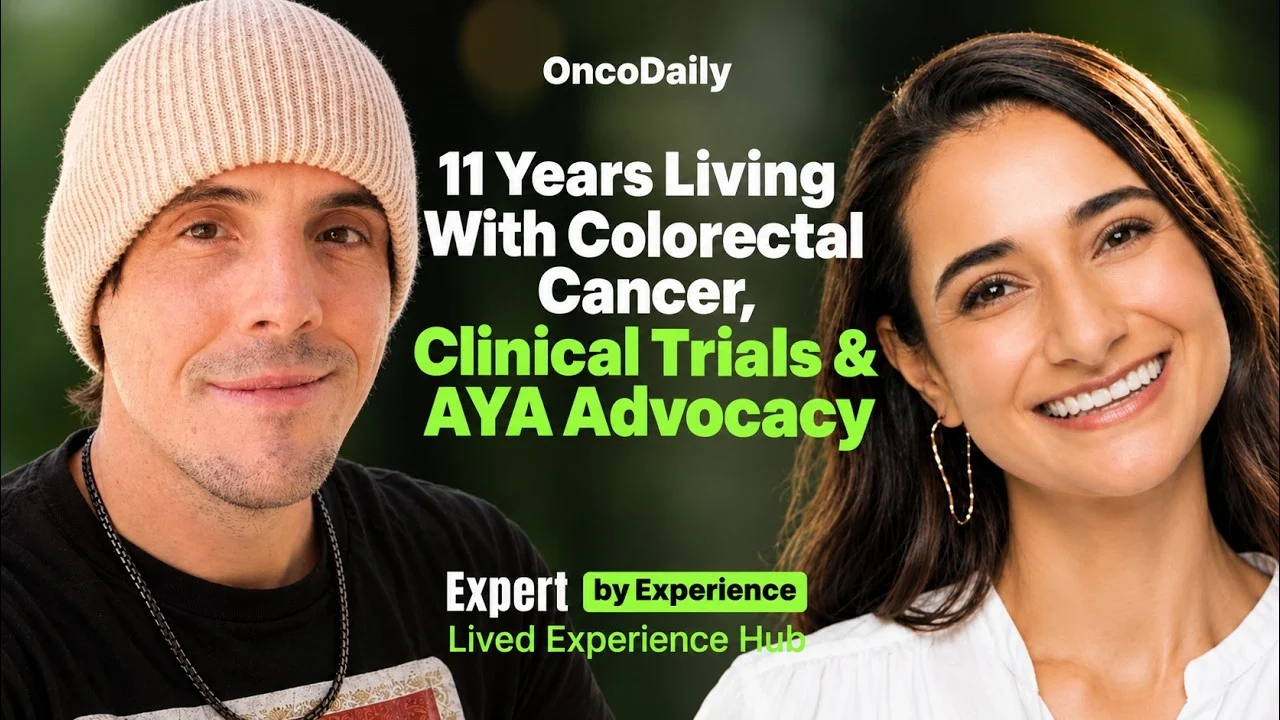
JJ Singleton was 27 when his mother finally made him go to the doctor.
For months, he had been living with abdominal pain, changes in his bowel movements and blood in his stool. He was losing weight and energy, but colorectal cancer was nowhere near the top of his list.
In his mind, that was something older people worried about.
“I remember lying in bed, looking up my symptoms. At the bottom, it always said, ‘This could be cancer.’ And I was like, no. I still had that invincible feeling you have in your 20s.”
By September 2015, his mother could see something was seriously wrong. Singleton was turning gray. He had lost so much weight that the tumor in his abdomen was visibly throbbing beneath his skin.
He went to the doctor on September 4.
A CT scan followed immediately. He barely made it to his car before being called back inside.
The scans showed colorectal cancer.
Within a week, Singleton was in surgery.
What followed would stretch far beyond anything Singleton could have imagined that day: chemotherapy, recurrence, metastatic disease, failed treatments, complications, surgeries and years of living with the side effects of cancer therapy.
Then, in late 2016, the options narrowed to one.
A clinical trial.
“There were no other approved drugs. There was one trial that was open that I could qualify for.”
And the stakes could hardly have been clearer.
“If it didn’t work, I was going to hospice. I was so sick, and I was getting sicker very quickly.”
He calls it his “Hail Mary.”
With no approved treatment options left, Singleton entered the trial.
A Diagnosis That Did Not Fit His Age
Singleton had entered adulthood expecting the same things most people his age did: independence, work, relationships, plans.
Instead, his days began filling with scans, treatment and hospital visits.
In a small town in North Carolina, there were few people around him who could understand what it meant to have colorectal cancer in his 20s.
Before his diagnosis, most of what Singleton knew about cancer came from what he had seen on television: surgery, chemotherapy, the visible signs of being sick. Nobody had really shown him what happened in your head.
Looking back, that became one of the biggest lessons of the last eleven years.
“There’s the isolation part of feeling like I’m the only one with this. I can’t go to anyone. So the biggest lesson is learning not to isolate and that it is okay to talk about your mental health and the struggles.”
Cancer changed a lot of what Singleton thought his life would look like. It also brought people and experiences he never expected.
“I’ve met amazing friends. I’ve got to do incredible things. So I guess one of the big lessons is keep going because you never know what’s going to be next.”
For Singleton, one of the biggest reasons there was a “next” at all was the clinical trial he entered in late 2016.
The Trial That Became His Last Option
Singleton speaks about clinical trials differently because, for him, they are not an abstract part of cancer research.
One kept him alive.
By the time his medical team at Duke Cancer Center found the study, he had already gone through multiple treatments. Qualifying meant repeated trips from his home to Duke – around five hours each way – during a three-week period of testing and paperwork.
He was also carrying a fear many patients still have about experimental treatment.
Before entering the study, the words clinical trial made him think of being a “lab rat.”
What changed that was the way the trial team spoke to him.
“They told me every single day, multiple times, that I’m in charge, that I had the power.”
That message stayed with him.
“You can say no to the drugs. You can say no. You can back out. You have all the power.”
Nearly a decade later, Singleton still encounters patients who assume that signing a trial consent means surrendering control of their care.
His own experience became one of the reasons he now works in research advocacy: explaining what participation actually involves, but also pushing researchers to think more carefully about what they are asking patients to carry.
A trial is rarely just a treatment appointment.
There may be blood draws, scans, procedures, travel, time away from work, caregiver responsibilities and financial pressures. Those burdens can decide whether participation is realistic long before the science becomes relevant.
Singleton wants patients to know all of that before saying yes.
But he also knows what trials can make possible.
Years later, he sometimes sees the drug he helped test being used in other settings.
“I was one of the first people on that drug that helped it get to where it is.”
The trial had already given Singleton something deeply personal: more time.
Years later, seeing the same drug help other patients changed how he understood his own place in that research.
“To know that it’s doing it for so many countless other people too. And then I’m a small little part of that… it’s really an indescribable feeling.”
Trying to Keep Up With Life at 27
Singleton’s experience also made him increasingly involved in advocacy for adolescents and young adults with cancer.
He knows what it means to have treatment arrive at the exact stage of life when everything else is supposed to be moving forward.
“That’s the time you’re supposed to be, you know, solidifying your life, finding a job, becoming more independent.”
Cancer interrupts that momentum in ways that are not always reflected in treatment protocols.
While friends may be getting married, having children or establishing careers, the young adult with cancer may be dealing with hospital appointments, treatment fatigue, financial pressure and dependence on family again.
Singleton puts the contrast plainly:
“Your friends are creating families, having kids, getting married. You’re just trying to get out of bed that day.”
The problem extends into quality of life.
Treatments developed largely around older patient populations may affect a 27-year-old very differently – not necessarily because the toxicity itself changes, but because the life surrounding it does.
After an infusion, Singleton did not simply want to remain home until the next cycle.
He wanted to go out with friends. He wanted an appetite. He wanted a private life. He wanted the parts of being 27 that cancer care did not always ask about.
Sexual health was one area where that difference in age became especially clear. Singleton says the effects of treatment were rarely discussed with him, and he did not want problems affecting his sex life to be dismissed as something he simply had to accept.
“I was like, well, I don’t want that to be part of my life at 27.”
Fertility, relationships, independence, work and sexuality can all sit alongside survival as legitimate concerns for younger patients.
For Singleton, acknowledging those differences is one of the first steps toward designing care and research that actually fits their lives.
Finding the Men Who Would Talk About Cancer
Singleton did not initially imagine himself becoming a patient advocate. For a long time, even talking openly about cancer came with its own frustration.
He did not always look the way people expected a cancer patient to look. His hair thinned during treatment, but he did not lose it. Steroids made him gain weight rather than become visibly thinner, and some people took those outward signs as evidence that he could not be that sick.
“People would say, ‘Must not be that bad. You’re gaining weight and you have your hair.’”
There were periods when Singleton was sick enough that he simply did not have the energy to explain himself.
“For a while, I was so sick, I was like, that’s why I’m not saying anything about this, because I don’t want to hear what people have to say about it.”
By the time he started sharing more of his experience online during COVID-19, he had decided that if he was going to talk about cancer publicly, he was not going to tidy it up first.
“It’s got to be completely honest, real. It’s going to show the good, the bad, everything else.”
Around the same time, he was invited to join Man Up to Cancer, a support community for men affected by cancer. Singleton assumed it would be another group he joined briefly and left. Instead, it became the first cancer community he stayed with.
What kept him there was the way men talked to one another. There was room for jokes and dark humor, but also for conversations that might have been much harder to have elsewhere. Singleton describes the expectation many men carry as a kind of “cowboy culture”: shoulder the burden, stay strong, keep moving.
Inside the group, that posture became easier to drop.
“You get a lot of guys in a group where it’s nobody else but other guys in there, and they’re very open and they talk about all kinds of things.”
For Singleton, Man Up to Cancer became the first domino. It led him toward colorectal cancer organizations, conferences, research advocacy and work across AYA cancer, rural oncology and clinical trials.

JJ Singleton, colorectal cancer survivor and patient advocate, announced as a keynote speaker for the 2026 Man Up to Cancer Gathering of Wolves. Photo: Man Up to Cancer.
He had once wondered what someone from a North Carolina town of around 1,500 people could possibly have to say. Now, that lived experience takes him around the country.
“It definitely changed the trajectory of my life.”
The Skydive Cancer Delayed, But Didn’t Take Away
There was something Singleton had wanted to do even before cancer: jump out of an airplane.
About nine years earlier, he had tried to make it happen between treatments. Then he became too sick.
The idea stayed with him.
Eventually, nearly eleven years into life with cancer, he made it to New Jersey with friends, climbed into a small plane and went up to about 9,500 feet.
Singleton could see the New York City skyline below him. The view was spectacular, although getting there involved a few second thoughts as the small plane climbed higher.
Once he made the jump, those doubts disappeared quickly enough that he was already thinking about doing it again – this time from even higher, maybe over the Arizona desert or somewhere near the Grand Canyon.
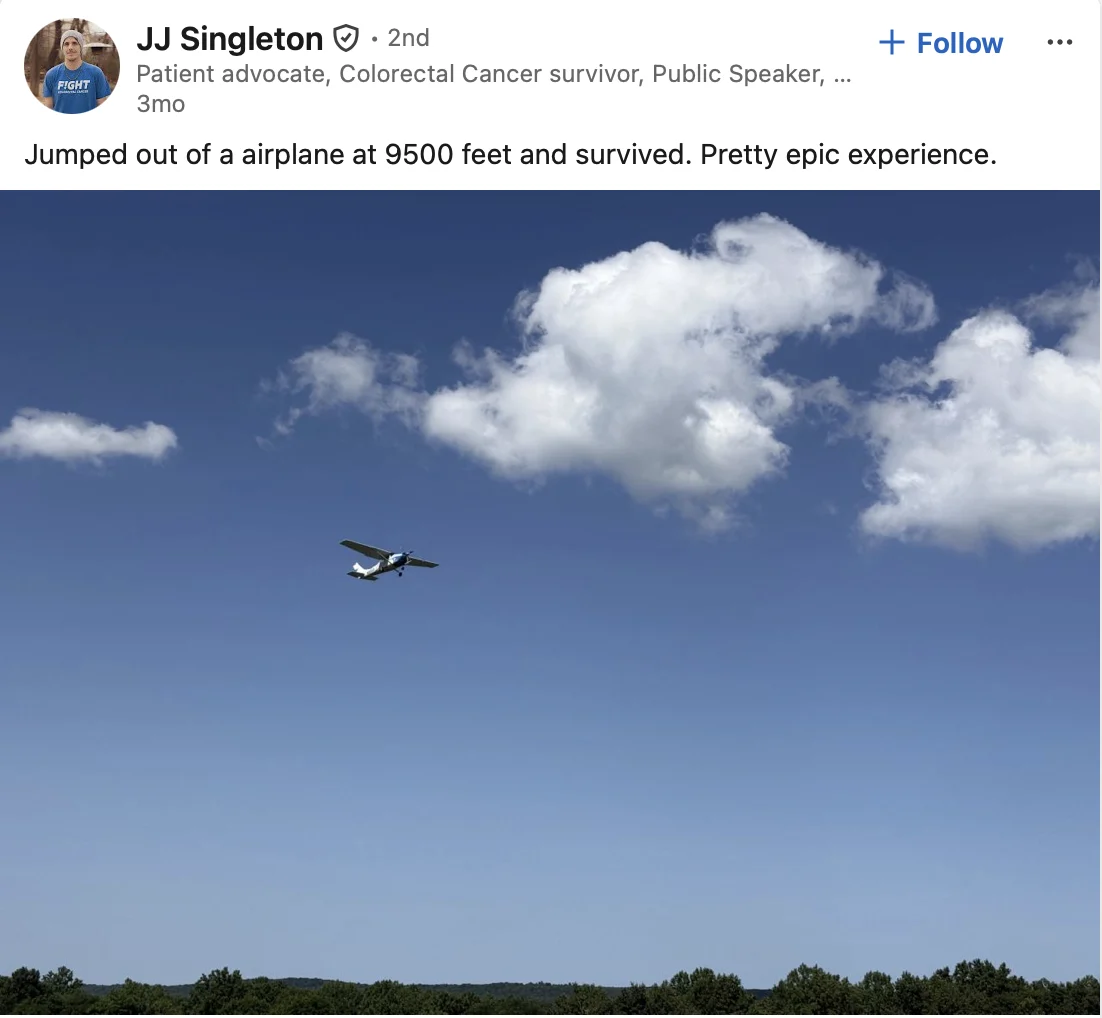
Photo: JJ Singleton/LinkedIn
The skydive had been on his list long before cancer, and years earlier he had come close to doing it before becoming too sick. Finally making that jump almost eleven years into treatment gave the moment a different weight. It was something cancer had delayed for years, but had never quite managed to take away.
“That says somehow life still goes on and that we can still do whatever we want.”
Making It Easier for Whoever Comes Next
Singleton does not have children.
Cancer and treatment changed that possibility for him.
But he has nieces and nephews. His closest friends have children. And when he thinks about the future of advocacy, he thinks about them.
Some of those young people, he knows, will eventually hear the word cancer.
That possibility gives his work a very personal endpoint.
“If I can help them not go through everything that I’ve experienced, that is everything to me.”
That means better treatment, but also fewer unnecessary barriers. Better clinical trials. More attention to AYA needs. Greater inclusion of people from rural and underserved communities. More honest conversations about mental health, fertility and sexual health. More places where patients do not have to feel like the only person their age living through this.
Eleven years have given Singleton an unusual vantage point on how quickly cancer care can change.
He has lived through some of that progress himself.
“The advancements in treatment options and treatment protocols from 11 years ago to today are crazy and amazing to see.”
He wonders what another decade might bring if patients keep speaking, researchers keep listening and treatment continues moving forward.
Perhaps, he says, some cancers will increasingly be approached as chronic illnesses – conditions people continue living with rather than diagnoses that immediately narrow the future.
His optimism is not constant.
“Some days it doesn’t feel so optimistic.”
But over the longer distance, he still finds reasons to believe in what comes next.
Eleven years after a diagnosis he never expected, years after a clinical trial became his last available option, Singleton is still on treatment.
Still advocating.
Still planning another skydive.
And still living by the lesson cancer took years to teach him:
“Good, bad. Either way, there is next.”
Written by Eliz Baloyan, MD, Features Writer and Editor at OncoDaily and CancerWorld
Interview by Carmen Monge-Montero, Lead of the OncoDaily Lived Experience Advocacy Hub