Key takeaways
- Recognize and mitigate your moral distress.
- Debrief your grief.
- Master the difficult conversations.
- Partner with palliative care or supportive oncology.
At the Community Oncology Global Congress (COGC 2026), organized by OncoDaily, Janet Abrahm, Professor of Medicine at Harvard Medical School and Institute Physician at Dana-Farber Cancer Institute, shifted the conversation from cancer treatment to the clinicians delivering it.
Her focus was on the role of supportive oncology in recognizing and preventing burnout and compassion fatigue, particularly among clinicians repeatedly exposed to suffering, loss, difficult decisions, and limited resources.
Rather than treating burnout as simply a problem of workload, she explored some of its less visible sources: moral distress, unprocessed grief, guilt, countertransference, and the expectation of perfection in a healthcare system that can never provide everything every patient needs.
Supportive Oncology Is More Than End-of-Life Care
“Palliative care or supportive oncology focuses on things that may have been on the periphery of our training, but they are at the heart of our clinical challenges.
I was an oncologist for 20 years, and I was never really taught many of the things I am sharing with you – even some of the basic skills that might have prevented my own episodes of compassion fatigue and burnout.
When people think about palliative care, they sometimes imagine the grim reaper at the tumor board. But that is not what we are there to do. We can support everyone at the tumor board and help make decision-making more focused and more patient-centered.
We may bring up geriatric assessment issues that others have not had time to consider, and we can help the team arrive at a decision that is focused on the individual patient rather than simply the protocol.
These are supportive oncology skills that many of us were never formally taught:
- Pain and symptom management,
- Communicating very bad news,
- End-of-life care,
- Bereavement,
- Understanding the individual cultural, religious, and social needs of our patients.
When I learned more about these aspects of care, it helped me become a more comprehensive and balanced clinician. Before that, I often felt helpless in the face of uncontrolled suffering and the limitations of medicine, and that helplessness contributed to compassion fatigue and burnout.”
Where Burnout Begins
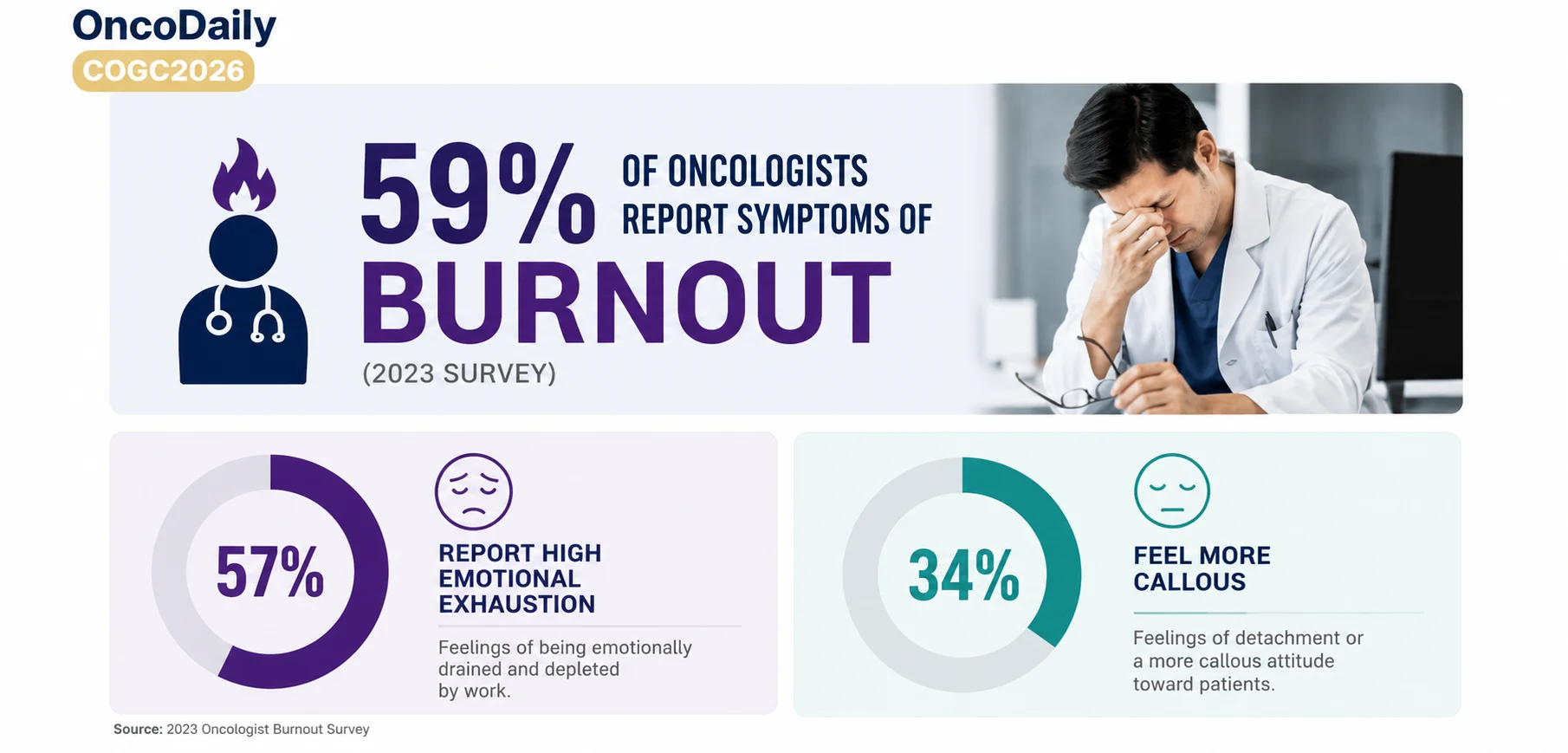
“In the United States, 59% of oncologists report symptoms of burnout, and 57% report high emotional exhaustion – feeling emotionally drained and depleted by their work.
There are many contributors.
One is moral distress. Maybe you had to give somebody a treatment that you believed was wrong. Or perhaps you wanted to offer a treatment, but the family could no longer afford it.
That causes moral distress, and it can contribute to burnout and compassion fatigue.
Then there is overwork. There is unprocessed grief and guilt. There is countertransference. There are difficult conversations.
And then there is something that I think many oncologists understand very well: we expect perfection.”
The Grief Oncologists Rarely Get to Process
“The emotions that we associate with grief in our patients – denial, anger, bargaining, depression, and eventually acceptance – are also emotions that clinicians experience.
We are grieving our patients too.
Unprocessed grief was huge for me as an oncologist. There was nobody to talk to about the patients who had died. The nurses would talk to each other, but I did not have a way to really process that grief.
Sometimes it may even feel easier to feel guilty than to feel grief. We blame ourselves because medicine had no more options.
When I accompany an oncologist into a very difficult conversation with a patient and family, I often hear the oncologist go through every treatment they have given: ‘We tried this, and then this, and then this.’
In some ways, it is saying: I tried everything. I feel terrible. I feel guilty.
The family is recognized as grieving. Friends are recognized as grieving. But oncologists are rarely thought of as people who grieve when their patients die.
We may have cared for somebody for years, watched their family change, accompanied them through treatment, and then lost them. Yet we are usually not part of the rituals or remembrances surrounding that loss.
If you do not recognize your own grief and you do not have ways of dealing with it, you may simply push it away.
That is what I did, until eventually it contributed to compassion fatigue.”
That experience of grief is not unique to Abrahm. For oncologists who build long relationships with their patients, loss can become inseparable from the care and attachment that came before it.
Mark Lewis, Director of Gastrointestinal Oncology at Intermountain Healthcare, recently captured that connection in a simple reflection:
“I’ve started to think of love and grief as complementary strands of a very different double helix.”
When Our Own Emotions Affect Patient Care
“Then there is transference and countertransference.
In transference, the patient may project feelings from previous relationships onto you. Perhaps you remind them of a parent, teacher, or somebody else from their past.
But what we particularly need to recognize as clinicians is countertransference – when we project our own personal feelings onto the patient.
One of my teachers told me that if we suddenly find ourselves treating one patient very differently – if we are being unusually nice to them, or if we simply do not want to see them – then countertransference may be happening.
A patient might remind you of your grandmother or your aunt. You may do things for that person that you would not ordinarily do. You may allow them to go off the treatment schedule because that is what you would have allowed somebody you loved to do.
If you do not recognize that you are treating that patient differently, it can actually affect their care.
The opposite can happen as well.
A patient may remind you of an angry teacher, family member, or coach. You may unconsciously begin avoiding that person. You may not connect with them in the same way. You may even be less inclined to offer them the latest clinical trial.
This is very human.
The question to ask yourself is: am I treating this person differently from most of my patients, either better or worse – and why?
Signs can include:
- Intense emotions during an encounter,
- Overcompensation,
- Dread before seeing the patient,
- Unusual attachment,
- Avoidance.
The strategies are introspection, discussing the situation with colleagues, sometimes seeing the patient together with another member of the team, and becoming more aware of your own personal triggers.”
Perfectionism in an Imperfect System
“Many of us expect perfection. Good is not enough.
But oncology is not a place for those of us who expect perfection.
We can strive for perfection. We can do our best. But if we expect perfection, we are going to fail.
We do not work in perfect organizations. We do not have every resource our patients need. Patients cannot always afford the treatments we want to give them. In some settings, clinicians may not even have access to basic medications such as morphine.
If we blame ourselves for every one of those failures – for every organizational failure and every limitation of medicine – we are setting ourselves up for compassion fatigue and burnout. And burnout does not affect only the clinician. It can affect our patients.
We may delay goals-of-care conversations because they are too difficult. We may continue treatments whose burden has become greater than their likely benefit. Patients may begin to mistrust us because they sense that we do not want to see them.
They may even feel abandoned because we simply do not have the same emotional capacity left.
Sometimes the signs appear in ourselves or in our colleagues as absenteeism, unexpected anger, detachment, or changes in the way we interact with patients and families.
Those changes are worth noticing.”
Preventing Burnout Requires More Than Resilience
“There are personal, interpersonal, and organizational solutions, and the organizational ones may be the hardest.
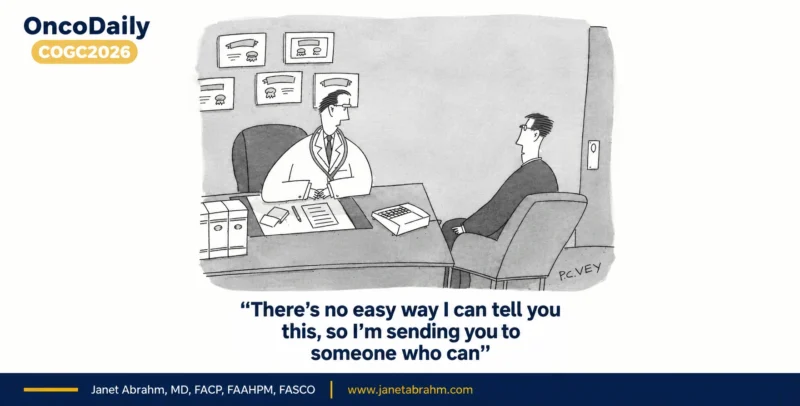
One of the most important things for preventing burnout is having some control over your schedule.
You may choose to work extremely hard, but having some control over how you work matters – control over your schedule and even over how much time you have with your patients.
Supportive oncology can also help. Sometimes we can step into the conversations that are particularly difficult. We can support clinicians as well as patients and families.
So I would leave you with four things:
- Recognize and mitigate your moral distress.
- Debrief your grief.
- Master the difficult conversations.
- And partner with palliative care or supportive oncology.
Caring for patients with cancer asks a great deal of clinicians. If we want to continue providing compassionate care, we also have to recognize the emotional weight of that work and find ways to process it rather than simply carrying it forward.”
Written by Eliz Baloyan, MD, Features Writer and Editor at OncoDaily and CancerWorld