Key takeaways
- Cancer care access is a pathway - from diagnosis to treatment to follow-up.
- Evidence needs implementation. Global standards only matter once they are translated into locally feasible care.
- Networks multiply capacity. Connecting community, regional, and specialized services extends the reach of the expertise we already have.
At the Community Oncology Global Congress (COGC 2026), organized by OncoDaily, Imène Hadji, medical oncologist at EPH Ibn Zohr in Algeria, focused on the broader challenge of ensuring that patients can access the right cancer services at the right time, throughout the entire continuum of care.
Her presentation, “Improving Access to Essential Cancer Services,” looked at access not as a single point of entry, but as a chain stretching from prevention and diagnosis to treatment, supportive care, and follow-up.
As Hadji framed it, the discussion comes down to one simple question:
“Can the patient reach the right service at the right time and receive the right care?”
Access Is a Continuum
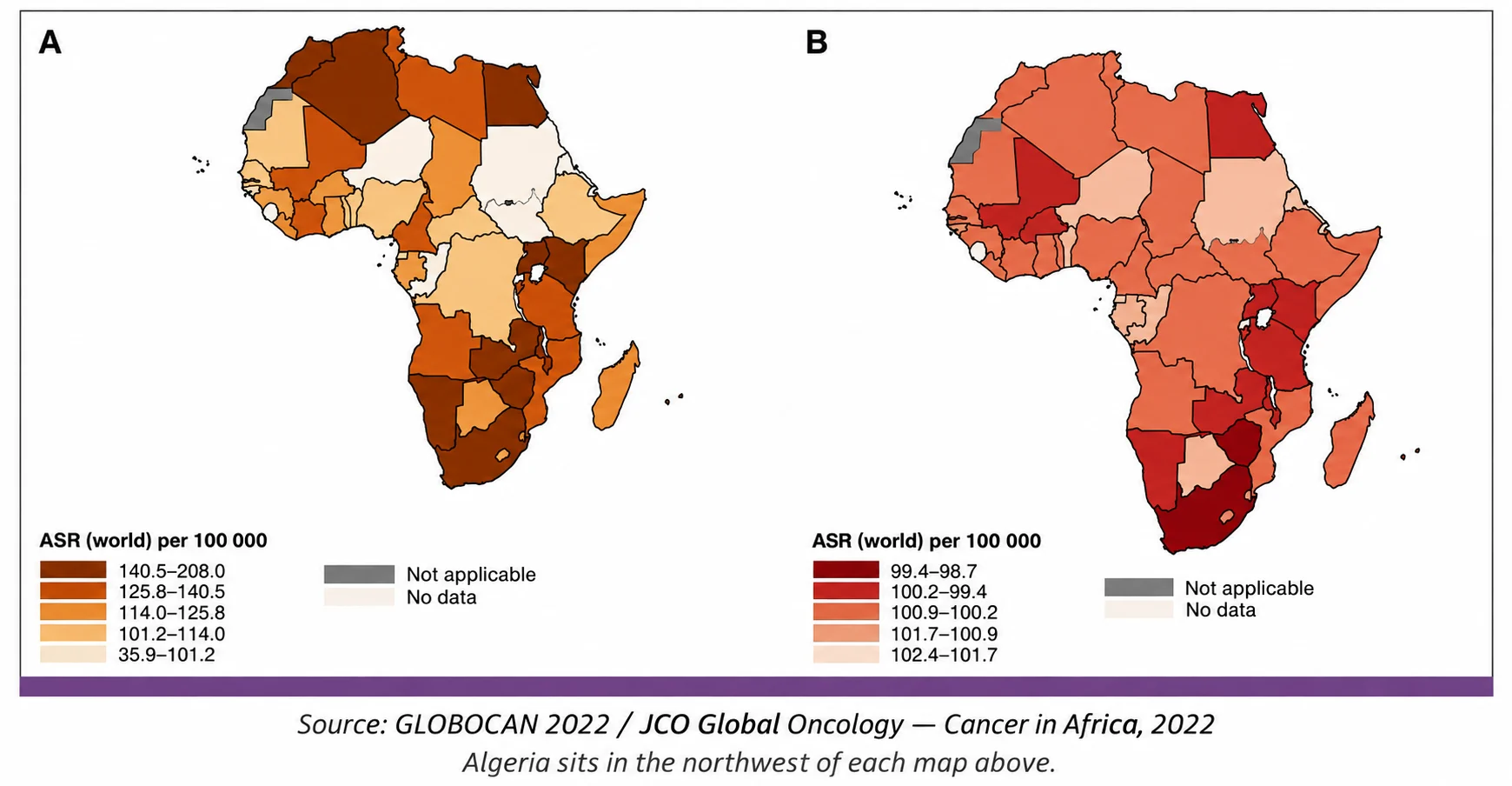
“In 2022, Africa recorded roughly 1.15 million new cancer cases and over 750,000 deaths, a mortality-to-incidence ratio of about 65%, compared with a global average near 49%.
That gap tells us something important. It isn’t only that cancer is common; it’s that too many patients are being reached too late or without the resources to give them a fair chance.
Access is tempting to think of as one moment – walking into a treatment room. It is not. It is a continuum: prevention, early detection, diagnosis and pathology, staging and biomarkers, multidisciplinary decision-making, evidence-based treatment, supportive and palliative care, and follow-up and survivorship.
A gap at any single step can become a fatal delay for the patient, no matter how strong the other steps are.
That continuum is really a chain, and the chain is only as strong as its weakest link.
At first presentation, a patient can be lost to awareness or geography. At referral, to a fragmented pathway. At diagnosis, to pathology and imaging capacity. At staging, to the availability of investigations. At treatment, to medicines, infrastructure, and workforce. And at follow-up, to continuity and coordination.
Improving access means strengthening the entire pathway, not just one component of it.”
The Five Dimensions of Access
“So what does strengthening actually mean?
Access has five dimensions:
- Availability: Is the service or medicine present?
- Affordability: Can the system and the patient sustain it?
- Accessibility: Can the patient physically reach it?
- Acceptability: Is the care appropriate to their needs?
- Quality: Can it be delivered safely and according to evidence?
Access is the sum of all five. Miss one, and the others stop mattering.”
The Infrastructure and Affordability Gaps
“Look at workforce and infrastructure specifically.
The IAEA benchmark for radiotherapy capacity is one machine per 250,000 people. Across Africa, the actual figure is closer to one machine per 3.6 million – a roughly 14-fold gap.
Screening tells a similar story. Only five of 42 African countries assessed by WHO have an organized population-level breast cancer screening program, and only two meet the benchmark of one pathology lab per 100,000 people.
Without a lab, diagnosis is not a diagnosis. It’s a guess.
Then there is the affordability gap.
Even where cancer drugs exist on paper, fragmented procurement, near-total import dependence, and weak regulatory frameworks mean they are often unavailable, delayed, or priced beyond what households can bear.
Across much of the region, patients and families still cover the costs directly, out of pocket.
And that single fact pushes many to abandon treatment midcourse – not because the disease became untreatable, but because it became unaffordable.”
Why One Cancer Care Model Cannot Fit Every Country
“Before looking at solutions, it’s worth pausing on one thing: Africa is not one health system, and it is not one disease pattern either.
Cervical cancer is the leading cancer in some countries. Breast cancer is in others. And the cumulative lifetime risk of these two cancers alone ranges from under 1% in parts of Northern Africa to over 7% in parts of Eastern Africa.
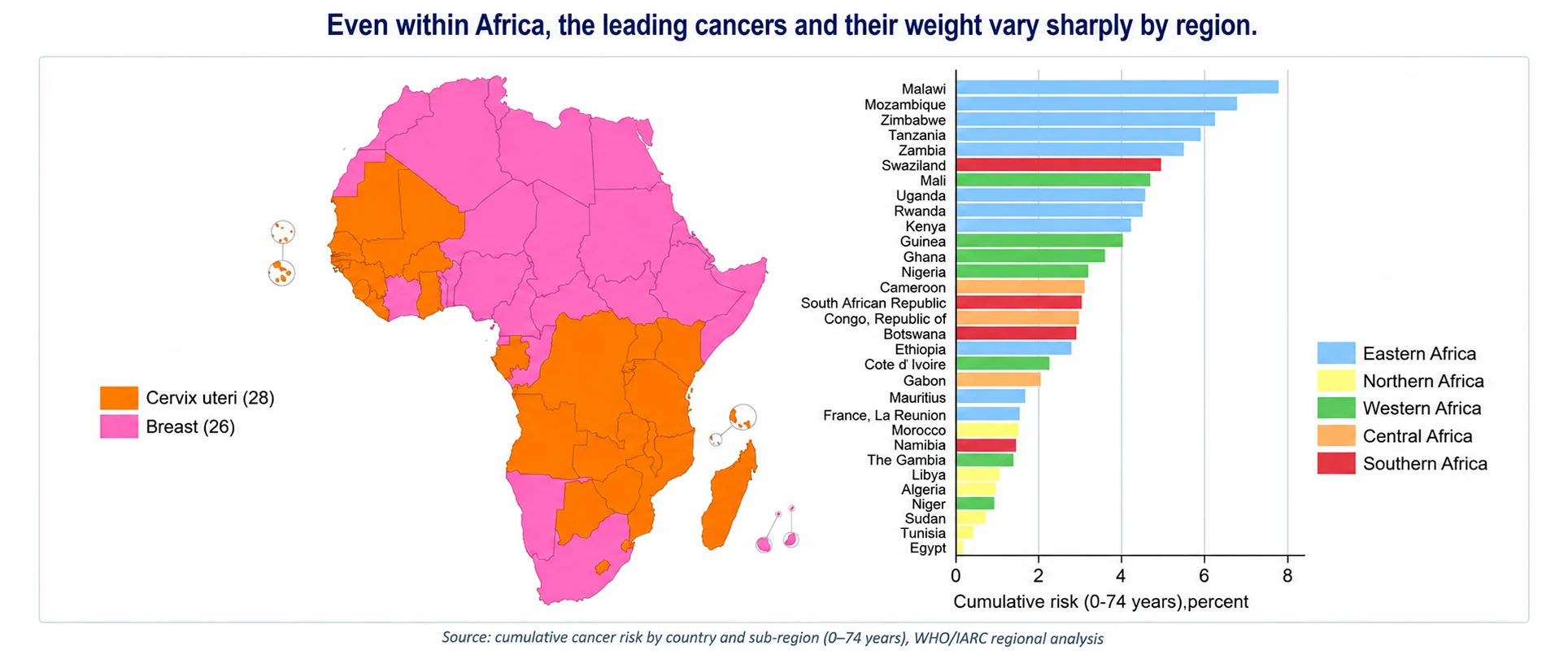
That diversity is exactly why we need to look at different regional models, not one template that is supposed to fit everyone.
So what does progress actually look like?
A few examples from across the region:
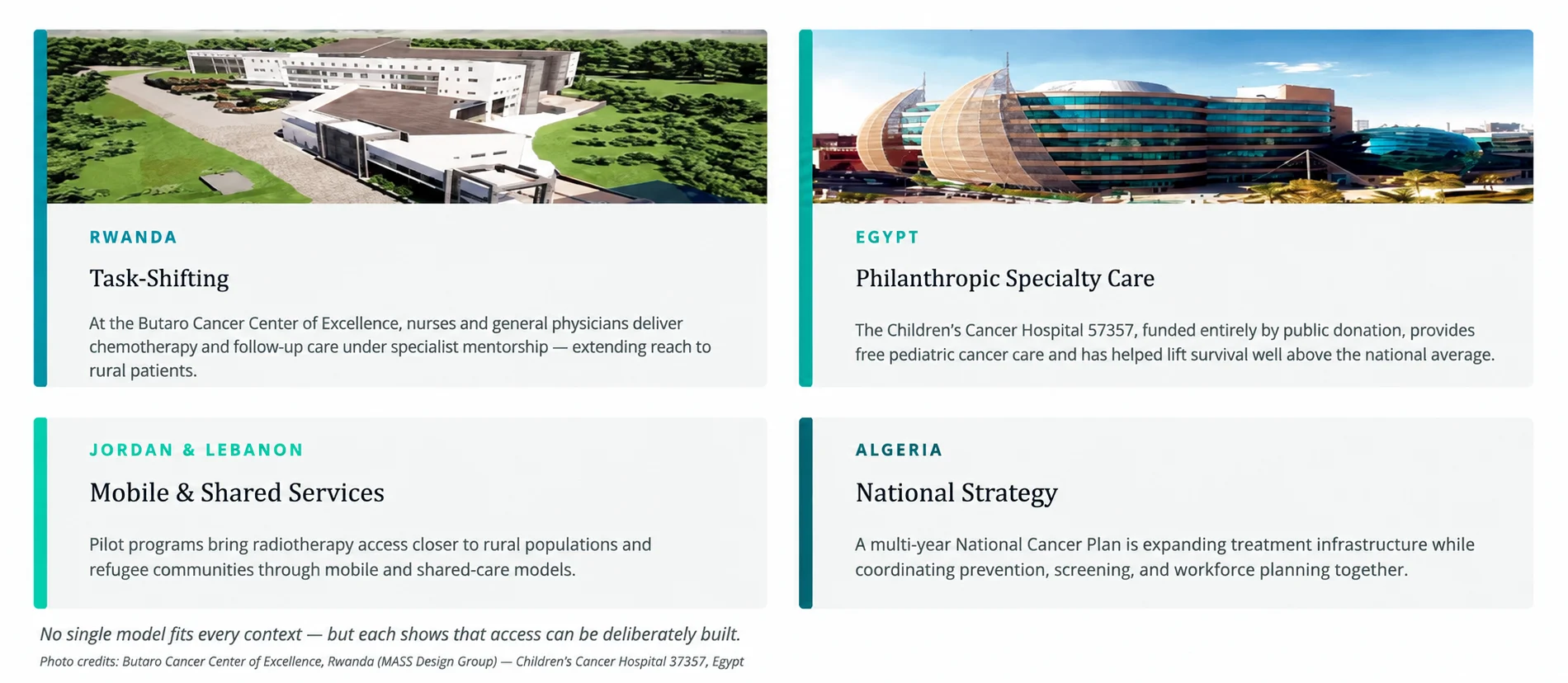
In Rwanda, the Butaro Cancer Center of Excellence trains nurses and general physicians to safely deliver chemotherapy and follow-up care under specialist mentorship, extending reach to rural patients through task shifting.
In Egypt, the Children’s Cancer Hospital 57357, funded entirely through public donations, provides free pediatric cancer care and has helped lift survival well above the national average.
In Jordan and Lebanon, pilot programs are bringing mobile and shared radiotherapy services closer to rural populations and refugee communities.
And in Algeria, a multi-year national cancer plan is expanding treatment infrastructure while coordinating prevention, screening, and workforce planning together.
I’ll go one level deeper into that last example, since it is the system I know best.
Algeria’s national cancer strategy, Horizon 2035, is structured around five connected pillars: prevention, early detection, diagnosis, patient pathways and treatment access, and training and research.
I chose Algeria as my deep-dive example not because it is the most advanced system in the region, but because it is the one I can speak about with direct, first-hand knowledge. That is why Rwanda, Egypt, Jordan, and Lebanon also deserve space in this discussion.
Like every plan on this stage today, this one is a work in progress, not a finished story. Implementation varies by region, and the timeline to 2035 reflects that this is a multi-year build.
No single model fits every context, but each one shows that access can be deliberately built.”
What Every Patient Should Be Able to Reach
“Given everything we’ve covered, it is worth being precise about what we are actually asking every system to deliver.
A practical minimum package includes:
- Early diagnosis and referral
- Pathology and essential imaging
- Multidisciplinary clinical assessment
- Essential systemic anti-cancer therapy
- Surgery and radiotherapy when indicated
- Supportive and palliative care
- Follow-up and continuity of care
The goal is not to reproduce every tertiary-center service everywhere. It is to make sure every patient can reach these essential components.
And practically, there are five priorities that can help make that possible:
- Strengthen referral pathways to reduce delays.
- Build regional multidisciplinary networks to share expertise.
- Invest in people through continuous education, team-based care, and task sharing where appropriate.
- Standardize care pathways so evidence becomes practical protocol.
- Measure what actually happens in real life through registries and real-world data.
Progress doesn’t always require a new system. Sometimes it requires connecting and strengthening the one we already have.”
Connecting the Levels of Cancer Care
“And that does not mean every service has to live in the same place.
Picture three connected levels: community and primary care, regional oncology services, and specialized cancer centers – linked by referral pathways, shared protocols, and tele-oncology.
Cancer is a team sport.
The question isn’t, ‘Where should the cancer center be?’
It is: How do we connect the patient to the expertise they need?”
Three Messages to Close
“So, three messages to close.
- Access is a pathway – from diagnosis to treatment to follow-up.
- Evidence needs implementation. Global standards only matter once they are translated into locally feasible care.
- Networks multiply capacity. Connecting community, regional, and specialized services extends the reach of the expertise we already have.
And the goal is not to build the same cancer system everywhere.
The goal is to make high-quality cancer care possible everywhere.”
Written by Eliz Baloyan, MD, Features Writer and Editor at OncoDaily and CancerWorld