Key takeaways
- Cancer can become financially toxic long before the treatment bill arrives.
- Financial navigation works best when it starts early, identifies the patient’s specific barriers, and connects them with the right support.
- The strongest navigation programs are built into care pathways rather than added on as a separate service.
- Patients should not need to become experts in navigating fragmented cancer care just to receive treatment.
At the Community Oncology Global Congress (COGC 2026), organized by OncoDaily, Hadi Mohamad Abu Rasheed, Scientific Advisor and Director of Programs at Qatar Cancer Society, approached patient access from two connected but distinct angles.
One of them was financial navigation – moving beyond the idea of simply helping patients pay for treatment and toward identifying financial vulnerability early, understanding the full cost of cancer, and connecting each patient with the support they actually need.
Then, he widened the lens to patient navigation across the cancer journey, asking what happens when patients face fragmented referrals, transportation problems, language barriers, psychosocial distress, or simply do not know where to go next.
The two topics ultimately came back to one question: if patients need navigators to get through cancer care, what does that say about the way the system itself is designed?
From Financial Toxicity to Financial Protection
Financial toxicity is often reduced to a question of whether a patient can afford the treatment bill. But the burden reaches much further.
Cancer can affect transportation, accommodation, childcare, food, employment, savings, and the ability to meet basic household expenses. Patients may delay care, skip medication, or make treatment decisions because of cost. At the same time, financial stress can follow them psychologically, bringing anxiety about work, family, and what will happen after treatment.
The effects can continue even into survivorship. Returning to work, obtaining insurance, securing housing, or accessing financial services may remain difficult because of a previous cancer diagnosis.
This is where the idea of the “right to be forgotten” becomes important: after successful treatment, a history of cancer should not continue to define a person’s access to insurance, employment, mortgages, or other parts of ordinary life.
Financial toxicity therefore cannot be understood only through direct medical costs. Non-medical expenses and indirect social costs are part of the same experience, even though they are often left out when health systems calculate the cost of cancer care.
Financial assistance can solve an immediate problem – covering a drug, paying for transport, or helping with day-to-day expenses. But financial navigation goes further. It looks at why a patient is struggling, which barriers are affecting their care, and what support will actually help them stay on treatment and move through the system.
How Much Can Navigation Really Change?
Financial pressure looks different for every patient. For one person, the biggest problem may be getting to the hospital. For another, it may be lost income, childcare, medication costs, or insurance.
That is why financial navigation has to start early and be tailored to the patient in front of you, rather than treating financial hardship as one single problem.
The conversation itself also matters. Patients may feel embarrassed or uncomfortable talking about money, even when financial pressure is beginning to affect their care. Making cost discussions a normal part of cancer care can help bring those problems to the surface before they become crises.
From there, navigation means helping patients understand eligibility, benefits, available resources, and where they can turn for support. And it cannot be a one-time intervention because financial needs can change throughout treatment.
A 2025 scoping review, together with randomized trials and real-world studies discussed in the presentation, suggested that financial navigation can reduce some aspects of financial toxicity, lower missed appointments, and improve participation in clinical trials.
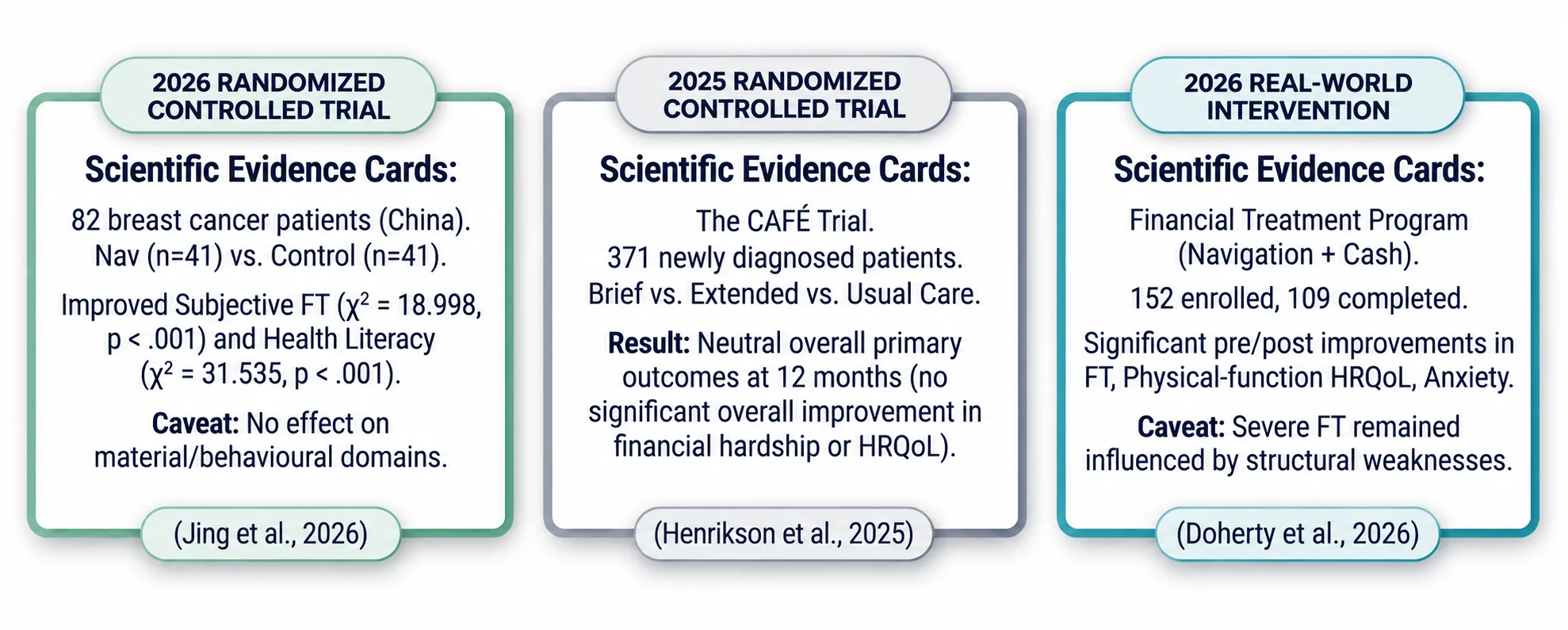
But navigation has limits.
It cannot solve weak social protection, inadequate health coverage, high out-of-pocket costs, or poor employment protection on its own.
That is why the discussion ultimately moved from financial navigation to financial protection.
At the individual level, that means early financial-risk assessment, cost-of-care discussions, personalized navigation, psychosocial support, and shared decision-making.
At the community level, it means clear referral pathways connecting patients with social workers, transportation support, government resources, civil society, and other services. And at the policy level, it means confronting the structural causes of financial hardship through stronger health coverage, reduced out-of-pocket exposure, and better social and employment protection.
The distinction is important:
“Some financial barriers require navigation, but others require policy change. We should not make patients better at navigating financial hardship. We should create a cancer system that exposes patients to less financial hardship in the first place.”
What Patient Navigation Should Actually Do
Healthcare systems often divide cancer care into separate services: screening, diagnosis, treatment, supportive care, survivorship, and palliative care.
Patients experience something very different and their questions are much simpler:
Where do I go? What happens next? Who is coordinating my care? And who can help when something gets in the way?
Patient navigation is meant to answer those questions across the whole journey rather than at one isolated point, which requires looking first at the barriers standing between the patient and timely, coordinated care.
The barriers can look very different from one patient to another, and some can be deeply personal, including fear, distress, cultural beliefs, and psychosocial needs.
The navigator’s role is to identify those unmet needs, provide understandable and culturally appropriate information, coordinate appointments, connect patients with clinical and social resources, and help patients and families participate more actively in decisions.
Who carries the job title matters less than whether those functions are actually being performed. That is especially important as health systems develop formal navigation programs. A program can have navigators on paper and still fail patients if the barriers remain untouched.
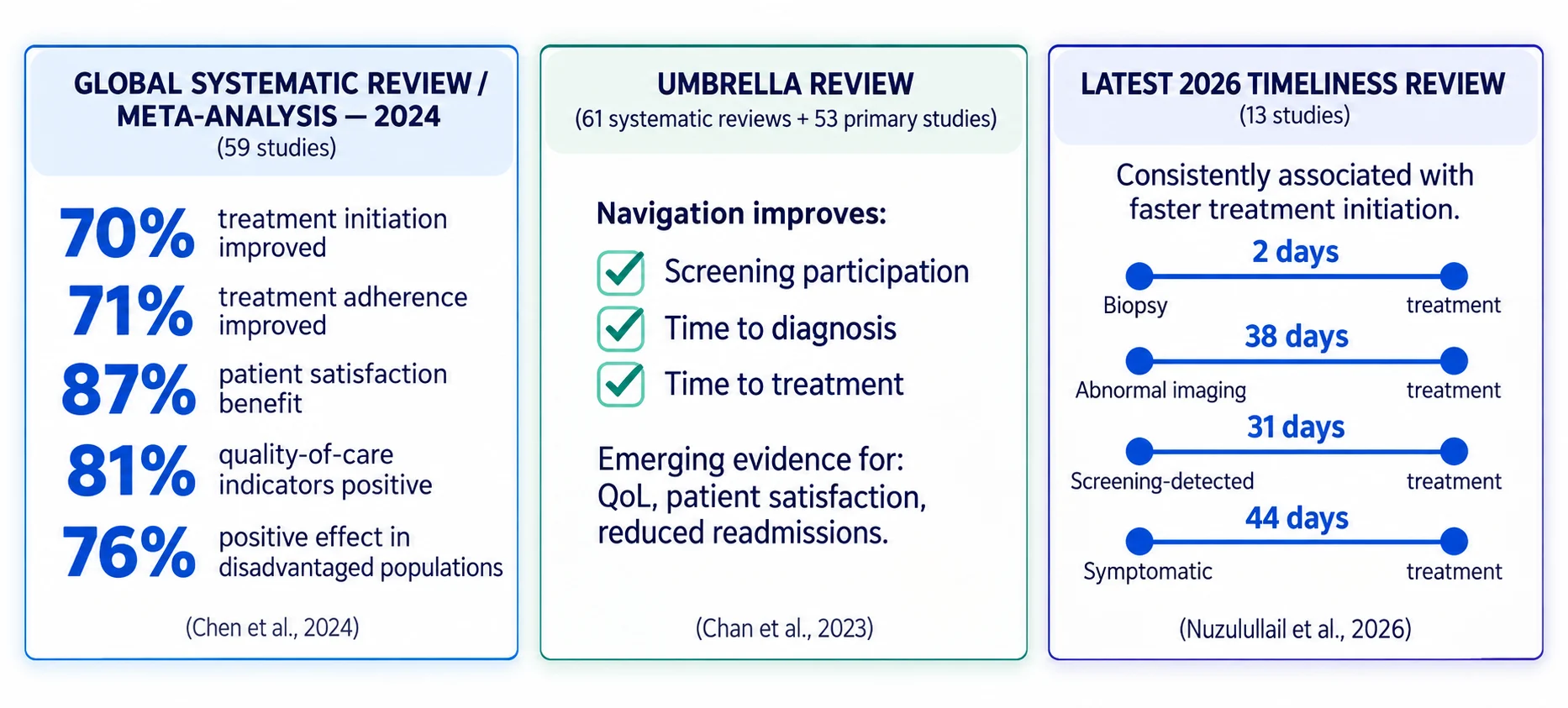
The evidence for navigation is becoming stronger. Systematic reviews and implementation studies presented in the talk showed improvements in screening participation, timeliness of diagnosis and treatment, adherence, patient satisfaction, and the experience of disadvantaged populations.
From Navigating Barriers to Removing Them
Navigation works best when it is built into the pathway itself.
When it sits outside the system as an additional service, it can help patients work around problems. When it becomes part of how care is organized, it can help change the pathway that created those problems.
That difference matters.
A navigation program should not be judged simply by how many phone calls were made, appointments were booked, or referrals were completed.
The more meaningful questions are whether patients reached treatment faster, whether barriers were resolved, whether continuity improved, whether patients understood their care, and whether the people who are usually left behind were actually reached.
Equity belongs at the center of that evaluation.
Which groups still experience longer delays? Which barriers keep coming back? Who is still not reaching care?
Repeated navigation can reveal patterns. Once those patterns become visible, they can guide system redesign: map the pathway, identify where patients are repeatedly getting stuck, build solutions around those failure points, and measure whether the problem disappears.
Financial navigation and patient navigation are useful because they help people through imperfect systems. But success should not mean becoming better at guiding patients around the same obstacles forever.
The stronger measure is whether those obstacles are being removed.
“The success of navigation should not be measured by how well patients learn to navigate complexity. It should be measured by how much unnecessary complexity we remove from their cancer journey.”
Written by Eliz Baloyan, MD, Features Writer and Editor at OncoDaily and CancerWorld
Watch on YouTube: COGC 2026: Beyond The Treatment Bill | Hadi Mohamad Abu Rasheed
COGC 2026: What Cancer Patient Navigation Really Means | Hadi Mohamad Abu Rasheed