Key takeaways
- NGS is a workflow, not a single order. Patient identification, test selection, tissue quality, result delivery, interpretation, and action all have to work together.
- Sample adequacy remains a major weak point, especially when tissue collection, storage, retrieval, and transfer between hospitals and testing laboratories are inconsistent.
- A result only has value if the clinician can find, understand, and act on it in time to influence treatment decisions.
- Financial clearance needs to be more reliable so patients are not left with unexpected bills for molecular tests that were ordered as part of their cancer care
- AI and digital integration could make precision oncology easier to use, by standardizing testing, helping interpret complex results, tracking prior findings, and supporting clinical trial matching.
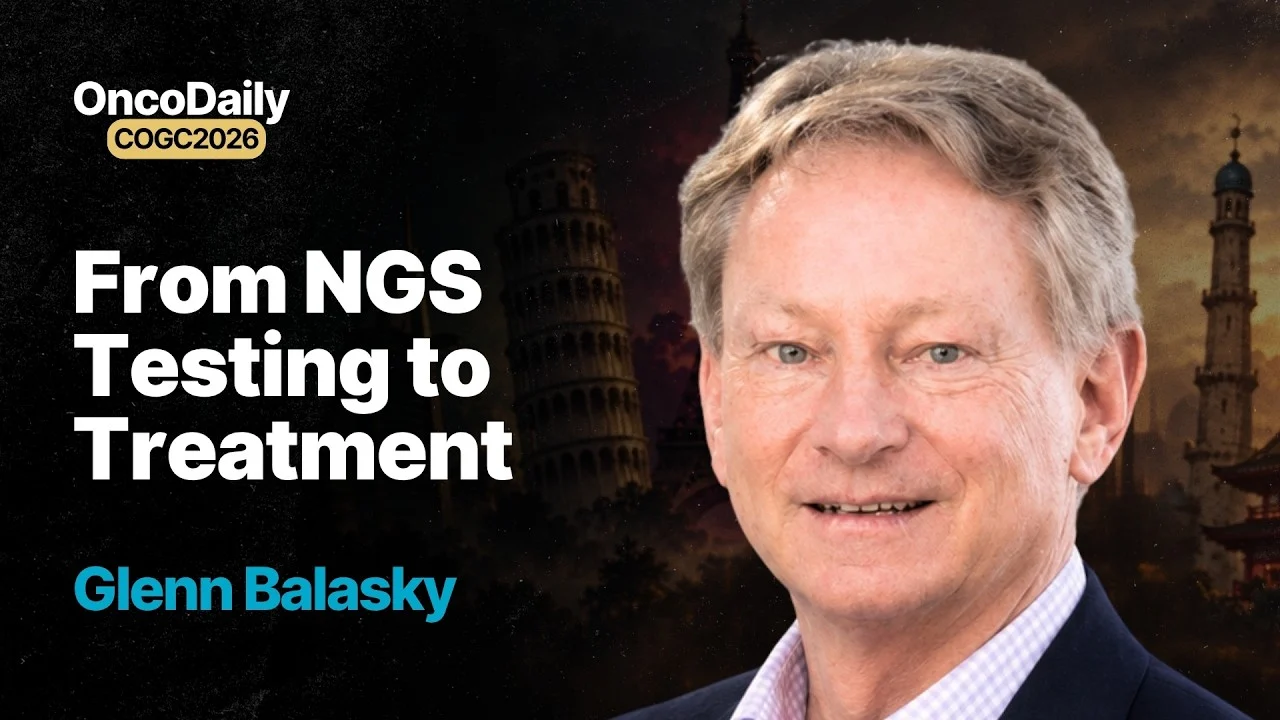
At the Community Oncology Global Congress (COGC 2026), organized by OncoDaily, Glenn Balasky, Executive Director of Rocky Mountain Cancer Centers, examined a problem that often gets overlooked in discussions about precision oncology: ordering next-generation sequencing is only one step in a much larger process.
His presentation followed the path of an NGS test from identifying the right patient to obtaining adequate tissue, choosing the test, receiving the result, interpreting it, paying for it, and ultimately acting on it.
At every stage, something can go wrong.
And in community oncology, that can mean the difference between having molecular information and actually using it to change care.
NGS Is a Workflow, Not an Order
Balasky began with the number of decisions that happen before a molecular result ever reaches the oncologist.
The right patient has to be identified. The appropriate test has to be selected. Enough tissue has to be collected, stored correctly, located later, and sent to the testing laboratory. Results have to return in a usable format and reach the clinician at the right time.
“There are really some critical process steps involved in NGS testing, and there are multiple steps that lead to multiple variables. Patient identification and proper prompting for which patient is eligible for which genomic test are very critical.”
Electronic health records can help standardize some of those steps, but Balasky argued that testing remains fragmented, particularly as practices navigate multiple testing companies and different assays.
Tissue remains one of the most fragile points in the chain.
“Adequate tissue is an incredibly challenging subject.
Blood is a great go-to, but blood is not a universal go-to in this space yet.
We still have to depend on the quality of the sample obtained by the surgeon or interventional radiologist. Was it stored properly? Can it be found again in the hospital pathology lab?”
Where Does the Process Break?
Sometimes the patient is never tested.
Sometimes the tissue is insufficient.
Sometimes the test is completed, but the result is difficult to find. In other cases, the report arrives but leaves a general oncologist facing a long list of alterations without a clear sense of what matters clinically.
“Do we fail to test?
Do we fail to get the results?
Can we find the results? Can we get them?
And then does the provider understand – is there adequate interpretation of the results so they really know what to do with the information?”
Timing creates another problem.
If a result is incomplete, delayed, or difficult to interpret, the clinician may have to choose between waiting and delaying treatment or beginning therapy before all the molecular information is available.
“The inconsistencies of the process can really make the challenge of acting on those results more difficult.”
For a busy community practice, Balasky argued, those failures cannot be solved simply by telling physicians to order more testing. The process around the test has to become more reliable.
The Patient Should Not Discover the Cost From the Bill
Diagnostic access also has a financial side.
NGS may be clinically important, but coverage and prior authorization are not always predictable. The result can be a patient receiving an unexpected bill for a test they were told was necessary – particularly difficult when the test ultimately does not reveal an actionable finding.
“There is nothing worse in practice than when a patient walks in and says, ‘I have a $1,500 or $1,000 bill for a test that you said was important, but then you said later it didn’t show us anything.’
How can we work that process so patients aren’t stuck with bills?”
Balasky called for stronger coordination between community practices, testing companies, and payers so financial clearance becomes more dependable before testing moves forward.
“How can we get a better safety net under the financial backing for these tests in a U.S. payer-based model?”
Sustainable precision oncology, in other words, requires more than proving that a test has clinical value. The patient also needs a realistic way to access it without an unexpected financial consequence.
Can AI Make the Result Easier to Use?
Balasky sees technology playing a larger role at several points in the workflow.
EHR systems can prompt clinicians toward appropriate testing and standardize orders. Practices can also simplify operations by limiting themselves to a smaller number of preferred testing vendors rather than building different processes around many laboratories.
“A practice should have only one or two key testing vendors, because then that standardizes not only the electronic part of the ordering by the physician or provider, but it also facilitates the workflow for the staff that has to deliver it.”
AI could go further.
Rather than leaving the physician to work through a complex molecular report alone, Balasky suggested AI could help summarize current findings, compare them with previous results, and make relevant information easier to act on.
Digitally structured molecular data could also improve clinical trial matching, both at diagnosis and later in the treatment course.
“AI is going to help go to the next step here – help provide an up-to-date, more concise interpretation of the current results for the provider, review historical results, and then that digital library of results is incredibly important for potential clinical trial identification.”
For clinicians already overwhelmed by the volume and complexity of genomic data, that support may become increasingly important.
“You see providers that are overwhelmed by this information, that are actually even ordering an NGS test because they do not want to be burdened with all the details of the results.
How do we use AI as an enabler to help make them feel more comfortable with those results?”
A Test Result Is Not Enough
For Balasky, the larger shift is organizational.
NGS should no longer be handled as a test that gets ordered, returned, and dropped into a physician’s queue.
“NGS and this type of testing really needs to be treated differently.
It is intricate, valuable information that is going to influence the treatment decision, the time to treatment, and the potential for the best long-term care for the patient.
Practices really have to come up with a much more robust program.
This is not, ‘Let’s try to get a test result, get it back, throw it in the doctor’s queue.’”
A mature precision-oncology program should know whether appropriate patients are being tested, whether adequate samples are reaching the laboratory, how often results return successfully, how quickly they return, and whether clinicians ultimately act on them.
That requires dedicated resources – and collaboration beyond the individual practice.
“Testing companies, AI providers, payers and community providers really need to work locally and nationally to make this process more standard and easier to achieve success.
This has been an area that has been very fragmented for the last 10 or 15 years.
How do we all work together to win on behalf of our patients?”
Precision medicine, Balasky concluded, is already part of cancer care. The remaining challenge is building a system capable of delivering on its promise consistently.
“Personalized medicine is here.
We need better testing processes, and patient expectations will continue to demand that community oncology meets more and more individual patient needs.”
Written by Eliz Baloyan, MD, Features Writer and Editor at OncoDaily and CancerWorld