
“What’s up, chat? I’m back for another edition of gastrochat, but guess what? This week we are live and direct from Madrid, Spain, here at the second part of the ESMO 2026 Fiesta.”
Welcome to episode two of “gastrochat”, Margaret-Ann’s podcast created in partnership with OncoDaily, where gastrointestinal health meets pop culture, scientific research, and whatever the internet has decided to obsess over this week.
And apparently, this episode we’re having a “Menti B.”
Don’t know what that means? Margaret-Ann is more than happy to explain.
“A Menti B is a young millennial, Gen Z slang term used to essentially say that you’re having a mental breakdown.”
But what does having a Menti B have to do with GI health? And why is she discussing it from Madrid?
Well, there’s a little oncology, a little psychology, and a bit of TikTok involved.
A Menti B in Madrid?
With ESMO Congress 2026 bringing the oncology community to Madrid, Margaret-Ann opens the episode with mental health on her mind.
And she’s enjoying the Spanish atmosphere, even if her language skills could use a little work.
“I know very little Spanish, but I just threw in a word for you there. Is it the right word? Who knows?”
Beyond the jokes, there’s an important conversation happening in oncology about mental health, particularly the stress and burnout experienced by healthcare professionals.
On October 7, 2026, the European Society for Medical Oncology (ESMO) welcomed the European Parliament’s adoption of a legislative report addressing psychosocial risks, workplace stress, and mental health.
Adopted on October 6, the resolution calls for stronger European action to protect workers from psychosocial risks, including excessive stress, burnout, harassment, and other workplace conditions that can harm mental well-being.
ESMO has called for an EU directive specifically addressing these risks, emphasizing the need to protect the oncology workforce.
It’s a serious issue, and one that extends beyond healthcare professionals. Patients, caregivers, and people living with chronic health conditions also face emotional and psychological challenges.
Listening to these discussions, Margaret-Ann began thinking about the people she knows best: those living with GI problems.
How could she connect a conversation about mental health to everyday gastrointestinal symptoms in a way that her audience would recognize?
And then it came to her.
“Wait a second, hot girls have stomach issues.”
Of course they do.
Hot Girls Have Stomach Issues. Yes, It’s a Thing.
If you’ve spent any time on TikTok, Instagram, or Reddit, there’s a good chance you’ve encountered some version of the phrase “Hot girls have stomach issues.”
It’s a meme, a hashtag, a running internet joke, and for plenty of people living with chronic digestive symptoms, a painfully relatable statement.
“Now, if you are chronically online or have chronic IBS, you will definitely know this meme.”
And she has no problem identifying with it herself.
“You are listening to a hot girl. Well, some would say I’m good looking, like my husband. Others, who knows, maybe I’m a four out of 10, but that’s your issue, not mine.”
The meme has taken on a life of its own, with people sharing experiences of bloating, constipation, abdominal pain, food sensitivities, and irritable bowel syndrome (IBS).
Some posts are funny. Others are surprisingly honest about the discomfort and frustration of living with unpredictable digestive symptoms.
And that mix of humor and personal experience is exactly what interests Margaret-Ann.
“It’s global, people, but it really connects a lighthearted internet joke to a genuine medical and psychological issue that so many people have.”
Because behind the memes is a question worth asking: Why do digestive symptoms and mental health seem so closely connected?
When Stress Gets to Your Head – and Your Gut
There’s actual science behind the relationship between stress, anxiety, and digestive symptoms.
It’s called the gut-brain axis, the two-way communication system connecting the gastrointestinal tract and the central nervous system.
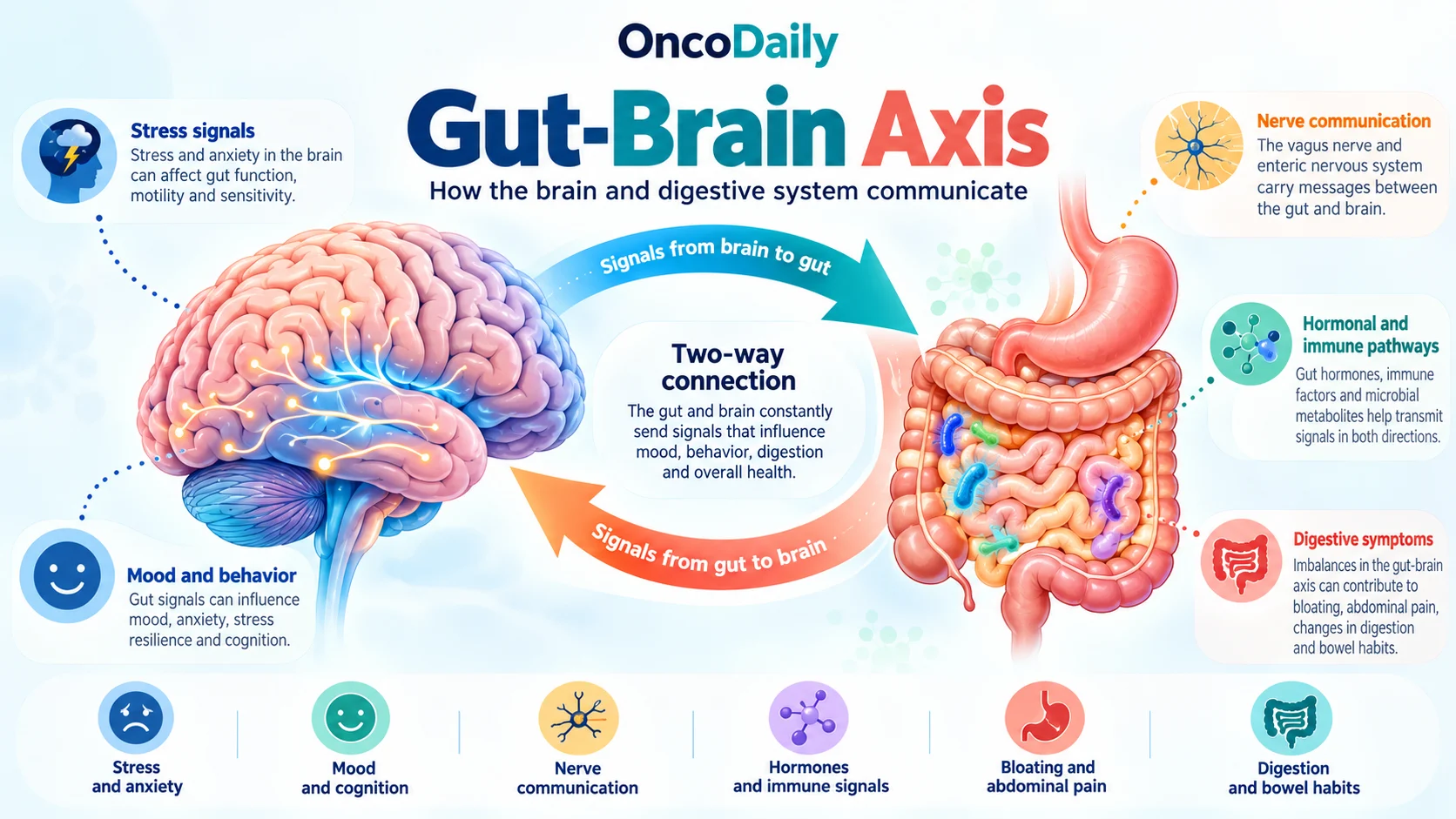
Signals travel between the brain and the gut through neural, hormonal, and immune pathways. This communication can influence intestinal movement, sensitivity to pain, and how the body responds to stress.
When someone feels anxious or stressed, changes in these signaling pathways may contribute to digestive discomfort, including cramping, bloating, and changes in bowel habits.
And the relationship works in both directions. Ongoing gastrointestinal symptoms can themselves increase stress, anxiety, and emotional distress.
IBS is now recognized as a disorder of gut-brain interaction, meaning that changes in communication between the digestive tract and the nervous system play an important role in the condition.
Importantly, this does not mean that IBS is imaginary or that symptoms are simply caused by worrying too much. The pain and digestive symptoms are real, and their development involves multiple biological and psychological factors.
The National Institute of Diabetes and Digestive and Kidney Diseases (NIDDK) also notes that women are up to twice as likely as men to develop IBS, although prevalence varies between populations.
Hormonal differences, changes in visceral sensitivity, and other biological factors may contribute to these patterns.
And Margaret-Ann, of course, has her own playful take on the science.
“If you’re a hot girl, extra hot, yeah, you’re going to have extra sensitivity. That part of the podcast is not scientifically proven, but I do think the hotter you are, the more stomach issues you have.”
We’ll leave that particular theory out of the medical textbooks.
But the underlying connection between mental well-being and GI symptoms is well established.
And for people already navigating the pressures of appearance, body image, diet culture, and everyday life, digestive symptoms can add another layer of stress.
When Bloating Became Something You Could Actually Talk About
For Margaret-Ann, one of the most interesting things about the “hot girls have stomach issues” trend is how it has changed the conversation.
“Prior to this hashtag, to this movement, was it sexy to talk about bloating, gas, IBS, the way of which you feel if your tummy’s a little off? No, no, it was not.”
Suddenly, people were posting about their digestive symptoms, comparing experiences, laughing at themselves, and discovering that thousands of others were dealing with remarkably similar problems.
For some, the humor makes an embarrassing topic easier to discuss. For others, it offers a sense of community when chronic symptoms can otherwise feel isolating.
And that’s a meaningful change.
Women, in particular, have long faced pressure to look and behave a certain way, often with little room to acknowledge the less glamorous realities of having a human body.
“We’re not here to stay quiet about it anymore. At least I’m not, right? I’m a hot girl and I have stomach issues and I’m going to tweet about it.”
But as much as she enjoys the trend, there’s a catch.
Making GI symptoms easier to talk about shouldn’t mean treating persistent pain or discomfort as something everyone simply has to live with.
Girl, That’s Not a Personality Trait. Get It Checked.
There’s a difference between finding humor in an uncomfortable situation and dismissing symptoms that might need medical attention.
That’s where Margaret-Ann wants to draw the line.
“We really shouldn’t be normalizing chronic pain, chronic stomach issues, chronic GI concerns, right? As fun as it is to have hot girl stomach issues, on the flip side, if we’re so able to discuss that online or with others in IRL why aren’t we taking that to our doctors?”
Online communities can offer support and reassurance, but a viral meme can’t determine what’s causing someone’s symptoms.
Recurring abdominal pain, persistent changes in bowel habits, and other ongoing digestive problems may have different causes, and appropriate medical evaluation can help establish what is happening.
There’s also the issue of people becoming so accustomed to their symptoms that they stop considering whether anything can be done about them.
Margaret-Ann knows that younger patients don’t always feel heard when seeking medical care, something she has spoken about from personal experience.
Still, she encourages listeners to bring their concerns to a qualified healthcare professional.
“If I can talk about how girls have stomach issues online, if I can like that meme, if I can relate to that TikTok video, then I should be able to hopefully go to my doctor or my nurse practitioner and discuss this with them.”
It’s a good way of looking at it.
The meme might help you realize you’re not the only person experiencing these symptoms. A medical conversation can help you understand what they mean and what to do next.
And speaking of using humor to discuss digestive health, Margaret-Ann has another example.
This time, it’s not a TikTok trend.
It’s a commercial.
And she has thoughts.
Constipation Has a Soundtrack Now. Thanks, Michael Bolton.
Apparently, the internet isn’t the only place where digestive problems become comedy.
Margaret-Ann brings up Fiber One’s rather unforgettable advertising campaign, Expecting.
Created by Saatchi & Saatchi and first released in 2015, the commercial uses the visual language of pregnancy to tell a very different story.
A man appears to be expecting a baby. His stomach is visibly enlarged, he’s uncomfortable, and he experiences a series of exaggerated emotional moments.
Except he’s not expecting a baby.
He’s constipated.
And the entire commercial is accompanied by Michael Bolton singing a specially recorded ballad, I Just Can’t Wait to Meet You.
Yes, an actual ballad.
About constipation.
Margaret-Ann’s reaction is immediate.
“It’s really cringe, people. I mean, how could it not be, right? A man pretending to be pregnant because he’s constipated.”
She also has a few questions about the song’s intended meaning.
“The song is called ‘I Just Can’t Wait to Meet You.’ One could presume that means what is going to be met inside your toilet bowl. Also weird.”
And perhaps some things are better left unanswered.
The commercial is deliberately absurd, but it does raise an interesting question about how brands communicate digestive health concerns.
Instead of presenting constipation through clinical language, Fiber One uses exaggeration, embarrassment, and humor to make the subject more approachable.
It’s another example of the same cultural shift Margaret-Ann has been discussing: bodily functions that were once kept firmly out of polite conversation are now being turned into mainstream entertainment.
Of course, not everyone will find the joke funny.
Margaret-Ann herself is critical of the comparison between pregnancy and bloating, particularly if it leaves people feeling uncomfortable about their bodies.
She takes a moment to speak directly to pregnant viewers and anyone who might feel judged by that kind of advertising.
“Never let a commercial make you feel bad about your body and your mental status. And that goes to people who aren’t expecting, right?”
It’s a notable point in an otherwise very funny discussion.
Humor can make conversations about digestive problems easier, but it shouldn’t come at the expense of making someone feel ashamed of their body.
The Memes Are Great. The Stomach Pain? Not So Much.
After the TikToks, the IBS memes, and the rather unusual commercial, Margaret-Ann brings the conversation back to the people experiencing these symptoms.
“At the end of the day, I’m a hot girl. You’re a hot girl. You’re a hot guy. You’re a hot in-between. And we all deserve to feel secure within our bodies and happy in our bodies.”
And the emotional impact can be just as important as the physical discomfort.
Living with unpredictable symptoms may influence everyday decisions: what to eat, where to go, whether there’s a bathroom nearby, or whether you’re going to feel comfortable in your own body that day.
The internet can provide community, comic relief, and the comfort of knowing that other people understand.
But Margaret-Ann wants listeners to take the next step when symptoms persist.
“There is a really great way to utilize the pop culture of hot girls have stomach issues and everything that has spawned since then to channel that comedic relief, understand that there are people globally who are in the same boat as you, and use that as a nugget to bring that information to a medical professional.”
The point is to make the conversation easier to start, whether that’s with friends, family, or a healthcare provider.
And mental health deserves attention in its own right. For listeners in the United States experiencing a mental health crisis or serious emotional distress, Margaret-Ann also highlights the availability of the 988 Suicide and Crisis Lifeline.
A Little Less Stress, a Little More Starbucks
After all that talk about gut health and mental breakdowns, one very important question remains:
“So am I having a Menti B here in Madrid? I don’t know. Hey, I actually feel really good today. Mind, body and soul. I hope you do too.”
Between the tapas, a little wine, some Instagram photos, and everything happening around ESMO, she’s making the most of her time in Spain.
And somehow, she’s managed to turn a conversation about oncology workforce mental health into an exploration of IBS, internet culture, body image, and a Michael Bolton song about constipation. And surprisingly, it all connects.
That’s quite a journey for one episode.
But it leaves listeners with something useful: you can laugh about your digestive problems, talk openly about them, and still take them seriously. There’s no need to choose between having a sense of humor and looking after your health.
And Margaret-Ann has one last wish for her listeners: stay regular. Not just when it comes to GI health, but at Starbucks, too. She has a reputation to maintain, after all.
“I’m wishing you guys a regular rest of your week, pun intended, wink wink. And I will catch you for episode three of gastrochat.”