Key takeaways
- Precision oncology only works when the pathway connects testing, interpretation, treatment access, and clinical trials.
- Community and academic centers can share expertise through tumor boards, telehealth, pathology review, and clinical trial matching without moving all care to the academic center.
- A molecular result is only useful when it is interpreted in the context of the patient’s cancer, prior treatment, evidence, germline implications, and available therapies or trials.
- Pathology is part of precision medicine from the start because tissue quality, test selection, and biopsy strategy can determine whether an actionable result is found.
- Expertise can be centralized without centralizing the patient.
At the Community Oncology Global Congress (COGC 2026), organized by OncoDaily, Fernando Maciel Barbosa, Genitourinary Medical Oncologist and Clinical Associate Professor at University of Iowa Health Care, focused on what it actually takes to expand access to precision medicine beyond major academic centers.
The challenge is no longer simply identifying more biomarkers. A patient can be tested correctly and still never benefit if tissue is inadequate, results arrive too late, molecular findings are difficult to interpret, insurance blocks access, or the recommended therapy or clinical trial exists only hundreds of miles away.
The presentation followed that entire pathway – from testing to interpretation, treatment, trials, and access – with one central message: precision medicine depends on the partnerships built around the test.
Precision Medicine Does Not End With the Test
“Precision oncology is really a continuum. We begin by identifying biomarkers that can guide clinical decisions. Then we need to make sure the right patient receives the right test at the right time.
But testing alone is never enough. The result has to be interpreted and translated into a therapeutic decision, and then the patient needs to actually gain access to the recommended treatment or clinical trial.
Only at the end of that entire process do we achieve what really matters: meaningful clinical benefit for the patient.
And this is where we see the gap between our scientific reality and our clinical reality. Scientifically, the field is moving incredibly fast. We have more biomarkers, broader multigene testing, tumor-agnostic indications, liquid biopsy, targeted therapies, and molecularly selected trials.
In clinical practice, however, testing can still be inconsistent. Tissue may be inadequate, turnaround time may delay decisions, insurance coverage varies, and reports are becoming increasingly complex. Trials and specialized expertise also remain concentrated in major centers.”
Where Patients Can Be Lost
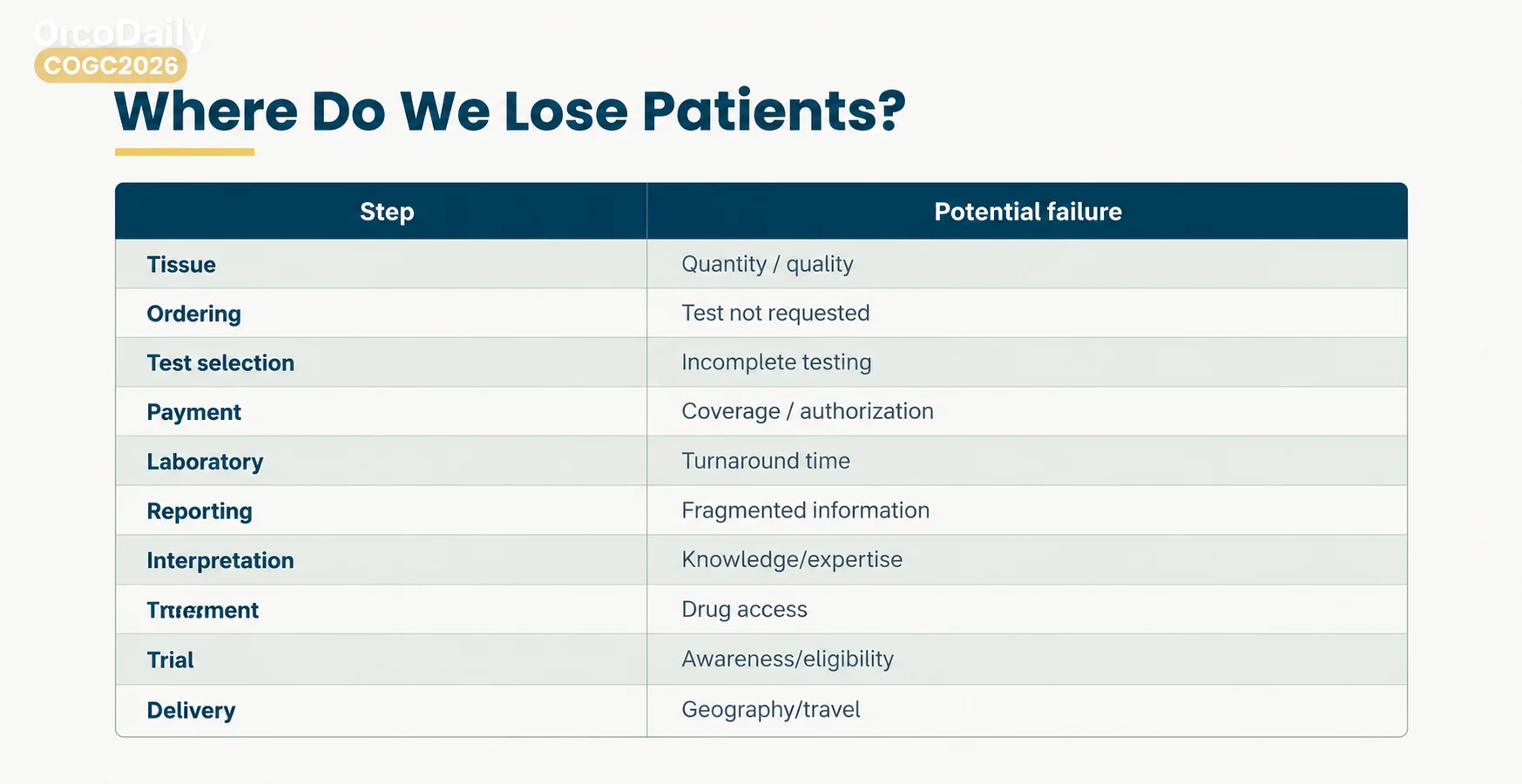
“If we follow one patient through the precision medicine pathway, there are multiple places where that patient can be lost.
- There may not be enough tissue.
- The test may never be ordered.
- The wrong test may be selected.
- Insurance authorization can fail.
- Turnaround time may be too long.
Even after the result comes back, the information may be fragmented or difficult to interpret.
And finally, an actionable result does not guarantee that the patient will have access to the drug or the clinical trial.
No single stakeholder controls this entire process. Community oncologists, academic centers, pathology, molecular laboratories, pharmacies, payers, industry, clinical trial networks, health systems, and patient organizations all play a role.
The patient has to remain at the center of that ecosystem.
Precision oncology should not be viewed as a single transaction – order a test and get a result back. It requires an interconnected system.”
Delivering Expertise to the Patient
“One of the most important partnerships is between community oncology and academic centers.
The traditional model is simple:
- A complex molecular result comes back,
- The patient is referred to the academic center,
- The patient travels,
- The evaluation and treatment occur there.
But we can increasingly move toward a different model. Instead of always moving the patient to the expertise, we can bring the expertise to the community physician.
The academic center can support interpretation and shared decision-making while the patient continues much of their care locally.
This is particularly important for patients who live far from major cancer centers.
These partnerships can include molecular tumor boards, disease-specific tumor boards, telehealth, shared clinical pathways, second opinions, clinical trial matching, germline genetics support, and specialized pathology review.
The scarce resource is often not treatment delivery. Many treatments can be delivered very well in the community. The scarce resource is highly specialized expertise.”
Molecular Data Still Need Clinical Interpretation
“A molecular report can tell us which alterations are present in a sample. But that is not the same as answering the clinically important question: what should we do with this information for this particular patient?
That decision requires context:
- Tumor type,
- Previous therapies,
- Level of evidence,
- Germline implications,
- Treatment availability,
- Clinical trial opportunities.
Virtual molecular tumor boards allow that expertise to be shared without transferring the patient’s entire care to a larger academic center.
The laboratory report should therefore never be considered the final product.
Take a BRCA2 mutation as an example. The result itself is data. But then we need to ask: is it somatic or germline? Is it pathogenic? What is the disease context? What is the level of evidence for a specific treatment? Does it have an immediate therapeutic implication?
Then comes the clinical decision:
- Do we treat now or later?
- Do we recommend germline testing or family counseling?
- Is there a relevant clinical trial?
Data are not the same as knowledge, and knowledge is not the same as a clinical decision.”
The Testing Pathway Starts With Pathology
“Another critical partnership is between oncology and pathology.
Precision medicine actually begins before the test is ordered.
Pathology helps determine whether there is enough tissue, which block should be tested, whether reflex testing is appropriate, whether testing should be sequential or multiplex, and whether another biopsy may be necessary.
Tissue is not an infinite resource.
The testing strategy therefore has to be planned carefully from the beginning, because decisions made before sequencing can determine whether an actionable result is ever found.”
From Actionable Finding to Real Treatment
“Clinical trials are another essential part of precision medicine.
When NGS identifies an actionable finding, the pathway may lead to an approved therapy – but it may also lead to a clinical trial. Biomarker testing without meaningful access to those trials is an incomplete strategy.
The barriers are familiar:
- Patients may not know that a trial exists.
- The trial may be far from home.
- Eligibility criteria may be complex.
- There may be financial or caregiver burdens,
- And sometimes there are simply no available slots.
Partnerships can reduce these barriers through community-based screening, centralized molecular matching, satellite trial sites, remote consent when possible, decentralized procedures, use of local laboratories and imaging, and transportation support.
The goal is to bring research opportunities closer to patients whenever possible.”
Access Has to Be Part of the Strategy
“We also have to acknowledge the financial side of precision medicine.
A clinically appropriate test that a patient cannot access or afford is not truly accessible.
Precision medicine requires alignment between evidence, guidelines, insurance coverage, testing, and ultimately treatment.
Prior authorization, variable coverage, out-of-pocket costs, differences between tissue and liquid biopsy coverage, repeat testing, germline testing, and off-label therapy can all create barriers. And that means we also need to rethink how we measure success.
If I tell you that we sequence 1,000 patients every year, that tells you something about activity – but not necessarily about success.
We should ask how many eligible patients were tested, whether testing was guideline-concordant, how quickly results came back, whether actionable findings were actually reviewed, whether patients received biomarker-directed therapy, and whether molecularly eligible patients were offered clinical trials.
Ultimately, we need to know whether all of this improved patient outcomes.”
Closing the Distance to Precision Care
“Equity needs to be built into this process from the beginning.
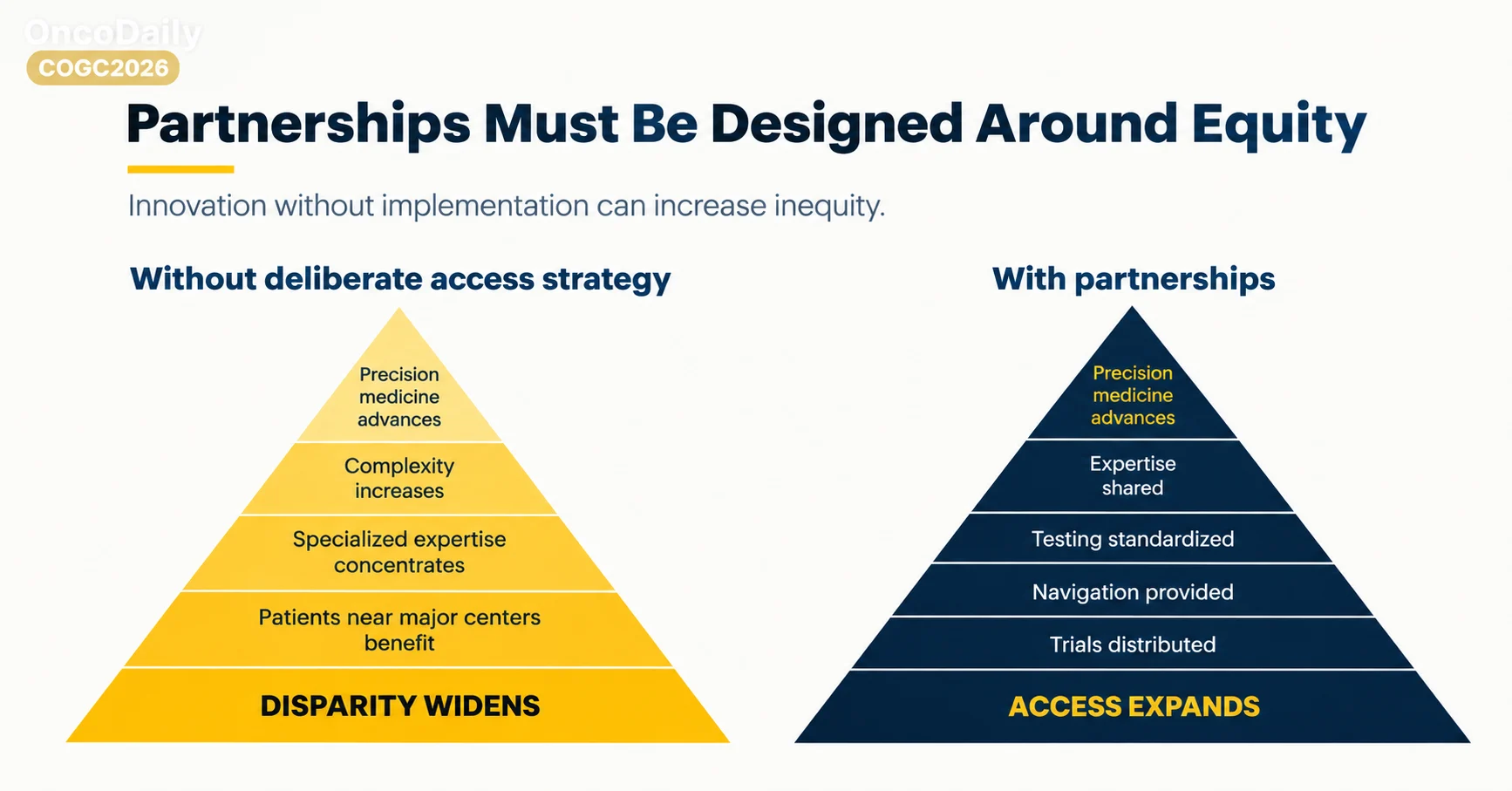
Precision medicine can actually increase disparities if innovation moves faster than implementation. As the field becomes more complex, expertise can become increasingly concentrated in major centers. If access depends on proximity to those centers, the patients who live closest will benefit first.
Partnerships can reverse that pattern. We can share expertise, standardize testing, provide navigation, and distribute clinical trial opportunities.
The framework is straightforward: appropriate testing, connected expertise, clinical interpretation, equitable delivery, shared care, and access to both targeted therapies and clinical trials.
Whenever possible, patients should be able to receive appropriate care close to home.
And if I could leave one message, it would be this:
We do not necessarily need to centralize the patient in order to centralize expertise.”
Written by Eliz Baloyan, MD, Features Writer and Editor at OncoDaily and CancerWorld