Key takeaways
- Cardiovascular risk assessment should begin at cancer diagnosis and continue through treatment and survivorship.
- Cancer survivors should leave treatment with a written cardiovascular surveillance plan that documents prior exposures and future follow-up needs.
- Exercise and rehabilitation can help address deconditioning, cardiovascular risk factors, fatigue, pain, and other treatment-related effects.
- Survivorship plans need to move beyond recurrence surveillance and include cardiovascular health, long-term treatment effects, and clear responsibility for follow-up.
- Cardio-oncology cannot depend on specialists alone; oncology, primary care, cardiology, and survivorship services need shared pathways based on local resources and patient risk.
At the Community Oncology Global Congress (COGC 2026), organized by OncoDaily, Susan Dent led an expert discussion on cardiovascular health in cancer survivorship with Peter Wolf, a lymphoma survivor and cardio-oncology patient; Michelle Nadler, breast medical oncologist at Princess Margaret Cancer Centre; and Joshua Mitchell, Director of the Cardio-Oncology Center of Excellence at Washington University.
As cancer survival improves, the cardiovascular effects of treatment are becoming an increasingly important part of long-term care. Some complications appear during therapy, while others may emerge years or even decades later, particularly after treatments such as anthracyclines or radiation.
The session looked at what cancer providers can do across that timeline: assessing cardiovascular risk before treatment, recognizing toxicity during therapy, using exercise and rehabilitation to support recovery, and making sure survivors leave oncology with a plan for the years ahead.
Wolf’s experience showed why that last point matters. More than two decades after radiation for Hodgkin lymphoma, he developed progressive cardiovascular symptoms that took five years to connect to his prior treatment. His story became the starting point for a broader discussion about how cardio-oncology can move from specialist knowledge into routine cancer care.
The Cardiovascular Plan Cannot Start After Symptoms Appear
Looking back, Wolf said the knowledge needed to explain his symptoms did not exist when he completed treatment in 1994.
By the time his symptoms appeared decades later, however, the evidence had developed. What was still missing was the connection between that evidence and his care.
“I wanted expertise and guidance on what I needed to do, and my medical team at the time did not know what to do.”
When he eventually found the International Cardio-Oncology Society and reached a specialty clinic, he described feeling both relief and vindication.
By then, he could see how different his survivorship might have looked with a structured cardiovascular plan.
“When I read now what the field says that should happen – a real risk assessment before treatment even starts, a plan that follows a patient through treatment and past it, a surveillance schedule that doesn’t wait for symptoms to force the issue – I read it as a specific document that was missing from my own heart chart for 30 years.”
His request to cancer providers was direct:
“That patient needs to leave your care with an actual written cardiovascular surveillance plan, not a mention in passing, a plan on a schedule that follows them into life.”
Four weeks after the session, Wolf was scheduled to undergo open-heart surgery for aortic valve replacement.
Cardio-Oncology Starts at Cancer Diagnosis
Dent used Wolf’s experience to make a broader point: survivorship begins when cancer is diagnosed, not when treatment ends.
As cancer survival improves and more people live for years with advanced disease, cardiovascular risk increasingly has to be managed across the entire cancer trajectory.
That means looking beyond acute cardiotoxicity during treatment.
Some patients already have hypertension, diabetes, cardiovascular disease, or other risk factors before therapy begins. Cancer treatments may then add further cardiovascular risk, while complications from treatments such as radiation can appear many years later.
“Cardiovascular risk in cancer survivors begins right at the time of the cancer diagnosis.”
Dent outlined a practical roadmap developed to help cancer providers incorporate cardiovascular care into routine oncology rather than leaving it entirely to cardiologists.
That begins with identifying pre-existing cardiovascular disease and risk factors, considering how those factors may influence treatment selection, and recognizing which cancer therapies themselves carry cardiovascular risk.
Baseline assessment may include blood pressure, lipids, hemoglobin A1c, electrocardiography, or echocardiography depending on the treatment being considered and the patient’s baseline risk.
Risk tools such as HFA-ICOS can also help identify patients at low, moderate, high, or very high risk of cardiovascular toxicity.
Cancer Providers Have a Role During Treatment Too
Risk assessment is only the beginning.
Dent also focused on what oncology teams can do during treatment: address smoking, physical activity, hypertension, diabetes, and lipid abnormalities; consider cardioprotective approaches when appropriate; and monitor for new cardiovascular symptoms or worsening risk factors.
Changes in cancer therapy have also reduced some cardiovascular risks. Radiation techniques now allow greater attention to cardiac exposure, while some cancers can be treated with non-anthracycline regimens or other approaches that reduce cardiotoxicity.
But the expanding use of targeted therapies also means oncologists are increasingly encountering treatment-related hypertension, hyperglycemia, lipid abnormalities, arrhythmias, and ventricular dysfunction.
Dent argued that those problems can no longer sit outside the oncologist’s field of view.
The expectation is not that every cancer provider becomes a cardiologist.
It is that they recognize the problem, address what falls within their scope, and know when to refer.
“If you don’t feel comfortable treating it, I acknowledge that, but then just refer that individual to someone who has the ability to treat that condition or risk factor.”
During treatment, new symptoms, poorly controlled cardiovascular risk factors, arrhythmias, or declining left ventricular function may all signal the need for specialist input.
Exercise Is Part of Cardiovascular Care
Nadler shifted the discussion from risk surveillance to something that remains difficult to implement consistently in practice: exercise.
Cancer survivors can face several overlapping cardiovascular challenges.
They may enter treatment with risk factors such as obesity, hypertension, or age-related cardiovascular risk. Cancer therapy may cause direct injury to the cardiovascular system. Treatment can also produce indirect effects including weight gain, muscle loss, deconditioning, neuropathy, pain, fibrosis, depression, anxiety, and reduced mobility.
Exercise can address several of those problems at once.
“Exercise is a treatment that actually can address all of the ‘multiple hits’ of cancer therapy.”
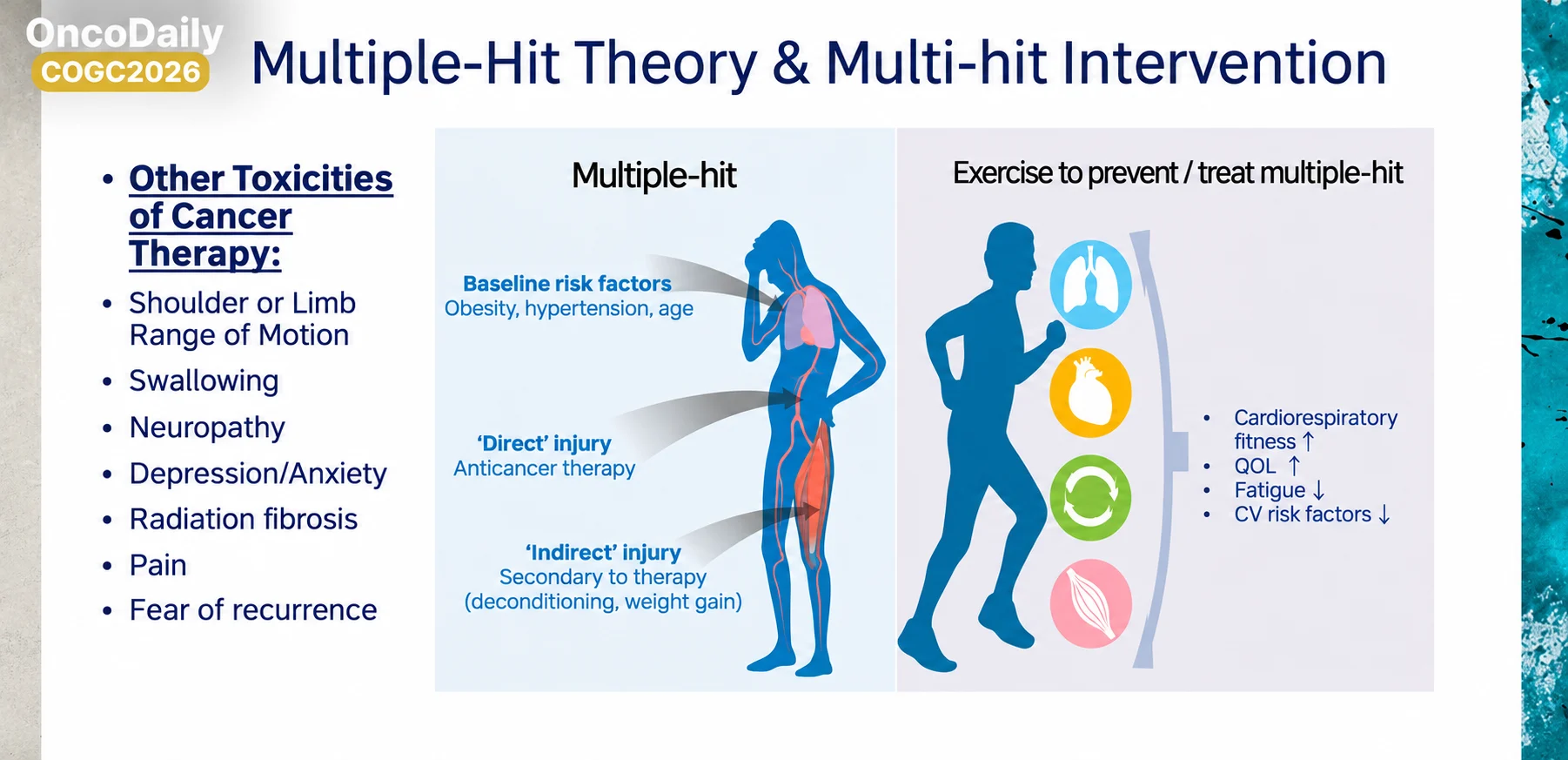
Nadler discussed cancer rehabilitation and cardio-oncology rehabilitation as ways to improve function while accounting for the specific toxicities and limitations cancer survivors may have.
That distinction matters because a survivor with neuropathy, restricted range of motion, prior cardiotoxic therapy, or impaired cardiovascular function may need something more tailored than a standard community exercise program.
She also pushed back against making exercise recommendations unnecessarily intimidating.
Telling an inactive patient to immediately reach 150 minutes of aerobic exercise per week may create a target that feels unattainable.
Smaller, consistent doses can still matter.
The practical model she offered clinicians was simple: assess, advise, and refer.
Ask what the patient is currently doing. Give a realistic recommendation. Then determine whether they can exercise safely in the community or need supervised cancer or cardio-oncology rehabilitation.
Virtual programs may also help when access, insurance coverage, or geography limits in-person options.
Survivorship Plans Need to Catch Up With Survivorship
The panel then returned to Wolf’s experience and a difficult question: how much should patients be told about cardiovascular risks that may not appear for 10 or 20 years?
Wolf’s answer was that patients can handle more information than clinicians may assume.
“We’re a lot tougher than we might look.”
Even when a future complication is unlikely, he argued, knowing that it is possible gives survivors information they can use later.
“Being prepared helps.”
Mitchell asked how that information should be carried forward as patients move between oncologists, primary care clinicians, cardiologists, and other providers.
Dent acknowledged that traditional survivorship plans have not always worked well.
One problem, she said, is that many were focused primarily on cancer recurrence.
“As we move forward, and we start thinking about survivorship in a new way, hopefully, we need to start thinking about the entire person, not just their cancer.”
A modern survivorship plan may need to include cardiovascular risk, blood pressure, lipids, glucose, medication-related risks, treatment exposures, surveillance needs, and clear responsibility for who acts on the information.
Nadler added that survivorship plans are becoming increasingly complex as the long-term consequences of cancer treatments become better understood.
That does not make the information less important.
“Having that information written down in some way can be a huge tool and asset for the patient to have that information on discharge.”
Digital health and AI may eventually make it easier to generate individualized survivorship plans based on a patient’s cancer, treatment history, and specific long-term risks.
Not Every Survivor Needs a Cardio-Oncologist
The growing population of cancer survivors creates another problem: specialist capacity.
Mitchell noted that even at a major academic center, there are more patients who could benefit from cardiovascular optimization than cardio-oncology specialists can realistically see.
The panel therefore focused on how care can be shared.
Dent argued that the model will depend heavily on local resources.
Some systems may have cardio-oncology programs. Others may rely on survivorship clinics, nurse practitioners, primary care physicians, general cardiologists, or clinicians with a particular interest in cardiovascular care after cancer.
“As oncologists, we cannot do it all.”
Nadler suggested that risk stratification can help determine where patients belong.
A low-risk survivor may be followed by primary care with specific discharge instructions. Someone at intermediate or higher cardiovascular risk may require an internist, cardiologist, or specialist service.
Mitchell added another practical solution: automate as much as possible.
Routine order sets, lipid testing, hemoglobin A1c testing, and predefined referral or handoff pathways can make cardiovascular care less dependent on someone remembering each individual step during a busy oncology visit.
The goal is not to make every oncology clinic look the same.
It is to ensure that cardiovascular risk is identified, communicated, and handed to someone who can act on it.
More Survivors Means More Responsibility After Cancer
Dent closed the session by returning to the consequence of progress in oncology.
More patients are surviving cancer.
That success also means more people are living long enough to experience the late effects of treatment, while others are living for years with advanced cancer and accumulating cardiovascular risk across multiple lines of therapy.
“We’ve made great strides in cancer care, more people are surviving, but we can’t forget about cardiovascular health.”
For cancer providers, that expands survivorship beyond recurrence surveillance alone.
It means assessing cardiovascular risk before treatment, reducing risk where possible, recognizing toxicity during therapy, promoting exercise and healthy behaviors, documenting treatment exposures, and making sure long-term follow-up has a clear owner.
Wolf’s experience showed what can happen when that chain breaks.
His request was not that oncologists predict every complication decades in advance.
It was that survivors leave cancer treatment knowing what happened to them, what risks may follow, and what they should do if those risks eventually become real.
Written by Eliz Baloyan, MD, Features Writer and Editor at OncoDaily and CancerWorld