Key takeaways
- Community oncology needs strong local leadership to turn national plans into practical care.
- AI should support, not replace, clinical judgment and must be used with validated data.
- Clinical trial access should reach community patients through partnerships and flexible research models.
- Workforce shortages and burnout require different solutions, including better workflows and stronger team support.
- The future of community oncology depends on resilient systems that bring care, research, and expertise closer to patients.
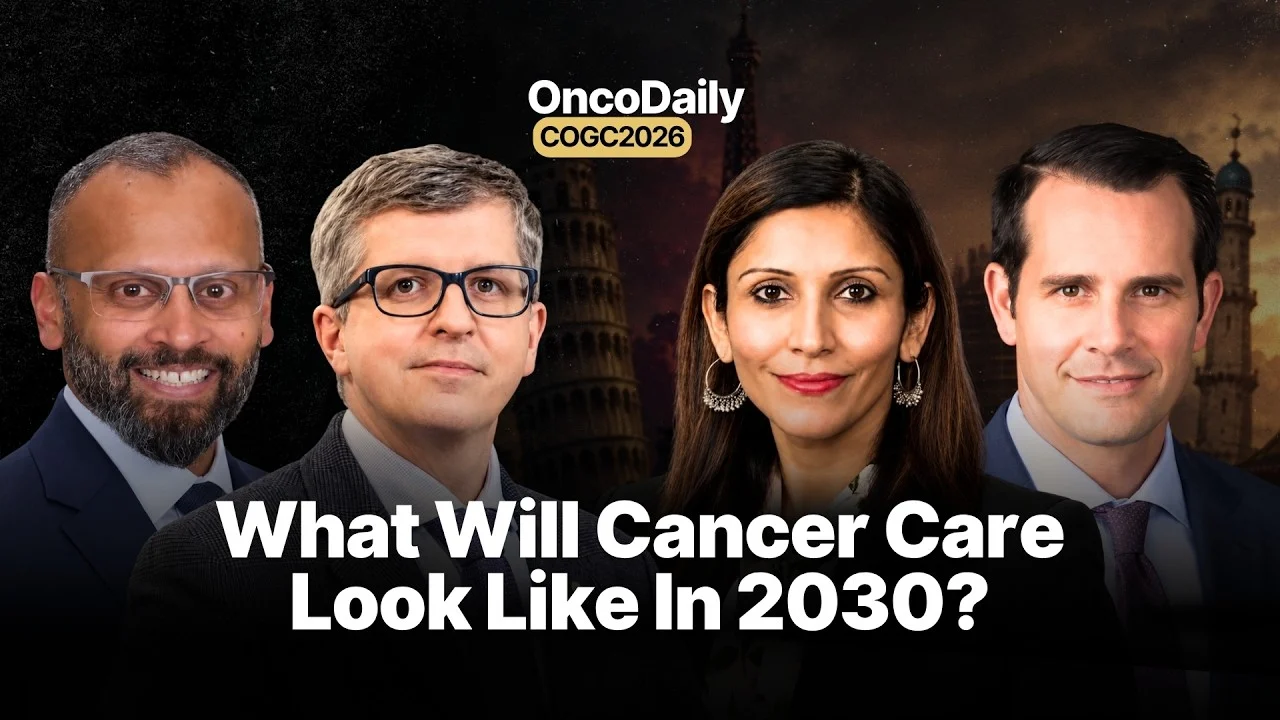
At the Community Oncology Global Congress (COGC 2026), organized by OncoDaily, Joanna Metzner-Sadurski, Director of Medical Oncology at Self Regional Healthcare, Founder and Executive Director of Oncology101.org, and COGC 2026 Co-Chair, led an expert discussion on what community oncology should look like by 2030.
She was joined by Alti Rahman, Chief Strategy and Innovation Officer at American Oncology Network; Jasmine Kamboj, President of COGC 2026 and Medical Director of the Cancer Care and Infusion Center at Northfield Hospital + Clinics; Mark Walshauser, Partner at Cancer Care Specialists of Illinois; and Piotr Rutkowski, Professor of Surgical Oncology and Head of the Department of Soft Tissue/Bone Sarcoma and Melanoma at the Maria Skłodowska-Curie National Research Institute of Oncology in Poland.
The conversation covered artificial intelligence, clinical research, prevention, digitalization, workforce shortages, burnout, insurance barriers, telemedicine, and the challenge of keeping advanced cancer care close to home.
But the future they described was not built around one technology.
It depended on whether community oncology can develop the leadership, partnerships, infrastructure, and workforce needed to make innovation work in everyday practice.
Community Oncology Needs a Voice Where Decisions Are Made
Kamboj began with two priorities for 2030:
- Stronger leaders in community settings
- Stronger community oncology voice in national cancer planning.
“If you have an empowered leader, if you have an intentional leader, they are going to be the champions of bringing access, navigation, research, whatever are the regional or local challenges, because they understand them.”
That local understanding matters because the barriers facing a rural clinic in Minnesota will not necessarily resemble those facing an oncology service elsewhere in the world.
Policy can define what a health system should achieve. Implementation determines whether it happens.
“It’s one thing to say, okay, these are the should-be’s in the next five years, but it’s an entirely another thing to say, hey, how are the should-be’s going to be implemented?”
For Kamboj, that is why community oncologists need to be present when national plans and policies are developed rather than being left to implement decisions designed without their perspective.
“Implementation is a completely different beast.”
Rahman raised another form of governance: who ultimately controls clinical decisions.
In the U.S., he noted, treatment choices can be heavily shaped by insurance approval processes, leaving physicians downstream of payer decisions. He described an American Oncology Network pilot exploring whether more clinical governance could be returned to provider organizations, with the aim of improving time to treatment and the overall patient journey.
“We hope that more will participate, and therefore clinical governance can start going back into the hands of the medical oncologist.”
The future of community oncology, in other words, will depend not only on what physicians know, but also on whether they have enough influence over the systems in which that knowledge is used.
AI Can Help – If Oncology Keeps the Human Judgment
Walshauser saw technology as one of the clearest opportunities for the next four years.
Community practices remain operationally inefficient, while clinicians are being asked to process an increasingly difficult volume of research, trial data, biomarkers, treatment options, and guidelines.
“When I started, I was able to keep everything in my head.”
That is becoming less realistic.
He argued that AI could help oncologists navigate information, make practices more efficient, accelerate diagnosis, and improve clinical-trial and drug-development processes.
Kamboj agreed, but drew a clear boundary.
“Technology is here to enable us, not to replace us.”
She described using OpenEvidence to support conversations with patients while continuing to rely on her own training and established resources such as NCCN, UpToDate, and The ASCO Post.
Her larger concern was that oncologists cannot remain outside the AI discussion and then expect to shape how the technology is deployed.
“We are living in times where we have to engage with AI.”
And that engagement, she argued, needs to happen responsibly enough that clinicians can participate when policies governing AI in healthcare are developed.
Rutkowski was similarly cautious about allowing algorithms to become decision-makers.
Cancer care is too multifactorial. Patient preferences, comorbidities, performance status, previous treatments, and individual circumstances all influence what should happen next.
“The interpretation, this is still your knowledge, your experience.”
Walshauser added another practical rule: AI-generated information still has to be checked.
He described using AI to bring together information from multiple sources, followed by cross-checking the references and making sure the system has not generated inaccurate information.
The value of AI, in this vision, is not independent decision-making.
It is helping oncologists manage complexity without surrendering clinical judgment.
Rahman extended the AI discussion to data infrastructure.
At American Oncology Network, he described efforts to make EHR-derived data more meaningful by validating whether what is recorded actually represents the patient’s clinical context. For him, using AI effectively requires more than layering an application onto existing records. The underlying data first has to be accurate enough to support the conclusions being drawn from it.
That same infrastructure could eventually help identify disparities, support clinical-trial matching, and extend services into places where behavioral or social health resources are scarce.
Community Oncology Extends Beyond the Clinic
For Kamboj, the future of community oncology also requires looking outside the consultation room.
“Community oncology at the heart is collaborations and relationships.”
She pointed particularly to cancer prevention.
Community oncologists already have relationships with primary care clinicians, local organizations, survivors, patients, and families. Those relationships create opportunities to talk about tobacco use, alcohol, obesity, physical activity, screening, survivorship, and other parts of cancer prevention that may otherwise receive less attention.
But she felt those connections were still underused.
“Going beyond your clinics and doing things in your community around survivorship or prevention or screening programs, et cetera, because that creates trust.”
That trust can then influence engagement and adherence inside the clinic.
She also argued that community partnerships can become a source of resources. While government and large organizations remain important, local practices can build relationships with organizations within their own communities to support programs that would otherwise struggle for funding.
Walshauser described accreditation as another mechanism for keeping practices engaged with their communities. Through Commission on Cancer standards, affiliated hospitals are expected to maintain programs related to community outreach, screening, and quality improvement.
The point was less about accreditation itself than about creating structures that prevent community engagement from disappearing when clinics become busy.
Research Access Should Not Require Every Clinic to Become a Research Center
Clinical trials were another major test of what community oncology could become by 2030.
Metzner-Sadurski raised the problem directly: too many patients still have to travel to major academic centers simply to explore a clinical trial.
Kamboj agreed that research should become a much more routine part of community care, but resisted the assumption that every rural practice can build a full research program.
She described her own clinic, where one nurse may room patients, arrange appointments, coordinate imaging, and perform several other roles.
“She wears so many hats. I cannot add another research portfolio to her already busy profile.”
Her alternative was partnership.
“Every community clinic should have some sort of partnership to have research access for their patients.”
She described models in Minnesota in which community practices can connect patients to trials supported by larger research infrastructures or identify studies open elsewhere in the state. The community clinic does not have to run every trial itself; it needs a reliable way to find the right opportunity and connect the patient to it.
Rutkowski said access also depends on changing how clinicians think about trials.
In some regional settings, he noted, standard treatment is discussed first while clinical research may not routinely enter the conversation. Trial databases can also be outdated, with listed studies no longer recruiting at particular sites.
“We always should discuss also the possibility of the clinical trial nearby.”
Missing that conversation can matter. If a patient receives another treatment before anyone considers an appropriate second-line study, the opportunity may disappear.
Rahman described using data tools to compare patient populations with available studies and determine whether a trial exists inside the American Oncology Network or elsewhere in the surrounding research ecosystem.
Metzner-Sadurski added a simpler practical improvement: allow patients to complete more screening electronically before traveling several hours to an academic center, only to learn that they are not eligible.
Walshauser offered another approach through just-in-time clinical trials.
His practice participates in a community research network that can activate certain studies after a potentially eligible patient is identified rather than keeping every trial permanently open at every site.
“You don’t have to open the trial until they’re eligible, and then you can open it within about a week.”
He said the model has helped bring studies into more rural practices while reducing some of the administrative barriers involved in traditional trial activation.
Taken together, the panel offered a practical alternative to the idea that trial access requires reproducing an academic research center everywhere.
Bring Expertise and Information Closer to Home
Rutkowski also saw telemedicine and digitalization as central to the future of community care.
One persistent problem is fragmented information. Clinicians may have to reconstruct a patient’s history from records held across different institutions, while patients repeat tests or travel unnecessarily because the right information is not available in the right place.
Better digital continuity could allow the patient’s history, examinations, treatment decisions, and care plan to move with them.
Rutkowski linked that directly to telemedicine, which can make additional consultations available closer to where a patient lives and reduce travel for parts of care that do not require physical presence.
Metzner-Sadurski brought the conversation back to the idea of a patient record that follows the patient rather than remaining fragmented across systems.
The goal is simple even if the technical solution is not: the next clinician should be able to see what matters without reconstructing the entire cancer journey from scratch.
Rutkowski later described a related model emerging through Poland’s National Oncology Network: a tiered referral system in which more complex care can move to higher-level centers while other treatment remains closer to the patient’s home. He also highlighted the role of personal oncology coordinators in helping patients move through that system.
That balance – decentralizing what can safely move closer to home while concentrating highly complex procedures where expertise is strongest – may become increasingly important as cancer systems try to expand access without duplicating every service everywhere.
Protect the Workforce You Already Have
No vision for 2030 can avoid the oncology workforce problem.
Walshauser described difficulty recruiting physicians into rural Illinois and said his practice had increasingly relied on advanced practice providers.
One strategy has been to invest in people already embedded within oncology care. Experienced chemotherapy nurses may receive support to train as nurse practitioners and later return to practices where they already understand the patients, teams, and workflows.
At the same time, shortages extend beyond medical oncology.
Walshauser described a particularly acute shortage of radiologists available to interpret imaging for his practice.
“You can’t find anybody that has enough bandwidth to actually read our images.”
He suggested that AI may eventually help with parts of that workload, although it cannot solve every workforce problem.
Rahman made a similar distinction.
Some services can be expanded through virtualization. He described behavioral health as one area where practices may be able to connect patients to professionals who are not physically located in the same market.
But even as virtual care and AI expand, he argued that some aspects of oncology will continue to require “a human in the loop.”
Kamboj then separated workforce shortages from another problem often grouped together with them: burnout.
“It is a system problem.
It’s not a person problem.
It’s not the oncologist’s problem.”
Her concern was the accumulation of administrative and bureaucratic work that consumes clinicians’ time without directly contributing to patient care.
She gave one example: after two days away, she returned to 85 emails, only three of which were actual patient-related questions.
The solution, in her view, is not simply asking physicians to become more resilient.
It is redesigning work.
She described small workflow changes – including limiting non-urgent interruptions during clinic – that can materially change how exhausted someone feels at the end of the day.
“We need intentional leadership that is protective of their oncologists.”
That protection matters because a system already facing shortages cannot afford to continuously lose experienced clinicians to unsustainable working conditions.
“Intentional leadership and resilient systems are required for prevention of burnout.”
Community Oncology in 2030
When the discussion turned toward what should happen next, the panelists approached the future from different directions.
Rahman saw an opportunity for better data and carefully applied AI to help health systems understand differences in treatment cost, value, access, and outcomes across markets.
Rutkowski emphasized greater individualization of treatment, stronger prevention, digitalization, and a more deliberate balance between decentralized medical treatment and centralized complex surgery and radiotherapy.
Walshauser wanted community oncology to become a stronger organized stakeholder in cancer policy and planning.
Kamboj returned to the problem running through the entire discussion.
Access matters. Research matters. Equity matters. Workforce matters. Technology matters.
Trying to solve each one independently may not be enough.
“How do we create a structure or infrastructure that addresses all of these problems?”
Her answer was the same framework with which she had approached much of the congress:
“Intentional leadership with resilient systems and empowered oncologists.”
That may be the clearest vision of community oncology in 2030.
Not every clinic will run every clinical trial.
Not every service needs to be delivered in every building.
Not every clinical decision can be automated.
And no single model will fit every community.
The goal is to build systems in which clinicians can lead, technology can reduce rather than add burden, research can reach patients without unnecessary travel, information can follow people across settings, and community practices have the partnerships and authority to respond to the challenges in front of them.
Community oncology in 2030 will not be defined by how much innovation exists.
It will be defined by how much of that innovation can actually reach patients where they live.
Written by Eliz Baloyan, MD, Features Writer and Editor at OncoDaily and CancerWorld