Key takeaways
- Bring trials closer to patients. Opening studies in community centers can reduce travel burden and make participation realistic for patients who live far from major academic institutions.
- Start focused and build from there. Community research programs can begin with one committed investigator and one disease area, then expand as enrollment, experience, and infrastructure grow.
- Trial design itself can create unnecessary barriers. Extra biopsies, central testing, and other protocol requirements may delay care or push patients away when they do not add meaningful clinical value.
- Infrastructure alone is not enough. Community sites also need a strong trial portfolio, sponsor partnerships, and adequate funding to make research sustainable.
- Patients need to hear about trials early and understand their options. Better education, health literacy, and accessible trial information can help patients become more proactive participants in research.
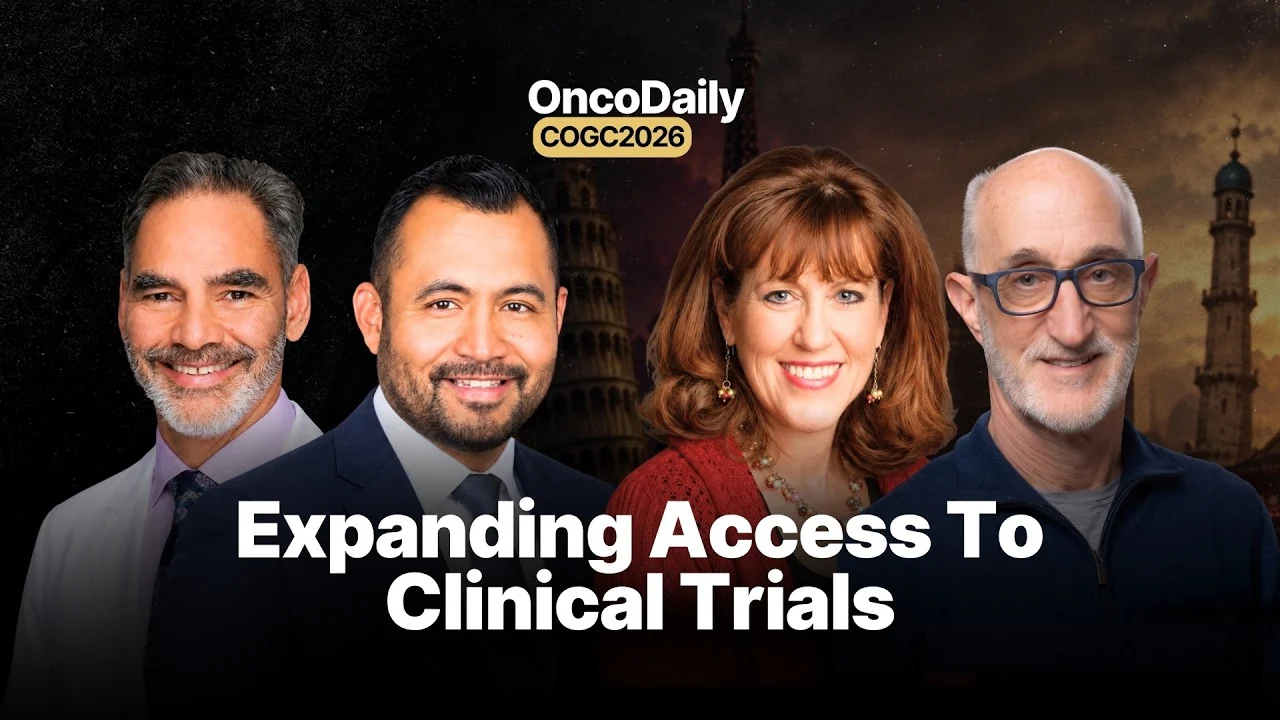
At the Community Oncology Global Congress (COGC 2026), organized by OncoDaily, Adedayo Joseph, Research Program Director at the Medserve-LUTH Cancer Centre, led an expert discussion on what it actually takes to make clinical trials work outside major academic centers.
She was joined by Jenny Ahlstrom, cancer patient advocate and Founder and CEO of HealthTree Foundation; Gustavo Fonseca, Director of Research and Clinical Trials at Florida Cancer Specialists and Research Institute; Jack Hensold, President of the Montana State Oncology Society and medical oncologist at Bozeman Health Cancer Center; and Jose W. Avitia, medical oncologist at New Mexico Cancer Center.
The discussion moved between the patient perspective, rural oncology, community research operations, and the realities of building trial infrastructure in lower-resource settings.
But one problem connected nearly every part of the conversation: patients cannot participate in trials they cannot reach, clinicians cannot offer trials they do not have, and community centers cannot sustain research programs that were never designed or funded with community practice in mind.
So how do we bring research closer to where patients actually receive their care?
If Patients Cannot Reach the Trial, Bring the Trial to Them
For Ahlstrom, the most important step is also the most straightforward: make trials available where patients already are.
“The number one thing is having the trial open at a community center.
Bringing the trials and distributing them to places where patients are – bringing the trial to the patient instead of requiring the patient to travel to the trial – is the biggest thing.
Patients are very interested in joining clinical trials. Most of the time they are not joining because they never get brought up.”
That problem becomes particularly visible in large rural regions. Ahlstrom pointed to the western United States, where patients may live several hours – or even several states – from a major academic cancer center.
The burden does not disappear once a trial is identified. Participation often means more clinic visits, additional testing, and more time away from everyday life.
Yet Ahlstrom argued that patients may accept that burden when they understand why the trial matters to them.
“If you are explaining the value of the trial to the patient – that this is an opportunity to access a new therapy – then you can overcome some of those barriers.
As a patient, I know I am going to spend more time in the clinic. I am going to do more tests. But I am willing to do that because I want to take advantage of this opportunity.
I just really think it has to be brought up.”
Research Cannot Depend on One Determined Investigator
Opening trials in the community, however, requires more than enthusiasm.
Fonseca placed leadership commitment at the beginning of the process.
“Once you build it, they will come.
You need the infrastructure to make sure that the clinical trial is performed properly.
We build it not so much as a center of income, but as a service to the community.
Many times, a clinical trial is the best option for the patient. So it needs to be built into the system.”
Joseph connected that directly to what often happens in lower-resource settings: research programs may survive largely because one highly motivated investigator keeps them alive through personal effort.
For community research to become sustainable, she argued, support has to extend beyond that individual to institutional and governmental leadership.
Avitia described how a program can still begin small.
At New Mexico Cancer Center, the research operation started with one principal investigator and one disease area, then expanded as the team gained experience.
“It starts with an N of one.
In our experience, it was essentially starting off with one principal investigator, which was me, one disease state, and then eventually building that infrastructure so that other physicians could join.
Now we are doing lung trials. Now we are doing breast trials. Now we are looking to branch out into some of the hematologic ones.”
For Avitia, the metric that matters most is not the sheer number of studies a center opens.
It is enrollment.
“It doesn’t matter if we have 100 trials if none of those enroll.
You lose the confidence of the sponsors, but you also don’t build those reps.
Building those efficiencies only comes with enrollment.”
The Real Bottleneck Is the Trial Portfolio
Hensold’s experience in Montana exposed another challenge: a community center can have capable staff, reliable data collection, and physicians committed to research – and still struggle to enroll patients because the right trials simply are not available.
His center has participated in trials through community research networks, academic collaborations, and industry-sponsored studies.
The recurring problem has been the trial portfolio.
“Most trials are relatively selective in terms of the subset of patients they are looking at.
Unless you are putting a large volume of patients through your center, you may simply never be able to get a patient on the trial.
We’ve got the infrastructure to do it. We’ve always provided good data.
But it becomes more of a portfolio problem.
The more options you have, the more likely you are going to be able to line up a patient to get them on a trial.”
That creates a difficult cycle for smaller sites.
Sponsors may hesitate to invest in opening a study at a center that can enroll only a few patients. But without a broader portfolio, the center has fewer opportunities to find trials that match the patients it sees.
Avitia offered a more targeted approach: instead of attempting to open trials across every disease state, community programs can identify the cancers and patient populations they see most frequently and build expertise there first.
“We recognize the limitations that we have within our population.
If our center sees a lot of breast cancer patients, and a large percentage are newly diagnosed ER-positive patients, then we are going to pick that trial set.
You may not have such a broad menu in other disease states, but at least you create that operational efficiency and literacy.”
Design for the Patient, Not Just the Protocol
Community access also depends on what happens long before a study reaches an individual practice: how the protocol itself is designed.
Fonseca described a patient with multiple myeloma whose diagnosis had already been established, but the trial required another bone marrow procedure for central confirmation.
The requirement would have delayed first-line treatment by several weeks.
The patient and her family declined participation.
“We know that she has it, but they needed centrally diagnosed myeloma.
There was no medical rationale.
I understand that maybe the sponsor wanted a tissue bank for future analysis, but don’t force that.
Don’t prevent the patient from enrolling by doing that.”
Avitia described a similar problem with protocols requiring fresh biopsies despite existing archival tissue.
“It adds another layer of complexity for the patient and it ultimately does nothing for the patient.”
For Joseph, working in an African LMIC setting, these requirements can become even more consequential.
Some protocol demands are clinically necessary. Others are largely administrative but can still delay site activation, complicate enrollment, or make participation impractical.
“We do come up against a lot of protocol requirements that make it very difficult for us to go live with the trial and to enroll patients.
We understand why some of them are necessary, but there are a number that are really just administrative and there is no actual medical reason why those things are required.
That is something we need to begin to talk about more with sponsors and partners – to make sure that we remove these barriers.”
If Community Trials Matter, They Have to Be Funded Like They Matter
The final barrier was one that infrastructure and enthusiasm alone cannot solve: money.
Avitia argued that expanding research into community settings requires incentives to line up across the entire ecosystem – practices, physicians, sponsors, and patients.
“You have to build it. If you don’t build it, then no one will come.
There have to be incentives for practices to do research. There have to be incentives for pharma companies to do research in the community setting.
It is all about aligning those incentives and forming those partnerships so that everybody gets what they need.”
Hensold made the financial tension more explicit.
In Montana, some capable practices do not participate in community research networks because reimbursement does not adequately cover the cost of running trials. At the same time, sponsors may consider opening a small rural site too expensive if anticipated enrollment is low.
Even protocol-mandated procedures can create unanswered questions about who pays.
“There is cost to running clinical trials.
If we are trying to do this well, we need to provide enough money to do it and to do it well.
There is a major financial barrier until somebody steps up and says, ‘This is important to us. Let’s figure out how we can overcome this barrier and who is going to help us overcome it.’”
Patients Need the Tools to Find Research, Too
Building community trial capacity addresses one side of the problem. Ahlstrom ended by highlighting the other: patients need enough information to recognize clinical research as an option in the first place.
“Right now we have a model where brilliant people are caring for patients, and patients just show up when they are sick.
It is a very passive model from the patient perspective.
If you want us as patients to be more educated coming in – to know that clinical trials are an option – we need to have the tools and resources to show us what our treatment options are at every stage.”
Technology could make trial information more visible and locally relevant – for example, by alerting patients to a study available in Montana or New Mexico and providing accessible explanations of what the trial involves.
But the larger principle was simpler.
Community centers need trials that are feasible to run. Sponsors need sites capable of enrolling. Clinicians need systems that identify appropriate patients early. And patients need to know that research is an option before they have exhausted everything else.
“You need to do it both ways.
You need to have the community centers.
But let’s give the right information to the patient too, so they can be a more proactive participant in their own health.”
Written by Eliz Baloyan, MD, Features Writer and Editor at OncoDaily and CancerWorld
Watch the full video on YouTube.