Key takeaways
- Treatment-free remission is now an established option in CML care, allowing carefully selected patients to maintain molecular disease control without continuous TKI therapy.
- A second attempt at treatment-free remission is possible, offering renewed hope to patients who experienced molecular recurrence after their first discontinuation.
- The duration of deep molecular response is critical to TFR success, with prolonged molecular stability emerging as an important factor before attempting treatment discontinuation again.
- Early real-world experience suggests that asciminib discontinuation may be feasible, although larger prospective studies are needed to establish its safety and long-term outcomes.
- The future of TFR is becoming more flexible and personalized, with emerging evidence supporting second attempts, optimized monitoring schedules, and the potential inclusion of newer therapies.
At LeukO 2026: Global Virtual Congress on Leukemias, organized by OncoDaily, Dennis Kim, Head of the Malignant Hematology Program at Princess Margaret Cancer Centre and Professor of Medicine at the University of Toronto, Canada, explored the evolving practice of treatment-free remission (TFR) in chronic myeloid leukemia (CML), focusing on second attempts at treatment discontinuation, less intensive molecular monitoring, and the emerging possibility of achieving TFR after asciminib therapy.
For patients with CML who achieve sustained deep molecular responses, stopping tyrosine kinase inhibitor (TKI) therapy has become an established clinical option. But as experience with treatment-free remission grows, new questions are emerging.
Can patients who experience molecular recurrence after their first attempt safely try again? Is the traditional frequency of PCR monitoring always necessary? And could patients receiving newer agents such as asciminib also benefit from treatment discontinuation?
Drawing on international clinical trials, updated European LeukemiaNet recommendations, and real-world experience from Canada, Kim examined how these questions could shape the next stage of CML care.
From an Experimental Idea to Everyday Clinical Practice
The possibility of stopping TKI therapy once seemed difficult to imagine.
The introduction of imatinib and subsequent generations of TKIs had transformed CML into a disease that many patients could manage for decades. However, treatment was generally expected to continue indefinitely, even when molecular testing showed extremely low levels of detectable leukemia.
That began to change with landmark discontinuation studies.
Kim highlighted the pioneering STIM1 trial, which provided early evidence that selected patients with sustained deep molecular responses could discontinue imatinib and remain in remission without continuous treatment.
Subsequent studies, including EURO-SKI, TWISTER, ENESTfreedom, and the Canadian TRAD trial, expanded the evidence across different patient populations and TKIs.
Together, these investigations established an important finding: approximately 40–60% of carefully selected patients can maintain treatment-free remission after discontinuing TKI therapy, depending on the study population, eligibility criteria, and follow-up duration.
The implications have been substantial.
“So now it is not a research topic anymore. We are now using it in our clinical practice.”
Treatment-free remission has become an important consideration for patients with chronic-phase CML who have achieved sufficiently deep and sustained molecular responses.
However, eligibility remains carefully defined.
The 2025 European LeukemiaNet (ELN) recommendations emphasize the importance of an adequate duration of TKI treatment, a stable deep molecular response, reliable molecular monitoring, and patient willingness to participate in structured follow-up.
For standard TFR eligibility, the recommendations generally require more than five years of TKI treatment, or more than four years with a second-generation TKI, alongside more than two years of sustained MR4 or deeper response.
MR4 corresponds to a BCR::ABL1 level of 0.01% or lower on the International Scale, while MR4.5 represents an even deeper response of 0.0032% or lower.
Kim emphasized that both the depth and duration of molecular response influence the likelihood of successful treatment discontinuation.
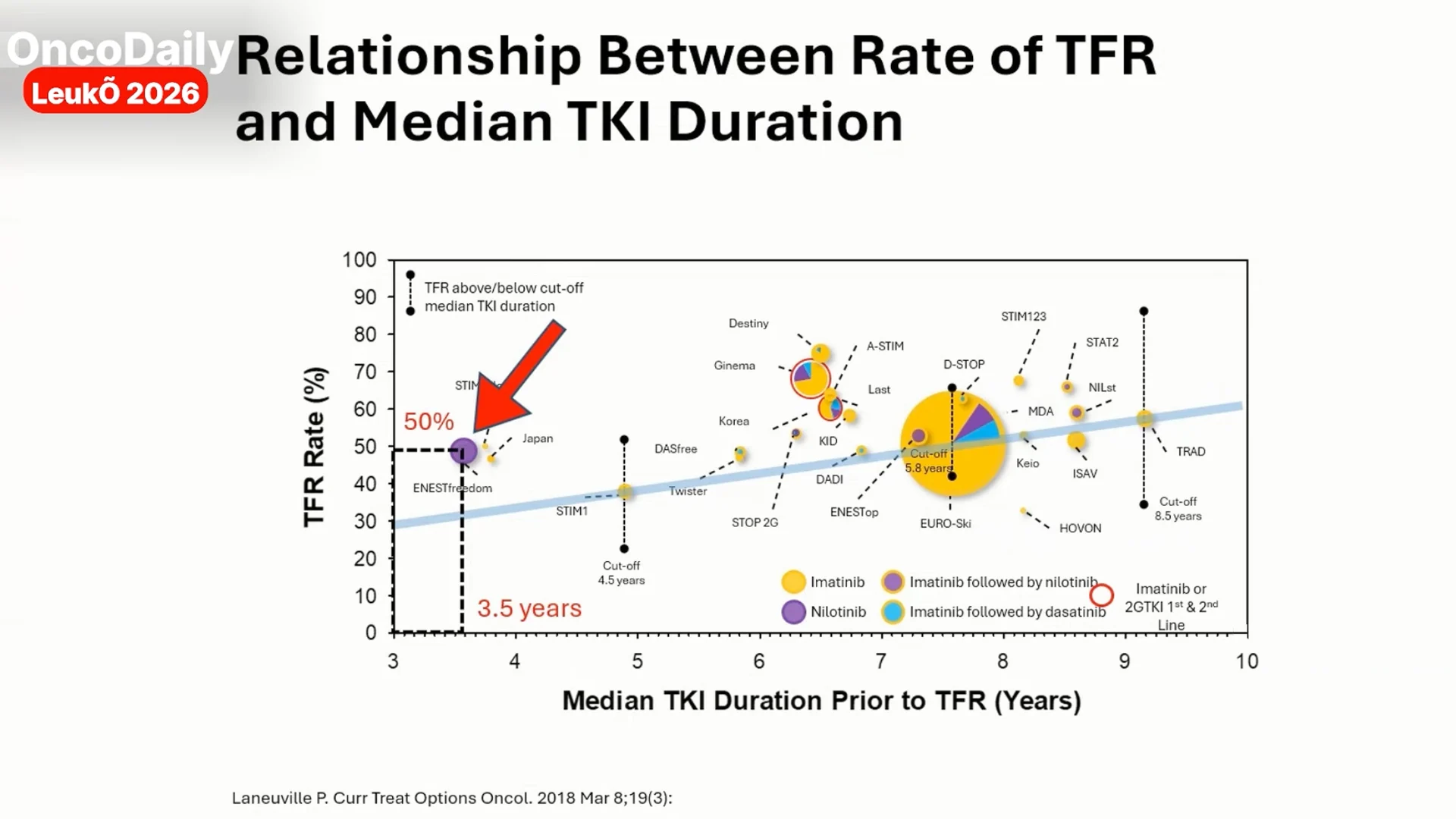
Data from EURO-SKI and other studies have consistently shown that patients with longer periods of TKI exposure and sustained deep molecular remission generally have better TFR outcomes.
These established findings provide the foundation for a more challenging question: what happens when the first attempt does not succeed?
A Second Chance After Molecular Relapse
For patients who experience molecular recurrence after stopping therapy, the usual approach is to restart an effective TKI.
Most regain their previous molecular response, often within several months.
But until recently, evidence supporting a second attempt at treatment-free remission was relatively limited.
Kim reviewed several studies exploring whether patients who had already experienced an unsuccessful discontinuation attempt could stop treatment again after regaining a stable deep molecular response.
The early RE-STIM study demonstrated that a second attempt was possible, reporting treatment-free remission in approximately 35% of patients at three years.
Further evidence came from the DAstop2 trial, which investigated second treatment discontinuation following retreatment that included dasatinib.
After a median follow-up of 27 months, approximately 46% of patients remained in treatment-free remission at two years.
These results suggested that molecular recurrence after an initial discontinuation attempt did not necessarily eliminate the possibility of future treatment-free remission.
However, the experience from Kim’s own Canadian research was more complicated.
The TRAD trial, conducted in Canada, investigated whether switching patients to dasatinib after an unsuccessful imatinib discontinuation could improve the likelihood of a second successful attempt.
Among patients who experienced molecular recurrence after stopping imatinib, most regained deep molecular response after receiving dasatinib.
Of the patients who proceeded to a second discontinuation attempt, however, a substantial majority subsequently lost major molecular response.
The results were disappointing compared with those reported in some other second-discontinuation studies.
Kim identified a potentially important explanation: patients in TRAD underwent a relatively short consolidation period after regaining their molecular response.
Many had received only about one additional year of dasatinib before attempting treatment discontinuation again.
This raised the possibility that the length of sustained deep molecular remission before a second attempt might be particularly important.
More recent studies have provided encouraging evidence supporting that approach.
At the 2026 European Hematology Association Congress, investigators presented findings from the NAUT trial, in which patients underwent prolonged retreatment that included two years of nilotinib before another discontinuation attempt.
Approximately 58% of evaluable patients maintained major molecular response at 12 months after stopping treatment.
Kim also highlighted results from the ResToP trial, which evaluated ponatinib consolidation followed by a second attempt at TFR.
The study reported encouraging outcomes, with approximately 68% of patients entering the discontinuation phase maintaining treatment-free remission at one year in the analysis discussed.
However, the proportion was lower when calculated across the broader enrolled population, reflecting the fact that not every patient proceeded to treatment discontinuation.
These studies differed in their designs, treatment histories, patient selection, and follow-up, making direct comparisons between the drugs inappropriate.
Nevertheless, they pointed toward a consistent principle.
“A second attempt at TFR, yes, it is feasible.”
For Kim, the most important consideration was not necessarily which TKI was used before the second attempt, but whether patients had achieved and maintained a sufficiently long period of deep molecular remission.
He suggested that at least two years of sustained MR4 or deeper response before another discontinuation attemptshould be an important consideration in future recommendations.
At present, there is insufficient evidence to conclude that nilotinib, dasatinib, ponatinib, or another TKI is inherently superior for achieving second treatment-free remission.
What matters is identifying patients who may benefit, allowing adequate time for molecular stability, and maintaining careful follow-up after stopping treatment again.
Do Patients Really Need So Many PCR Tests?
Another important question concerns the burden of monitoring after treatment discontinuation.
Frequent BCR::ABL1 PCR testing is essential during treatment-free remission because molecular recurrence can occur even when patients have no symptoms.
Historically, many discontinuation trials required monthly testing during the first year, followed by progressively longer intervals.
Although this approach supports early identification of molecular relapse, it also creates practical challenges.
Patients may need frequent hospital visits, while healthcare systems must provide the laboratory capacity, staff, and resources required for repeated molecular testing.
For individuals who have successfully discontinued medication, frequent monitoring can remain an important part of their ongoing experience of living with CML.
Kim examined whether the testing schedule could be simplified without compromising safety.
He highlighted research from Adelaide, Australia, in which investigators modeled different schedules for molecular monitoring after TKI discontinuation.
The analysis compared conventional frequent testing with alternative approaches involving longer intervals between assessments.
One proposed strategy involved PCR testing every two months during the first six months, followed by testing every three months.
In the model presented by Kim, this approach could reduce the number of molecular tests by approximately 52% compared with a more intensive schedule.
Importantly, the investigators also examined the potential consequences of delayed recognition of molecular recurrence.
The modeling suggested that reducing testing frequency could be feasible in appropriately monitored patients, although less frequent testing may delay detection of rising BCR::ABL1 levels in some circumstances.
The findings helped inform a broader reassessment of monitoring practices.
The 2025 ELN recommendations now support a less intensive schedule than many older discontinuation protocols:
- Every six to eight weeks during the first six months.
- Every two months during months six to twelve.
- Every three to six months thereafter.
- These intervals are intended for appropriately selected patients with access to reliable testing and rapid clinical follow-up.
Monitoring should become more frequent when BCR::ABL1 levels increase or show concerning fluctuations.
Kim also described how his team has adapted monitoring in clinical practice at Princess Margaret Cancer Centre.
Patients are generally monitored every six weeks during the first six months, followed by testing approximately every three months during the subsequent period.
In selected patients with prolonged molecular stability, intervals may eventually be extended further.
The distinction between different molecular response thresholds remains important.
Loss of major molecular response (MMR), rather than loss of MR4 alone, is the established trigger for restarting TKI treatment in most TFR protocols.
MMR corresponds to a BCR::ABL1 level of 0.1% or lower on the International Scale.
Patients may lose MR4 while still maintaining MMR, and such changes do not automatically require treatment reinitiation.
Instead, closer surveillance may be appropriate to determine whether transcript levels continue to rise.
For Kim, reducing unnecessary testing is not about weakening surveillance. It is about developing a monitoring strategy that remains clinically safe while being less burdensome for patients and healthcare systems.
Asciminib and the Next Frontier of Treatment Discontinuation
The introduction of asciminib has created another important question in CML management.
Unlike conventional ATP-competitive TKIs, asciminib is a STAMP inhibitor that targets the ABL myristoyl pocket, offering a different mechanism of BCR::ABL1 inhibition.
Its efficacy and tolerability have expanded treatment options for patients with chronic-phase CML, including those receiving therapy after resistance or intolerance to previous TKIs.
More recently, frontline studies have demonstrated that asciminib can produce deep molecular responses in newly diagnosed patients.
But can patients who achieve sustained deep molecular remission while receiving asciminib safely discontinue treatment?
Kim emphasized that the evidence remains limited.
Although asciminib is a newer agent with a different mechanism of action, there is no established biological reason to assume that patients receiving it would necessarily require entirely different TFR eligibility criteria.
However, dedicated clinical evidence is needed.
Kim noted that prospective investigations associated with the ASC4FIRST and ASC4START trials are expected to provide more information about treatment discontinuation after asciminib.
In the meantime, his team has begun examining its experience in routine practice.
At Princess Margaret Cancer Centre, clinicians have evaluated TFR outcomes among patients receiving different TKIs, including imatinib, nilotinib, dasatinib, and asciminib.
The overall treatment-free remission rate in the center’s selected discontinuation cohort was approximately 76%.
Kim stressed that these favorable outcomes likely reflected the characteristics of the population, including the long duration of TKI exposure and sustained deep molecular response before treatment cessation.
Patients had received TKI therapy for a median of approximately seven and a half years.
The experience with asciminib was especially interesting, although the number of patients remained very small.
At the time of the presentation, five patients had attempted asciminib discontinuation.
Four remained in treatment-free remission, while one had lost major molecular response.
These patients had not received asciminib as frontline treatment. They had generally been treated with it in later lines, often because of intolerance to previous therapies or specific resistance-related considerations.
The findings suggest that asciminib discontinuation may be feasible in carefully selected patients who meet established TFR criteria.
However, outcomes in five patients cannot establish a reliable success rate, demonstrate equivalence with other TKIs, or determine whether asciminib offers any particular advantage for treatment-free remission.
Longer follow-up and prospective studies will be essential.
For now, Kim’s experience offers an early indication that the established principles of TFR might eventually extend to patients receiving newer treatment options.
A More Flexible Future for CML Care
The development of treatment-free remission has already changed the expectations of CML management.
Treatment-free remission has become an established part of CML management, but important questions remain about how to make it work for more patients.
Kim’s presentation highlighted encouraging evidence for second discontinuation attempts, the potential to reduce unnecessary PCR testing, and early experience with asciminib discontinuation. While these developments offer new possibilities, clearer recommendations and larger prospective studies are still needed, particularly for newer therapies.
For patients, the implications are meaningful: another chance at treatment-free remission after an unsuccessful attempt, fewer hospital visits, and greater flexibility in long-term care.
As the evidence evolves, the next priority is to make treatment-free remission a more individualized option, with decisions guided by each patient’s molecular response, treatment history, and clinical needs.
Written by Eliz Baloyan, MD, Features Writer and Editor at OncoDaily and CancerWorld