Key takeaways
- Standardized biomarker order sets can help clinicians start with the right testing from the beginning.
- Pathology coordination is critical to turnaround time, especially when tissue is controlled by multiple hospitals and outside pathology groups.
- Biomarker results are most useful when they are integrated into the EMR and linked directly to treatment guidance.
- Molecular data can also support faster clinical trial pre-screening and patient identification across community networks.
- Rapid blood-based testing may shorten the time to actionable molecular information when tissue access or outsourced testing creates delays.
At the Community Oncology Global Congress (COGC 2026), organized by OncoDaily, Brian Grieb, Director of Gastrointestinal Malignancies Research at the Greco-Hainsworth Centers for Research at Tennessee Oncology, focused on a problem that can determine how quickly precision oncology actually reaches the patient: turnaround time.
Tennessee Oncology operates across a geographically broad network that includes major metropolitan areas as well as rural communities. But while the practice controls the care of its patients, it does not control much of the tissue needed for molecular testing. Biopsies may be performed at different hospitals, handled by different pathology groups, and processed according to different local workflows.
From standardized order sets and pathology coordination to real-time treatment guidance, trial matching, and rapid blood-based testing, the presentation explored what it takes to make biomarker information useful at the moment a treatment decision has to be made.
Building a Rapid Biomarker Workup
“We really wanted to build a rapid biomarker workup program.
The question was: how do we ensure that we are getting not only a thorough workup, but a timely workup for our patients, whether they are undergoing standard-of-care treatment or being considered for clinical trials?
We had three main goals:
- Make sure our providers are ordering the most up-to-date molecular profiling right out of the gate.
- Once that molecular profiling comes back, make sure our providers can act on it appropriately.
- Make sure our study teams are alerted when patients may be eligible for clinical trials based on their molecular profile.
Our challenge is that we do not control the tissue. Hospitals and pathology groups control the tissue.
We have control over the patients.
The first step is making sure that the physician orders the right test.
For every malignancy, we have a customized order set.
For example, with metastatic gastric adenocarcinoma, when the clinician opens the order set, it includes next-generation sequencing with DNA and RNA, along with PD-L1, HER2, and CLDN18.2 testing.
The physician does not have to opt into every appropriate test. They have to opt out of the right test.
That lowers the barrier for the physician and helps us make sure that the appropriate molecular workup is ordered from the beginning.”
The “Secret Sauce” Is Knowing Where the Tissue Should Go
“Once the testing is ordered, the information goes to what we call our pathology outreach group.
These are not the people performing the immunohistochemistry or the next-generation sequencing.
But they are really the secret sauce of our program.
They look at what has been ordered. They determine where the tissue is. And then they figure out how to get all of the necessary information back as quickly as possible.
A lot of this comes down to sending the tissue to as few places as possible.
If we can perform everything in-house, we bring the tissue in-house. If we need to send it to an outside vendor, we try to send it to one vendor that can perform as much of the required testing as possible.
What we have found is that when tissue is sent sequentially to multiple vendors, the first vendor may hold it until its testing is complete before passing it to the next one, and then the same thing happens again.
That can significantly delay the molecular information we need.
The pathway also has to adapt to what individual pathology groups can provide.
Two patients with the same gastroesophageal adenocarcinoma can come to us with very different pathology reports.
In one case, we may receive the diagnosis and quickly get an addendum containing the standard immunohistochemistry we need – HER2, PD-L1, mismatch repair, and CLDN18.2.
In that situation, we can bring the tissue in-house for our own next-generation sequencing, which gives us more standardization across the practice.
In another case, we may receive only the diagnosis, without the additional testing we need.
Because our own ability to perform all standard-of-care immunohistochemistry is limited, that may be a case where sending the specimen to an outside laboratory that can perform both the molecular profiling and the required IHC is actually the faster pathway.
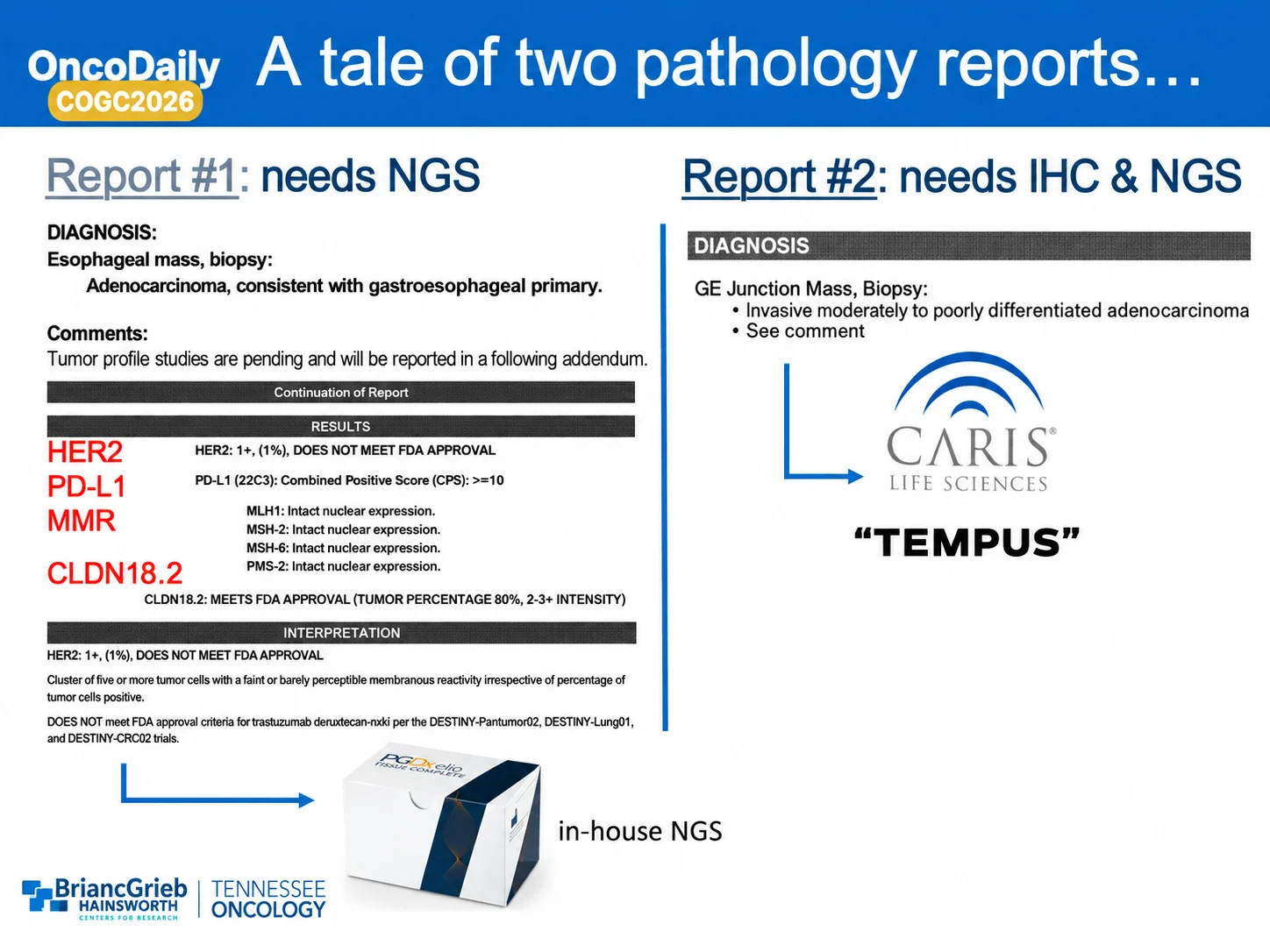
The important thing is not that every sample follows exactly the same route. The goal is to choose the route that gets the complete answer back fastest.”
A Biomarker Result Is Only Useful If It Changes Treatment
“Once the testing comes back, the next question is: what do we do with it?
The results are digitized and fed into the electronic medical record so that they can be searched.
But more importantly, we have built a system that provides physicians with therapeutic guidance based on the molecular information.
In the EMR, the physician enters the pathology and disease setting and then moves through a molecular workflow – for example, whether the patient is HER2-positive or HER2-negative, or whether the tumor is mismatch repair proficient or deficient.
Based on those molecular characteristics, the system can populate a preferred therapeutic option for that patient.
These pathways are updated quarterly by disease-specific content experts using the latest publications, NCCN guidelines, and conference data.
So our physicians are not only getting the appropriate molecular workup up front. They are getting updated treatment recommendations in real time as that molecular information enters the chemotherapy ordering workflow.”
Turning Biomarker Data Into Clinical Trial Access
“Then there is the clinical trial question.
Ultimately, the goal is to take a large international drug development program and figure out how to get that investigational therapy to the patient – whether that patient lives in urban Nashville or in a rural community.
Through Tennessee Oncology and the broader OneOncology Research Network, OneR, we can pool the resources of community oncology practices that are trying to operationalize clinical research.
OneR is OneOncology’s community-based research network, designed to expand clinical trial access across participating practices rather than concentrating research exclusively in academic centers.
The digital molecular information we accumulate feeds into our broader analytics infrastructure.
Our OneAnalytics team receives regular data feeds from major next-generation sequencing vendors.
For the trials we are running, I receive reports based on the molecular characteristics that are relevant to those studies.
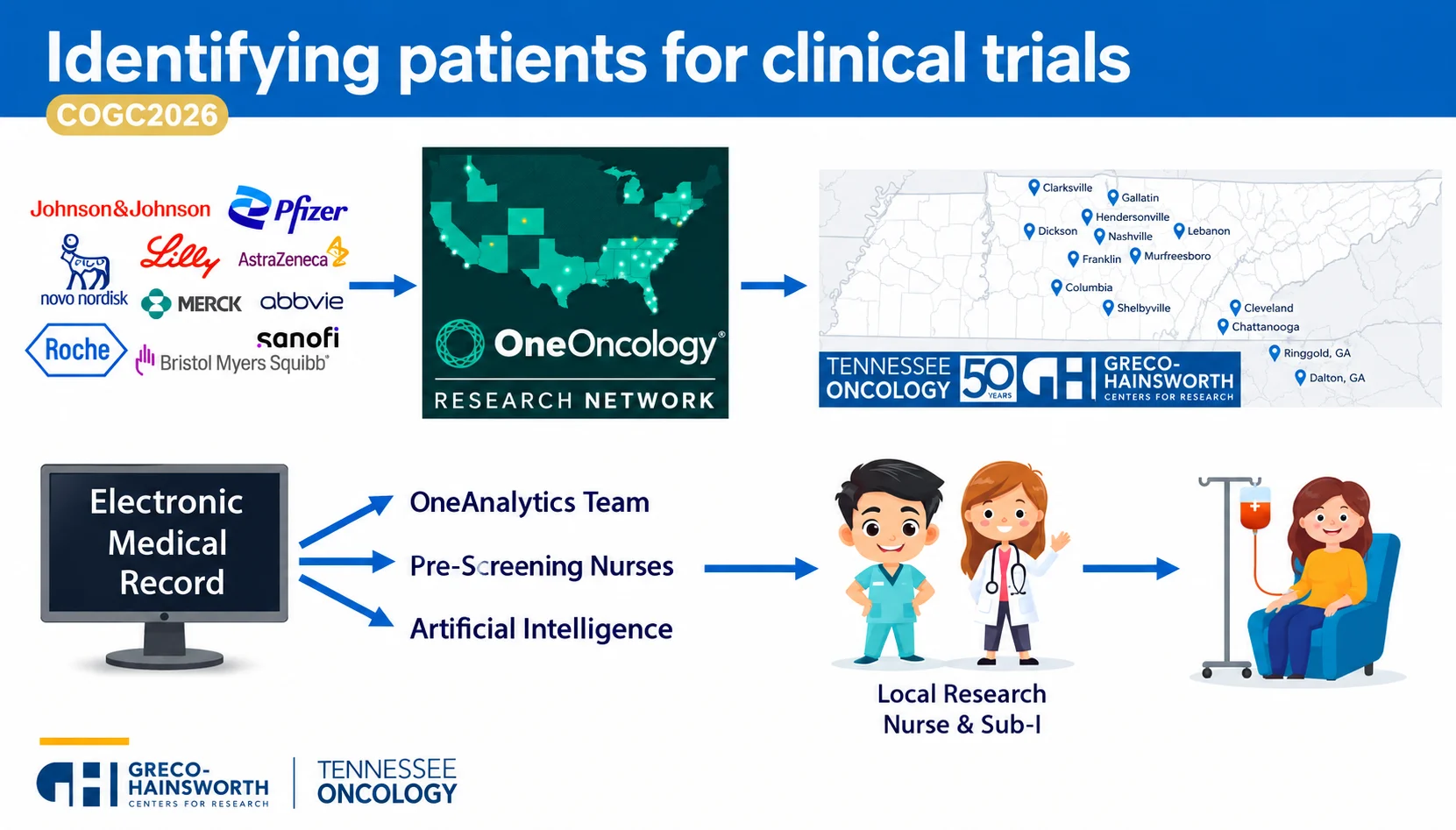
That information goes to pre-screening nurses who can review the charts, and we are also increasingly using homegrown artificial intelligence to identify information that may not already exist in a structured digital format.
Instead of having somebody manually review every patient, we can narrow the funnel.
The patients who appear potentially eligible can then be forwarded to the local sub-investigator and research nurse who have direct access to that patient and can discuss the trial with them.
That process has worked very well for us and has helped us become a leading enroller on many of the trials we participate in.”
From Faster Testing to a Faster Pathway
“We do not control the tissue, but we do control our patients, and we have direct access to their blood.
So the question becomes: can we perform blood-based testing in the office and get some of the molecular information we need for standard-of-care treatment or clinical trials even faster?
One approach we are exploring is rapid in-house molecular testing.
With systems such as the Biocartis Idylla platform, targeted molecular profiling can be completed in less than three hours with minimal hands-on time.
In gastrointestinal cancers, for example, rapid testing can provide information such as KRAS, NRAS, BRAF, and MSI status.
The idea is that molecular information could begin coming back at something closer to the pace of routine laboratory testing – potentially even before the patient returns after their initial blood draw.
That could allow us to connect a patient with an appropriate standard-of-care treatment or clinical trial much earlier.
And that really brings us back to the larger goal of everything we have been building at Tennessee Oncology: streamlining the entire biomarker pathway, not just one part of it.
These are solutions designed for our patients, our region, and our particular practice, and the exact approach may look different somewhere else.
What matters is building a pathway that gets the correct molecular testing ordered from the beginning, moves the specimen through the fastest appropriate route, puts the results directly into the clinical workflow, and allows both treatment and research teams to act on that information.
Because ultimately, biomarker testing only has value if the result gets back in time to change what we can offer the patient.”
Written by Eliz Baloyan, MD, Features Writer and Editor at OncoDaily and CancerWorld