
Key takeaways
- Comprehensive molecular profiling impacts both treatment selection and outcomes for patients with advanced cancers, particularly non-small cell lung cancer.
- Liquid biopsy can increase the detection of actionable genetic alterations and can be incorporated into routine diagnostic workflows.
- Barriers to broader liquid biopsy use, especially cost and availability, are improving and are likely to continue improving over time.
At the Community Oncology Global Congress (COGC 2026), organized by OncoDaily, Benjamin Bleiberg, thoracic medical oncologist at the University of Pennsylvania, opened with a case that clearly illustrated the challenge at the center of his presentation.
A 74-year-old woman with metastatic non-small cell lung cancer had lymph node and bone involvement. Tissue biopsy showed no actionable genetic alterations, yet circulating tumor DNA testing identified an ALK fusion. She was started on lorlatinib and had a robust response.
The case raised two central questions:
- When should comprehensive molecular profiling be performed,
- What should comprehensive testing include in the current era of precision oncology?
Why Comprehensive Profiling Needs Both Tissue and Plasma
“In a large pan-cancer cohort undergoing comprehensive next-generation sequencing, approximately 80% of patients had a clinically relevant alteration identified. These findings were not limited to prognostic information. Around 28% had changes in treatment eligibility, 17% had changes in immediate treatment sequencing or management, and 15% gained access to potentially safer treatments.
So comprehensive molecular profiling is not simply about generating more genomic information. It can directly change what treatment a patient receives and when they receive it.
Solid tumor testing remains a major foundation of comprehensive profiling and requires an adequate tissue sample from either the primary tumor or a metastatic site.
In lung cancer, that may include next-generation sequencing for alterations such as EGFR, KRAS, and BRAF, fusion testing for ALK, RET, and ROS1, and immunohistochemistry for clinically relevant markers such as PD-L1, HER2, and c-MET.
But liquid biopsy increasingly has a role in patients with advanced malignancies as well. With a peripheral blood sample, we can obtain genomic information through NGS, identify fusions, and assess biomarkers such as tumor mutational burden and microsatellite instability. Newer epigenetic and methylation-based approaches are also beginning to provide information about tissue of origin and potentially histology.
The question is therefore no longer necessarily whether we should use tissue or plasma. Increasingly, it is how we can use both intelligently within the same diagnostic pathway.”
Tissue and ctDNA Are Complementary
“Approximately 35% of patients with non-small cell lung cancer harbor potentially actionable genetic alterations, and large-panel testing is more likely to identify these alterations than sequential single-gene testing.
Both tissue and circulating tumor DNA can detect these molecular targets, and concurrent testing can increase the likelihood of obtaining a complete NGS result.
Importantly, having molecular results available before first-line therapy begins has also been associated with improved overall survival in several studies.
So when there is radiographic suspicion of lung cancer, the ideal workflow is:
- obtain a biopsy to establish the diagnosis,
- perform tissue and ctDNA NGS concurrently when possible,
- identify the molecular results,
- have that information available before starting first-line treatment.
Tissue and plasma results are often concordant, but not always.
In a large multi-institutional analysis, approximately two-thirds of alterations were concordant between tissue and ctDNA testing. Around 30% were detected only on tissue, while approximately 5% were detected only in plasma.
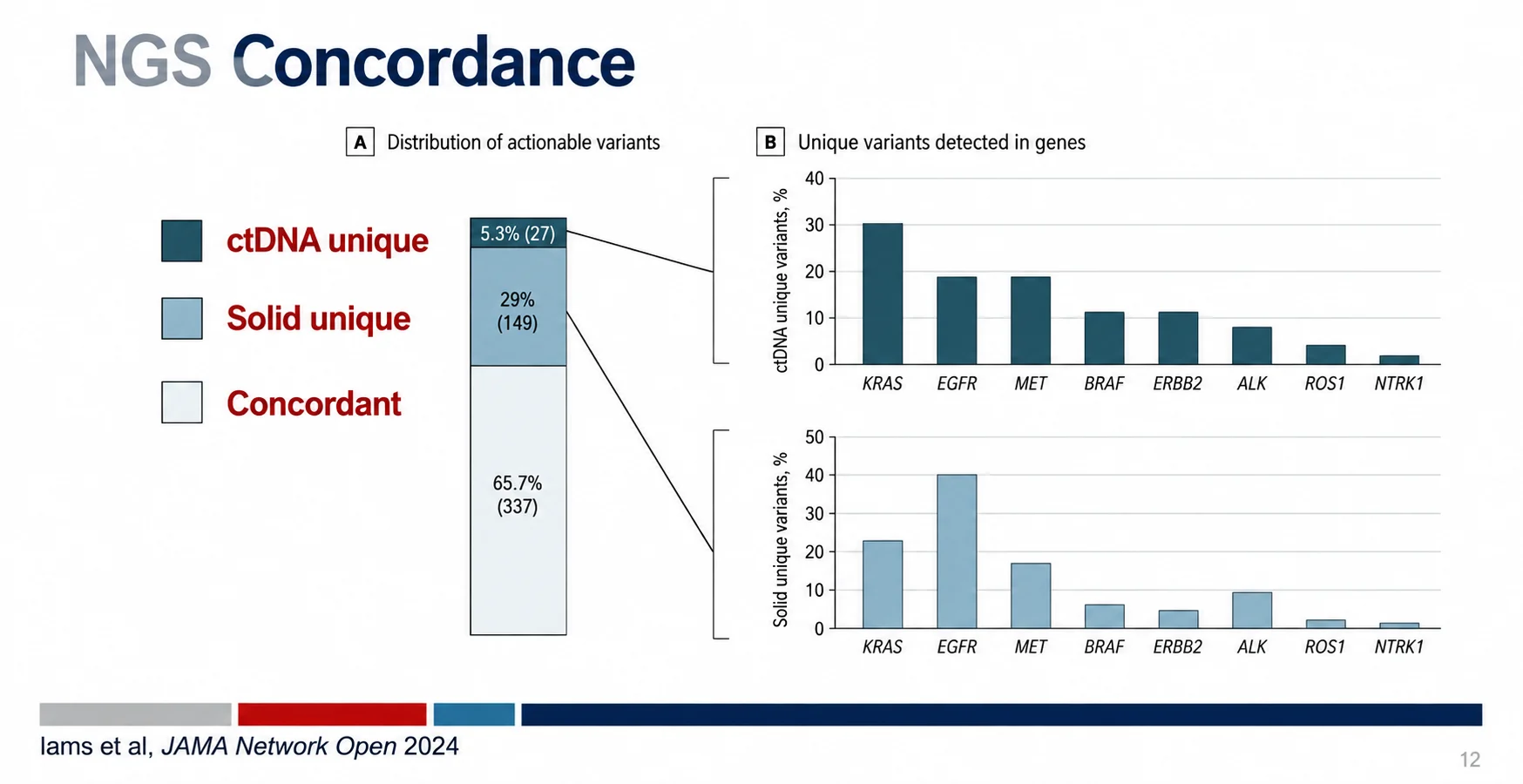
That discordance is clinically important because each testing modality can miss information for different reasons.”
When Plasma Finds What Tissue Misses
“We looked more closely at patients who had undergone concurrent tissue and plasma NGS to understand why some actionable alterations appeared only in one testing modality.
Again, approximately two-thirds of the time the results were concordant. Around a quarter of actionable alterations were detected on tissue alone, which may occur when the tumor is shedding too little DNA into the circulation for plasma testing to detect it.
Around 10% were detected on plasma alone.
We wanted to understand why.
- Was the tissue specimen insufficient in quality or quantity?
- Was the panel incomplete?
- Or had appropriate tissue testing genuinely failed to identify an alteration that was present in the circulating tumor DNA?
Most plasma-only findings could be explained by limitations in tissue quality or inadequate testing panels. But there was also a smaller group in which an adequate tissue sample had been obtained and the relevant tests had been performed, yet the actionable alteration was identified only through ctDNA.
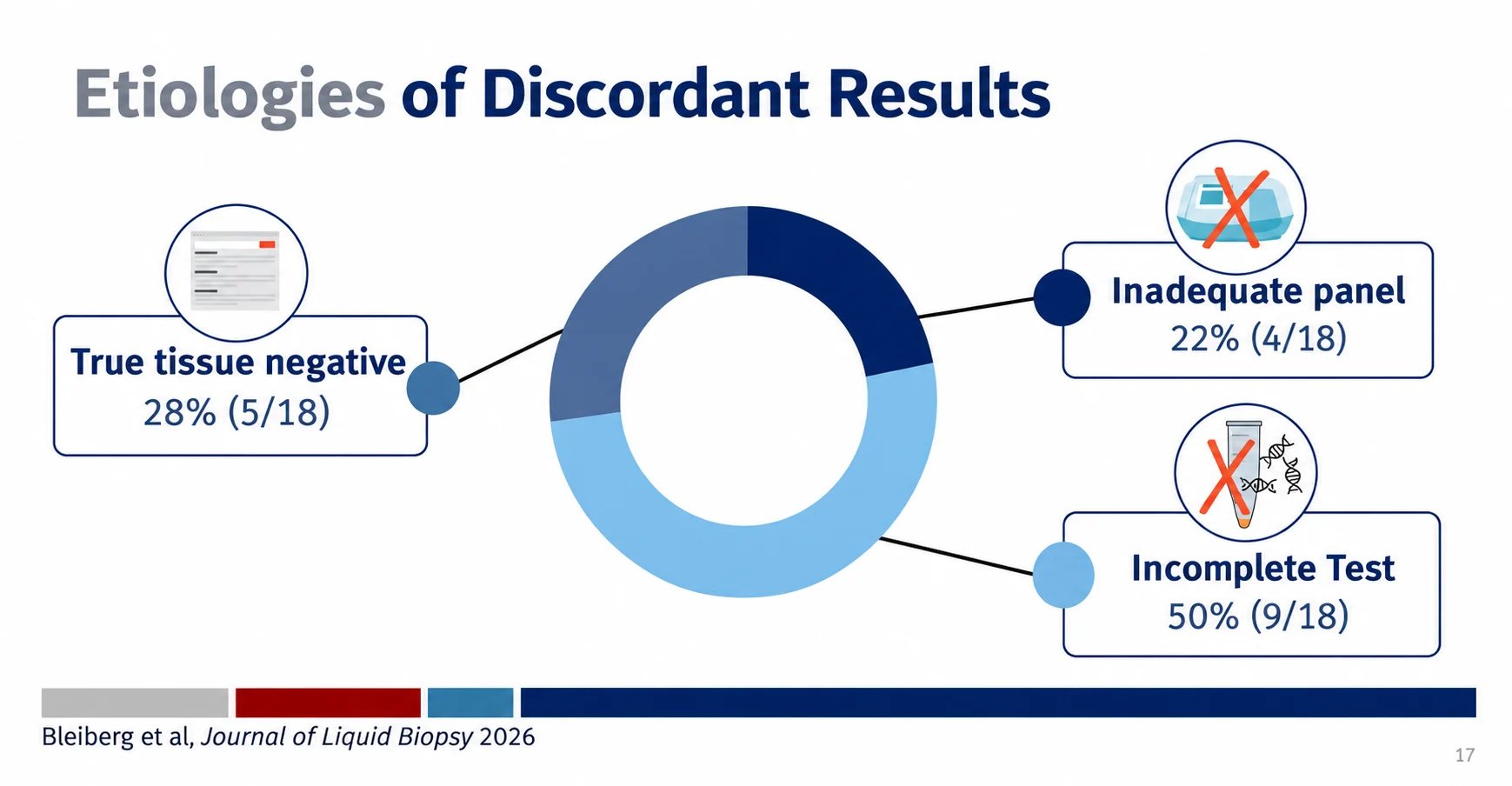
When those patients received appropriate targeted therapy, they could have very robust responses – just as we saw in the introductory case.
This is why tissue and ctDNA should be viewed as complementary rather than competing approaches.”
Liquid Biopsy: Broader Insight, Uneven Access
“Liquid biopsy is not simply another way of running NGS.
In advanced cancer, circulating tumor DNA may sometimes capture spatial and temporal heterogeneity that a single tissue biopsy cannot. A tissue sample reflects one lesion at one location and one moment in the disease course, while plasma can potentially contain material released from multiple tumor sites.
That can make liquid biopsy particularly valuable when the biology of the cancer has evolved or when a single tissue specimen does not fully represent the disease.
But there are still major barriers to broader implementation. A global survey of approximately 400 oncology professionals across 60 countries found broad agreement on the clinical value of liquid biopsy, but substantial differences in how frequently it was actually being used.
Utilization was higher in high-income countries, academic centers, and among disease-specific specialists. The major barriers included cost, availability, interpretation, and turnaround time.
There were also major differences in who was responsible for interpreting results. In some settings, interpretation rested with the treating physician; in others, it involved the laboratory, vendor, pathology team, or occasionally a molecular tumor board.
Coverage models also varied considerably, including government funding, insurance, self-pay, and company-supported access.
So even when the technology exists, integrating it into routine cancer care depends heavily on the surrounding health system.”
The Cost-Benefit Equation Is Changing
“Some health systems have already demonstrated that incorporating liquid biopsy into the evaluation of patients with non-small cell lung cancer can be cost-effective.
Part of that benefit comes from reducing the need for repeat invasive biopsies and increasing the probability that patients receive the optimal systemic treatment earlier.
Analyses from countries including Canada, Singapore, Germany, and Ireland have demonstrated varying degrees of cost-effectiveness or cost savings, and the Irish experience has even evaluated a plasma-first testing strategy.
I expect these barriers to continue decreasing over time because the cost of sequencing has fallen substantially over the past decade.
At the same time, the clinical value of identifying molecular alterations continues to rise because we are discovering more actionable targets and developing more effective targeted therapies.
So we are seeing two trends moving in opposite directions: sequencing is becoming less expensive while the number of clinically actionable targets and available targeted therapies continues to grow.
Comprehensive molecular profiling can influence both treatment selection and outcomes in advanced cancer, particularly in non-small cell lung cancer.
Liquid biopsy can increase the detection of actionable alterations and can increasingly be incorporated into routine diagnostic workflows.
The remaining barriers – especially cost and availability – are real, but they are improving.
The goal is ultimately to make sure that the right molecular information is available early enough to influence the treatment decision that matters.”
Written by Eliz Baloyan, MD, Features Writer and Editor at OncoDaily and CancerWorld