Key takeaways
- Late cancer diagnosis is not only a patient-delay problem; missed opportunities within the healthcare system can also prolong diagnosis and referral.
- Primary, secondary, and tertiary delays can occur at different points in the pathway, from waiting to seek care to diagnostic delays after presentation and treatment delays after diagnosis.
- Trust, communication, stigma, and word-of-mouth experiences can strongly influence whether patients continue along referral and treatment pathways.
- Trained cancer survivors can be effective navigators and sources of trust, but their involvement should be structured, supported, and ideally compensated rather than relying only on volunteerism.
- Community-based solutions, including health workers, civil society groups, referral tools, and community-led monitoring, can help identify delays earlier and bring cancer care closer to patients.
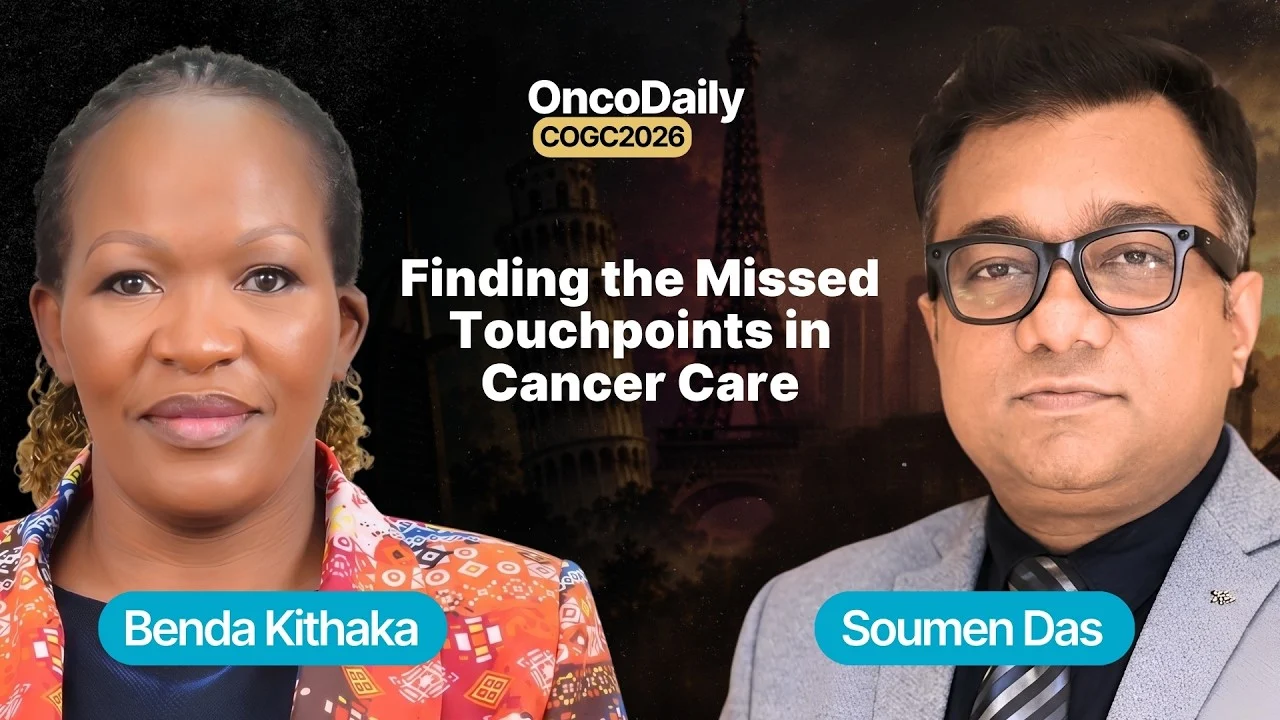
At the Community Oncology Global Congress (COGC 2026), organized by OncoDaily, Soumen Das, Breast Surgical Oncologist and Founder and Director of the Institute of Breast Diseases in Kolkata, joined Benda Kithaka, Founder and Executive Director of KILELE Health Association in Kenya and Secretariat Lead of the African Cervical Health Alliance, for a discussion on why patients still arrive late for cancer diagnosis and treatment.
The usual explanation is familiar: patients lack awareness, delay seeking care, or fail to follow referral advice.
Rather than focusing only on why patients present late, Kithaka shifted attention to the points along the care pathway where earlier diagnosis may have been possible.
For her, the more important question was how often patients had already come into contact with the healthcare system before cancer was suspected, whether those encounters led to appropriate referral, and whether patients felt enough trust in the system to continue seeking care.
“How many touchpoints are we missing?”
That question became the starting point for a broader discussion about diagnostic delays, referral pathways, communication, and the role of communities in improving early cancer detection.
Where Did the System Miss Her?
Kithaka described the common pattern of a woman recognizing that something is wrong, seeking care, and being treated repeatedly for the symptom rather than investigated for the underlying cause.
Abnormal bleeding may be attributed to hormones. A swelling may be dismissed. A persistent symptom may be treated as infection and reviewed months later.
By the time cancer is finally diagnosed, the disease may be considerably more advanced.
“Why are patients showing up late?
It’s because the healthcare system is set up in such a way that cancer diagnosis becomes everybody’s problem and responsibility the moment a diagnosis is made.
Suspicion of cancer should become everybody’s responsibility.”
Her focus was not on assigning blame to individual clinicians, but on strengthening the earlier touchpoints where cancer could have entered the differential diagnosis sooner.
Das framed those delays in three stages.
- A primary delay occurs when the patient notices an abnormality but does not seek care.
- A secondary delay begins once the patient enters the healthcare system but diagnosis is still delayed.
- A tertiary delay can occur after diagnosis, when patients move between facilities, delay treatment, or look for alternatives because of cost, toxicity, accessibility, or lack of trust.
For Kithaka, the secondary delay deserves far more attention.
She described evidence showing that some women with cervical cancer may make repeated facility visits before receiving the correct diagnosis – sometimes over a period of years.
“We don’t see the nine times she visited the facility.
We see the death.
And when we see the death, we think cancer diagnosis equals death.
Yet the healthcare system missed this woman.”
Trust Can Change the Referral Pathway
Das then raised a factor that is harder to measure than time to diagnosis or stage at presentation: trust.
Patients may leave one center for another, choose a less intensive treatment, follow advice from friends, or delay an intervention because of what they have heard about someone else’s experience.
Kithaka argued that trust should be treated as part of cancer care rather than an intangible extra.
“I wish the healthcare system would invest more heavily in the trust component.
I know it’s not measurable when it comes to epidemiology, but I wish we would invest more in trust as a precursor or a determinant of health.”
She described what she called the “WOMAN” network – Word of Mouth Advertising Network.
A single story about a painful screening procedure or difficult cancer treatment can travel quickly through a community. But the story may lack context: an early-stage intervention and treatment for metastatic disease are not the same experience.
That is why, she argued, referral pathways need to be designed with the patient’s perspective in mind.
“Until the patient question starts being addressed from the point of ‘where are we missing the patients as a healthcare system,’ we keep pointing fingers at the patient.
We need to start interrogating how the healthcare system can better improve to serve the woman.”
Survivors Can Build Trust – If They Are Trained
Das shared his own experience using breast cancer survivors as patient navigators.
A survivor who can tell a newly diagnosed patient, “I went through chemotherapy too, my hair fell out too, and now I am doing well,” can offer something clinicians sometimes cannot: lived proof that treatment can be endured and life can continue.
Kithaka strongly supported survivor involvement – with one important condition.
“Absolutely, let’s involve survivors.
But it’s a double-edged sword.”
Survivor stories can encourage treatment, but they can also unintentionally deepen fear or stigma if they focus only on pain, failure, or trauma.
For Kithaka, survivors need training in how to use lived experience constructively.
“Yes, I went through this.
It need not be your journey.
Come on board so that we can walk the journey with you.”
She also questioned whether survivor navigation should depend entirely on unpaid volunteerism.
“If we were able to remunerate them and compensate them as a tool to continue working in the community, most civil society organizations are started by people with lived experience.
Can we start funding civil society organizations so that they become tools that expand oncology care in the community?”
For her, investing in community trust also means investing in the people who already hold that trust.
Bring the Referral Tool Into the Community
Das then moved from trust to a practical example of decentralizing early detection.
He described BC-RADS, a clinical scoring tool developed to help identify patients who may require faster breast cancer referral using history and clinical examination rather than sophisticated equipment.
According to Das, the tool can be used through a simple spreadsheet or app and could potentially be taken into primary care and community settings.
“It doesn’t require any fancy instrumentation.”
He highlighted India’s network of ASHA workers – Accredited Social Health Activists – as one possible route for bringing screening messages and referral tools closer to households.
“This is the time when we can utilize these community health workers because we, the health system, need to go to the community.”
The principle behind the tool mattered as much as the tool itself: early detection should not depend entirely on whether a patient reaches a specialist center on their own.
Communities Should Help Design the Solution
Kithaka closed by pushing the role of the community beyond receiving education or services.
“It’s not just always about the community receiving.
We also have things to bring to the table.”
That can mean working with faith leaders who already influence health decisions, strengthening civil society organizations, creating open educational resources, or developing community-led monitoring systems that identify where referral pathways are failing.
She described initiatives through the African Cervical Health Alliance, including virtual education sessions, open-source cervical cancer materials, and the ACHA ASPIRE Scorecard, a community-led monitoring tool being piloted to capture where patients encounter delays and where systems can improve.
The discussion ultimately shifted the language around late diagnosis.
A patient who arrives with advanced cancer may indeed have delayed seeking care. But she may also have sought care repeatedly, been reassured, treated for another condition, struggled to understand where to go next, or lost trust somewhere along the referral pathway.
The more useful question may therefore be the one Kithaka asked at the beginning:
“How many touchpoints are we missing?”
Because improving early diagnosis is not only about teaching patients to arrive sooner.
It is also about making sure the health system recognizes them when they do.
Written by Eliz Baloyan, MD, Features Writer and Editor at OncoDaily