Key takeaways
- Community oncology is not peripheral care; it is where much of cancer care is actually delivered, so expertise and innovation must move beyond major centers.
- The community oncologist’s workload is expanding as guidelines, drugs, biomarkers, documentation, toxicity management, and coordination all become more complex.
- Real-world patients rarely look like trial populations, so treatment decisions must account for comorbidities, performance status, financial constraints, and social realities.
- Clinical trials, specialist expertise, and research capacity need to move closer to patients rather than requiring everyone to travel to tertiary centers.
- The next major breakthrough may be implementation: getting the advances we already have across the “last mile” from evidence to guidelines, clinics, and ultimately patients.
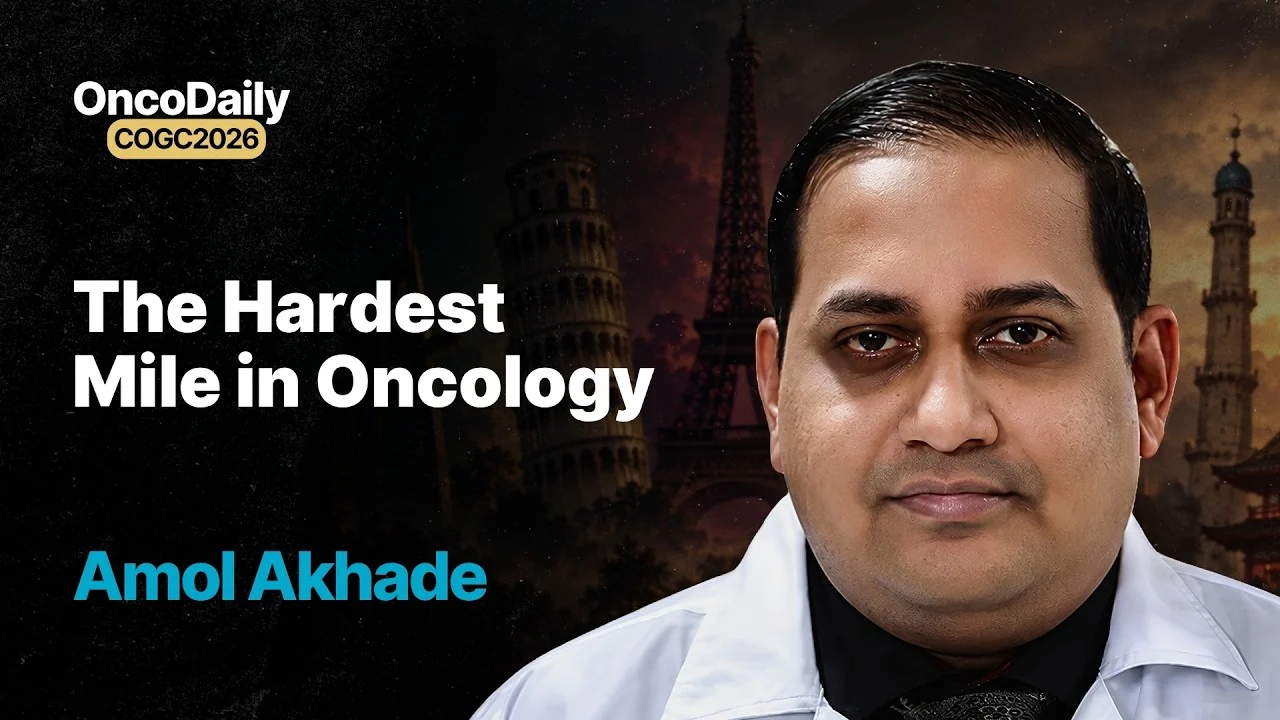
At the Community Oncology Global Congress (COGC 2026), organized by OncoDaily, Amol Akhade, Senior Consultant in Medical Oncology and Precision Oncology at Fortis Hospital, focused on where most cancer care actually happens – and why that matters as oncology becomes more complex.
Community oncology is often described as the place where discoveries made elsewhere are implemented. Akhade argued that this understates its role. Patients may be spread across cities, towns, and rural communities, while expertise, research, and innovation remain concentrated in a relatively small number of major centers.
The challenge is therefore not simply to generate better evidence. It is to make sure that evidence, expertise, and new treatments actually reach the places where patients are receiving care.
“The patients are distributed. They are not centered at one center of excellence, but the evidence and the innovation is concentrated at one or two centers. The system needs to get decentralized – not only the patient, but also the knowledge economy.”
The Community Oncologist Is Doing More With Less Time
Akhade described the community oncologist as much more than the person who selects treatment.
In smaller or less-developed centers, the same physician may be responsible for diagnosis, ordering and interpreting tests, coordinating care, managing toxicity, documenting the encounter, and navigating increasingly complicated treatment decisions.
“The community oncologist has to do too many tasks.
You are the one who is going to do diagnosis, then order the test, interpret them, manage the toxicity. You are the coordinator also. You are the one who is going to document also.”
At the same time, oncology itself is becoming harder to keep up with.
Guidelines change frequently. New drugs and indications appear rapidly. Precision oncology generates increasingly detailed molecular reports. And unlike highly specialized tertiary centers, a community oncologist may be treating breast, gastrointestinal, head and neck, genitourinary, and hematologic malignancies in the same clinic.
“The question is not, what can I give?
The question is, what should I give?
I have so many options. I have ADCs, I have immunotherapies, I have targeted therapies.
Options are multiplying faster than certainty.”
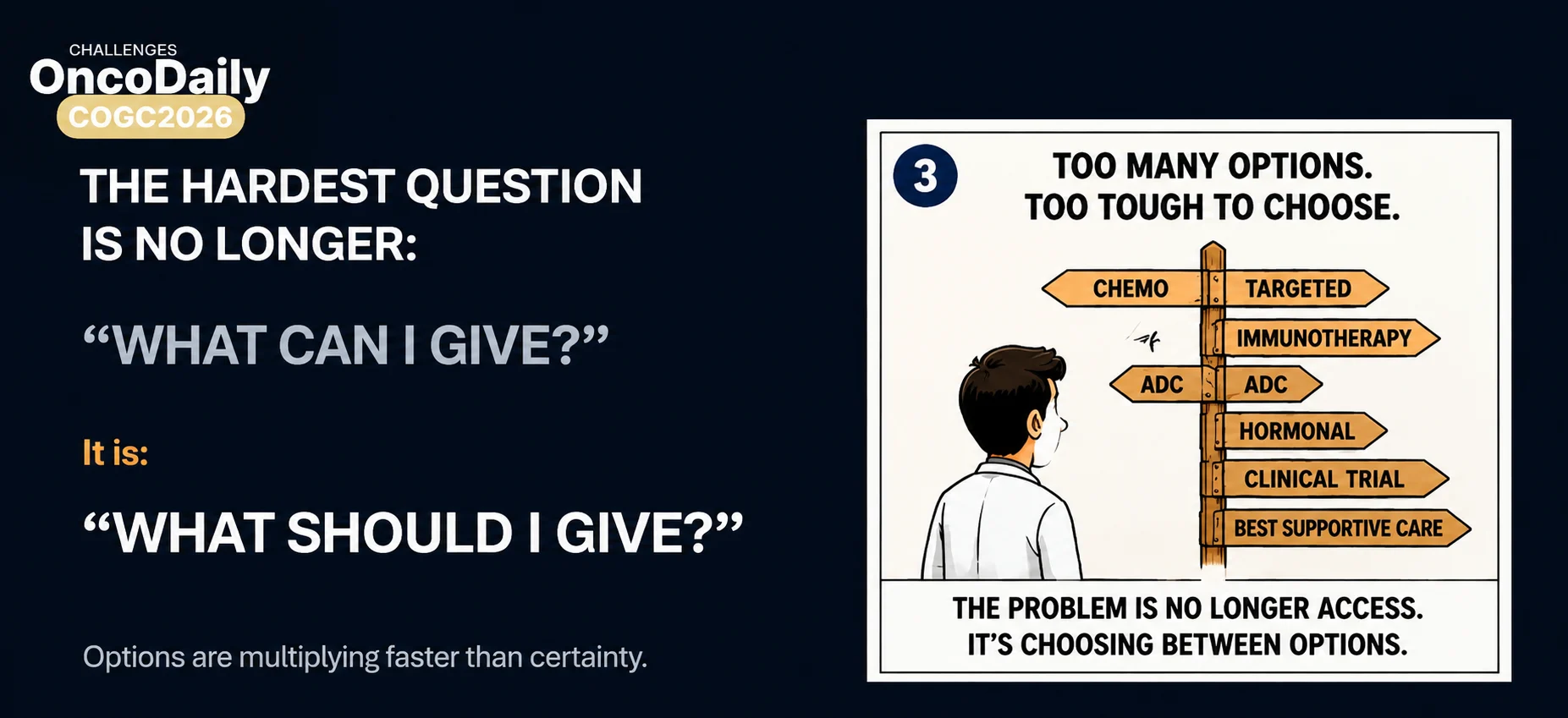
Akhade joked that precision medicine can sometimes become “precision confusion” at the community level – particularly when a molecular test identifies a variant and the oncologist must then determine whether it is actionable, which treatment is supported by evidence, and whether the patient can actually access it.
The Patient Did Not Read the Guidelines
Clinical guidelines may describe the ideal treatment pathway, but real-world patients rarely arrive as ideal trial participants.
“My patient did not read the guidelines.
He comes with so many other issues. He may be elderly, he may have borderline performance status, he may have comorbidities, he may have financial issues, he may have complex life and social issues.”
Akhade called the real world “the subgroup nobody randomized.”
Those differences matter because community oncologists often have to translate evidence generated in highly selected trial populations into decisions for patients with comorbidities, limited finances, competing priorities, or restricted access to supportive infrastructure.
The arrival of newer therapies makes that translation even more difficult. ADCs, immunotherapies, targeted drugs, and other advanced treatments bring their own toxicities and long-term effects, and community centers need the workforce and systems to manage them safely.
“Demand is rising faster than specialist capacity.
The solution cannot be to send everyone to a tertiary center.”
New Treatments Mean Little if Patients Cannot Reach Them
Access is not limited to geography.
Clinical trials remain concentrated in tertiary centers, creating another divide between where research happens and where many patients receive treatment.
“Some patients cannot travel to tertiary centers, so we require the trials to come to community centers.”
Akhade called for more decentralized studies, stronger research capacity within community practices, and closer collaboration between academic and community centers.
The same problem appears with drug costs.
Patients increasingly ask not only whether a therapy works, but whether they can afford it. Community oncologists may therefore find themselves discussing treatment efficacy and financial feasibility in the same consultation.
“The patient says, not just, ‘Will it work?’ but, ‘Can I afford it?’”
Insurance approvals, pre-authorizations, documentation, and reimbursement add yet another layer – particularly for standalone practices without large administrative teams.
AI Can Help, but It Cannot Carry the Clinic
Akhade sees artificial intelligence as one possible way to relieve some of that burden.
Trial matching, clinical decision support, documentation, and data extraction could all become easier with better digital tools.
But he was equally clear about the limitations.
“AI can help. It can find matching trials, it can have decision support, documentation, data extraction.
But at the same time, AI also has hallucinations, bias, automation bias.
AI can assist oncologists, but the community oncologist needs to be trained in how to use that AI.”
The goal is not to replace clinical judgment. It is to return time and cognitive space to physicians already managing an increasingly complex workload.
The Hardest Mile Is the Last One
For Akhade, the central challenge in modern oncology is no longer simply discovery.
“The hardest mile is going from evidence to guidelines, from guidelines to clinic, and reaching clinic to the patient.
The last mile is always the hardest mile.”
That led to the strongest line of his presentation:
“The next breakthrough may not be another drug. It may be getting the breakthrough we already have across the hardest mile.”
His solutions focused on making that last mile shorter: bring clinical trials closer to patients, build research capacity in community centers, connect academic and community expertise, invest in workforce and digital infrastructure, and recognize the value of real-world evidence generated in community practice.
Community oncologists, he argued, have a particular advantage when it comes to real-world evidence. They see large numbers of patients, often over long periods, including the complex patients who would never have qualified for a clinical trial.
“What happens after the trial ends is often learned in the community.”
Akhade closed with collaboration rather than competition.
“Community oncologists, industry, academic oncologists, technology, patients – all have to come together.
The future of oncology lies not only in standalone efforts, but in connecting.”
The science may start at a center of excellence.
But for most patients, its value is ultimately decided somewhere else: in the clinic where that evidence has to become real care.
Written by Eliz Baloyan, MD, Features Writer and Editor at OncoDaily and CancerWorld