 Algeria
Key takeaways
- Control the secretory syndrome first: somatostatin analogues for carcinoid, glucagonoma, and VIPoma; PPIs for Zollinger-Ellison; diazoxide and diet for insulinoma.
- Localized well-differentiated NETs are treated with surgery and no adjuvant therapy, whatever the grade or stage.
- Grade 3 well-differentiated NETs (Ki67 above 20%) are not NECs: reference treatment is dacarbazine- or temozolomide-based chemotherapy, not platinum-etoposide.
- Pancreatic NETs are more chemosensitive than gastrointestinal NETs; this drives the chemotherapy-first logic in duodeno-pancreatic disease.
- Patients on sunitinib need thyroid function monitoring every 3 months.
- Poorly differentiated NECs: etoposide-platinum, maximum 6 cycles; rechallenge is reasonable if progression occurs after a pause of 3 months or more.
Rare, heterogeneous, and often diagnosed late, neuroendocrine neoplasms (NENs) ask more of a multidisciplinary team than almost any other tumor group: the right pathology, the right sequence of treatments, and a clear view of what the patient is actually experiencing.
Neuroendocrine neoplasms account for only about 1% of malignant tumors, yet they are among the most clinically varied. They arise from the diffuse endocrine system, most often (70%) in the digestive tract, and are sporadic in about 95% of cases, with a minority occurring within hereditary syndromes. The 2026 Algerian National Therapeutic Guidelines in Medical Oncology devote a full chapter to them, built on one organizing idea: neuroendocrine neoplasms are treated on two parallel tracks, an anti-secretory track for hormone-driven symptoms and an anti-tumor track for the cancer itself.
Pathology Sets the Pathway
Diagnosis rests on pathology, with classification by grade, mitotic index, and Ki67 (WHO 2019). That classification is not a formality. It separates two very different diseases:
- Well-differentiated neuroendocrine tumors (NETs): often indolent, usually of better prognosis
- Poorly differentiated neuroendocrine carcinomas (NECs): more aggressive, with a poor prognosis, and managed with a different treatment pathway
The guideline also singles out a middle category that is easy to mishandle: well-differentiated grade 3 NETs, defined by good differentiation with a Ki67 above 20%, most often pancreatic. Despite their high proliferation rate, well-differentiated grade 3 NETs are distinct from poorly differentiated NECs. The 2026 Algerian guidelines identify dacarbazine- or temozolomide-based chemotherapy as the reference treatment for grade 3 NETs, rather than the platinum-etoposide regimen used for NECs.
As with every cancer in the 2026 guidelines, management is multidisciplinary and decided in an RCP.
Track One: Treat the Syndrome First
In functioning tumors, the guideline is explicit: anti-secretory treatment takes priority, with the choice determined by the clinical syndrome.
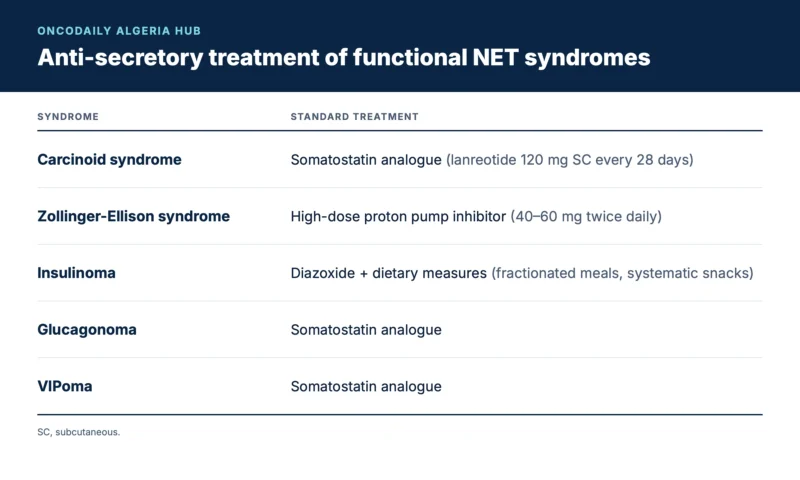
For refractory carcinoid syndrome, tumor debulking surgery or radiofrequency ablation are options. The practical point is that a patient’s symptoms (flushing, diarrhea, hypoglycemia, refractory ulcers) can be controlled while the oncologic strategy is being worked out, and they should be.
Track Two: The Anti-Tumor Strategy
Localized well-differentiated NETs: surgery, and no adjuvant therapy
For localized well-differentiated neuroendocrine tumors, surgery is generally the treatment of choice, although surveillance may be appropriate for selected small, asymptomatic, low-grade tumors. The 2026 Algerian guidelines do not recommend adjuvant treatment following complete resection, regardless of grade or pathological stage. The surgical approach then depends on the site:
- Gastric NETs: management depends on the three-type classification. Types I and II under 2 cm are candidates for endoscopic resection; larger tumors need surgical resection with lymph node dissection when nodal involvement is suspected. Type III requires oncologic surgery with systematic lymphadenectomy
- Duodenal and ampullary NETs: surgical resection, with endoscopic resection possible under 2 cm
- Pancreatic NETs: resection with systematic lymph node dissection; surveillance can be considered for asymptomatic, low-grade tumors of 2 cm or less, and enucleation for insulinomas of 2 cm or less
- Small bowel NETs: resection with systematic mesenteric lymph node dissection
- Appendiceal NETs: appendectomy, extended to colectomy with node dissection for tumors over 2 cm, grade II, R1 resection, or pT3
- Rectal NETs: endoscopic resection for tumors under 1 cm, grade I, without nodal extension; otherwise surgery with lymph node dissection
Advanced well-differentiated NETs: stratify before treating
For advanced disease, the guideline is built around stratification. Surgery retains a role even in advanced or metastatic disease whenever R0 resection is achievable, and primary tumor surgery is recommended if the primary is symptomatic. Beyond that, treatment choice depends on grade, tumor volume, degree of liver involvement, and primary site, and can range from simple surveillance to peptide receptor radionuclide therapy.
Lower-burden disease (Ki67 under 10%, asymptomatic, liver involvement under 50%): a somatostatin analogue is the standard, or surveillance alone if the disease is minimal, asymptomatic, and slowly evolving.
Higher-burden or progressing disease (Ki67 of 10% or more, symptomatic, liver involvement above 50%, or progression on a somatostatin analogue) branches by primary site:
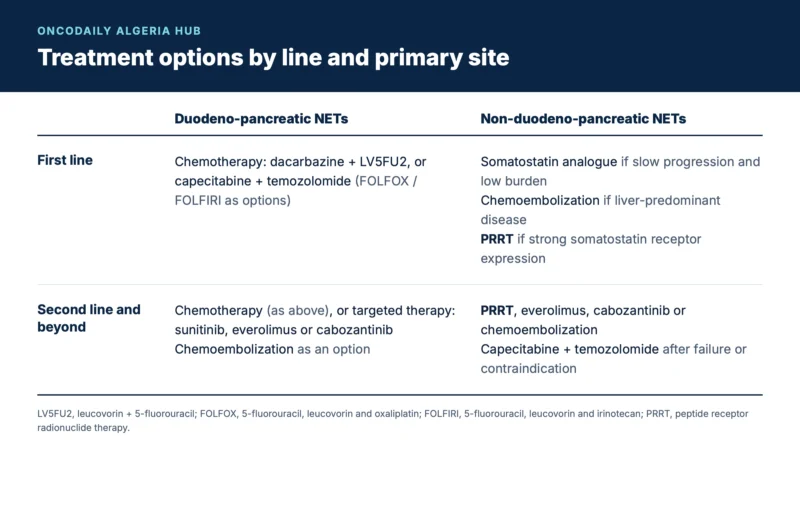
Two details are worth underlining. First, the guideline notes that pancreatic NETs are more chemosensitive than gastrointestinal tract tumors, which is why the chemotherapy-first logic applies mainly to the duodeno-pancreatic group. Second, if disease control is achieved, a therapeutic pause under close surveillance can be considered, and somatostatin analogue maintenance can follow induction chemotherapy or targeted therapy.
Poorly differentiated NECs: a different playbook
For NECs, the approach is chemotherapy-centered. Localized disease is treated with oncologic surgery and lymph node dissection followed by 3 to 4 cycles of adjuvant etoposide plus platinum (cisplatin or carboplatin). In advanced disease, etoposide-platinum for a maximum of 6 cycles is the first-line standard, and the same protocol can be reintroduced if progression occurs after a treatment-free interval of 3 months or more; progression within 3 months moves the patient to second-line treatment, for which there is no standard.
Monitoring Matters as Much as Treating
The guideline is practical about monitoring during treatment: clinical examination and laboratory work-up before each cycle, conventional imaging (CT or abdominal MRI) with or without functional imaging, and, for patients on sunitinib, a thyroid function check every 3 months or as clinically indicated. After treatment, follow-up schedules differ by disease: grade I-II well-differentiated NETs are followed at 3-6 months, then 6-12 months for 5 years, then annually for 10 years, reflecting their long natural history, while NECs and grade 3 NETs require far tighter early surveillance.
The Algerian Context: What the Documents Show
Rare tumors expose infrastructure gaps quickly, because several steps in the NEN pathway depend on technology and expertise that few centers have. Two sources help frame this, and it is worth being precise about what they do and do not say.
Functional imaging capacity. The Dashboard reports Algeria’s PET capacity as 8 PET scanners and 2 PET-MRI units, and places PET density in the lowest bracket (0-1 per million population) on the IAEA IMAGINE database, similar to Egypt and Jordan. The 2025 National Strategy sets a medium-term target of 1 PET-CT per million inhabitants, through redeployment of existing equipment and equipping nuclear medicine departments that lack one.
Radiopharmaceuticals and nuclear medicine. The National Strategy also addresses the regulatory and logistical barriers around radiopharmaceuticals: authorization timelines, a national framework for cyclotrons and radiopharmaceutical production under GMP standards, decentralized distribution, and easier transport to the south of the country. These recommendations appear in the strategy’s section on hematologic cancers, but the constraints they describe (supply, authorization, and delivery of radiopharmaceuticals) are the same ones that determine whether a radionuclide-based approach is feasible for any tumor type.
What these documents do not establish is how many Algerian patients can currently access PRRT, or where. The guideline recommends it for well-differentiated neuroendocrine tumors with strong somatostatin receptor expression, but whether and where it can be delivered is not specified in the Dashboard or the Strategy, and that is a question worth asking before assuming the recommendation is deliverable everywhere. More broadly, the Dashboard documents a lag between EMA approval and Algerian registration of new cancer medicines (16 of 60 approved between 2015 and 2020, or 27%, registered as of March 2025), which makes verifying local availability of each recommended agent a routine part of RCP planning.
Clinical Perspective
The neuroendocrine chapter of the 2026 guidelines reads as a lesson in not treating a heterogeneous group as a single disease. Pathology separates indolent neuroendocrine tumors from aggressive neuroendocrine carcinomas, and grade 3 well-differentiated neuroendocrine tumors from both. Symptom control and tumor control run in parallel. Advanced disease is managed by stratifying burden and primary site before choosing among surveillance, somatostatin analogues, chemotherapy, targeted therapy, chemoembolization, and radionuclide therapy.
For Algerian clinicians, the practical implication is that the quality of a NEN pathway depends heavily on what happens before treatment starts: expert pathology with reliable Ki67, a functional imaging pathway that patients can actually reach, and an RCP that includes the specialists needed for the decision. As with other rare tumors, concentrating expertise and building referral pathways may matter as much as adding drugs to the list.
FAQ
Does every well-differentiated NET need treatment as soon as it is found?
No. For lower-burden disease (Ki67 under 10%, asymptomatic, liver involvement under 50%), the guideline allows surveillance alone when disease is minimal and slowly evolving, with a somatostatin analogue started if progression occurs. Small, asymptomatic, low-grade pancreatic NETs of 2 cm or less can also be monitored rather than resected.
Is a high Ki67 always a sign of neuroendocrine carcinoma?
No. A Ki67 above 20% in a well-differentiated tumor defines a grade 3 NET, which is a distinct entity from poorly differentiated NEC and is treated with dacarbazine- or temozolomide-based chemotherapy as the reference approach. This is why differentiation and Ki67 must be read together.
Is adjuvant chemotherapy ever given for neuroendocrine tumors?
For well-differentiated NETs, no: the guideline recommends no adjuvant treatment regardless of grade or stage. For localized poorly differentiated NECs, adjuvant etoposide plus platinum for 3 to 4 cycles is the standard.
What is the "RIV" mentioned in the Algerian guideline?
It stands for radiothérapie interne vectorisée, the guideline's term for peptide receptor radionuclide therapy (PRRT). It is recommended for well-differentiated non-duodeno-pancreatic NETs with strong somatostatin receptor expression, in first line, and again from second line onward.
Is PRRT available to patients in Algeria?
The documents reviewed for this article (the 2026 guideline, the Cancer Dashboard, and the National Strategy) do not specify national availability of PRRT. The guideline recommends it, and the National Strategy addresses radiopharmaceutical logistics and nuclear medicine capacity more broadly, but whether a given patient can access it should be confirmed locally through the RCP.
How long should patients with well-differentiated NETs be followed?
Longer than most cancers. For grade I-II well-differentiated NETs, the guideline proposes follow-up every 3-6 months, then every 6-12 months for 5 years, then annually for 10 years, reflecting their slow natural history and the possibility of late recurrence.