Not every important oncology headline comes from a late-breaking session or a practice-changing trial. Some of the most consequential stories begin much earlier, at the point where new scientific questions are first given the support to be tested. That is what makes the American Cancer Society’s latest funding announcement worth close attention.
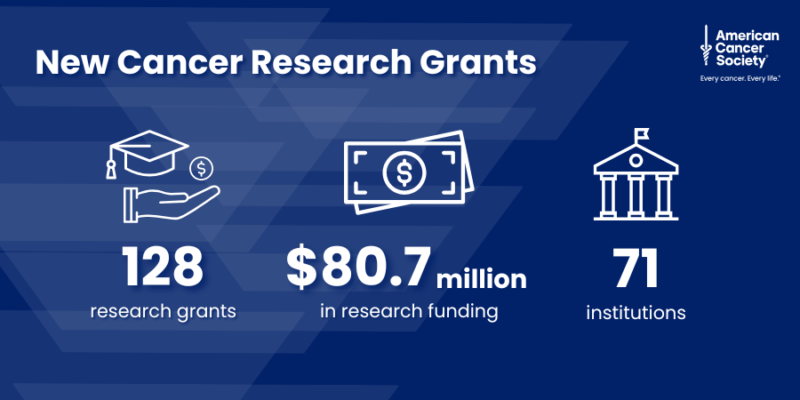
On April 1, 2026, the American Cancer Society announced a new investment of $80.7 million in cancer research grants that will take effect this spring. In total, the organization is funding 128 new grants across 71 institutions in the United States, marking one of the major research funding updates of the season. According to ACS, the new slate reflects a wide range of work spanning cancer prevention, detection, treatment, survivorship, and other areas across the cancer control continuum.
A Major Spring Investment in Cancer Science
The scale of the announcement matters on its own. More than eighty million dollars directed into new research is not simply an administrative update. It is a decision about which scientific ideas will move forward, which investigators will be able to build momentum, and which questions the oncology community will be able to answer in the years ahead. In a field where progress often depends on long timelines, sustained support remains one of the most important determinants of whether promising concepts become meaningful advances for patients.
ACS framed this funding round as an investment in innovation and scientific rigor. In comments accompanying the announcement, Chief Scientific Officer Dr. William Dahut said the slate reflects the “creativity and rigor” of the current cancer research community and emphasized that supporting investigators across institutions helps sustain a research ecosystem capable of expanding what is possible in cancer science. That language is notable because it places the focus not only on individual grants, but also on the broader infrastructure required for discovery.
Why This Announcement Deserves More Than a Passing Mention
Research funding announcements can sometimes be treated as background noise in oncology coverage, especially when they do not yet come with clinical outcomes or patient survival data. But this is exactly the stage where the future of cancer care begins to take shape. Every meaningful advance in screening, translational science, supportive care, precision oncology, survivorship, or therapeutic development depends on earlier investments that made the work possible.
What stands out in this ACS slate is not only the total dollar amount, but also the breadth of institutional reach. Funding 128 grants at 71 institutions suggests a deliberately distributed investment rather than a narrow concentration in only a handful of major centers. That kind of spread matters because it helps support a broader research ecosystem, creates opportunities for investigators working in different settings, and strengthens the national scientific pipeline at a time when cancer research demand continues to grow.
How American Cancer Society Says These Grants Were Chosen
One of the strongest parts of the ACS announcement is its emphasis on process. The organization states that, aside from a small number of targeted requests for applications developed in partnership with other groups, the majority of submissions are investigator-initiated. In practical terms, that means researchers are bringing forward their own strongest ideas rather than responding only to highly prescriptive funding calls.
ACS also notes that its peer review committees include more than 800 expert reviewers, who evaluate applications for innovation, rigor, and promise. Beyond scientific review alone, every application is also assessed by ACS Community Research Partners, with the stated goal of ensuring that funded work has meaningful relevance for patients, survivors, and families. That added layer is important. It signals that contemporary research funding is not being framed only around laboratory or methodological excellence, but also around real-world human impact.
For oncology, this matters. The strongest research programs today are increasingly expected to do more than generate data. They are expected to address questions that matter clinically, matter to patients, and matter across the full continuum of care. ACS is clearly presenting this slate as aligned with that broader vision.
The Surge in Applications Tells Its Own Story
Another detail in the announcement deserves attention: ACS reported that the applications selected for this cycle were largely submitted during the Summer 2025 application window, which received almost twice as many applications as the previous cycle. That single point says a great deal about the current research environment.
A near doubling in applications can be read as a sign of demand, urgency, and scientific energy. It suggests that investigators are generating more ideas, seeking more support, and competing more intensely for limited resources. In that setting, a large funding round does more than reward excellence. It also helps prevent momentum from being lost. When promising projects go unsupported, the field does not simply pause; it risks delaying discoveries that may later influence prevention strategies, diagnostic tools, treatment paradigms, or survivorship care.
Seen through that lens, the ACS announcement is not only good news for this year’s grantees. It is also a reminder of how much unmet demand exists within the research community, and how essential philanthropic and nonprofit funding remains to maintaining continuity in cancer science.
A Legacy That Gives This Funding Additional Weight
ACS is not positioning this announcement in isolation. The organization states that it is the largest non-government, non-profit funder of cancer research in the United States, with more than 825 active research grants across the cancer control spectrum. It also places these new awards within a much longer institutional history, noting that its research legacy stretches back to 1946 and includes 53 Nobel Prize winners whose work was supported along the way.
That legacy gives the spring 2026 slate added significance. These are not just new grants entering an empty system. They are becoming part of a long-standing funding architecture that has helped shape major parts of modern cancer research. For young investigators, established laboratories, and multidisciplinary teams alike, ACS support carries both practical value and symbolic weight. It offers funding, but it also places a project inside a tradition of nationally visible scientific investment.
What This Means for Patients, Even Before Results Arrive
Patients will not feel the effect of these grants overnight. That is not how research works. But this kind of funding is part of the reason future patients may eventually encounter better prevention strategies, earlier diagnosis, more precise treatments, stronger survivorship programs, and better quality-of-life outcomes.
The announcement itself emphasizes the full spectrum of cancer research, from prevention and detection to treatment and survivorship. That is important because the burden of cancer is not defined only by what happens in the infusion chair or the operating room. It also includes early risk reduction, equitable access to screening, symptom control, long-term monitoring, and the many physical and emotional consequences of living after cancer. Funding across that spectrum reflects a more mature understanding of what meaningful progress in oncology really looks like.
More Than A Funding Update
The ACS spring 2026 grant slate is, on the surface, a funding announcement. But at a deeper level, it is a statement about priorities. It says that bold ideas are still worth backing, that scientific review still matters, that patient relevance should be part of research evaluation, and that the cancer research enterprise needs sustained support if it is going to keep moving forward.
In a moment when oncology continues to evolve rapidly, investments like this one are easy to underestimate because their outcomes are still in the future. Yet this is exactly where the future begins. With $80.7 million, 128 new grants, and 71 institutions involved, ACS has done more than expand its portfolio this spring. It has helped give the next wave of cancer research a place to start.
Discover more articles like this on OncoDaily.
Written by Nare Hovhannisyan,MD