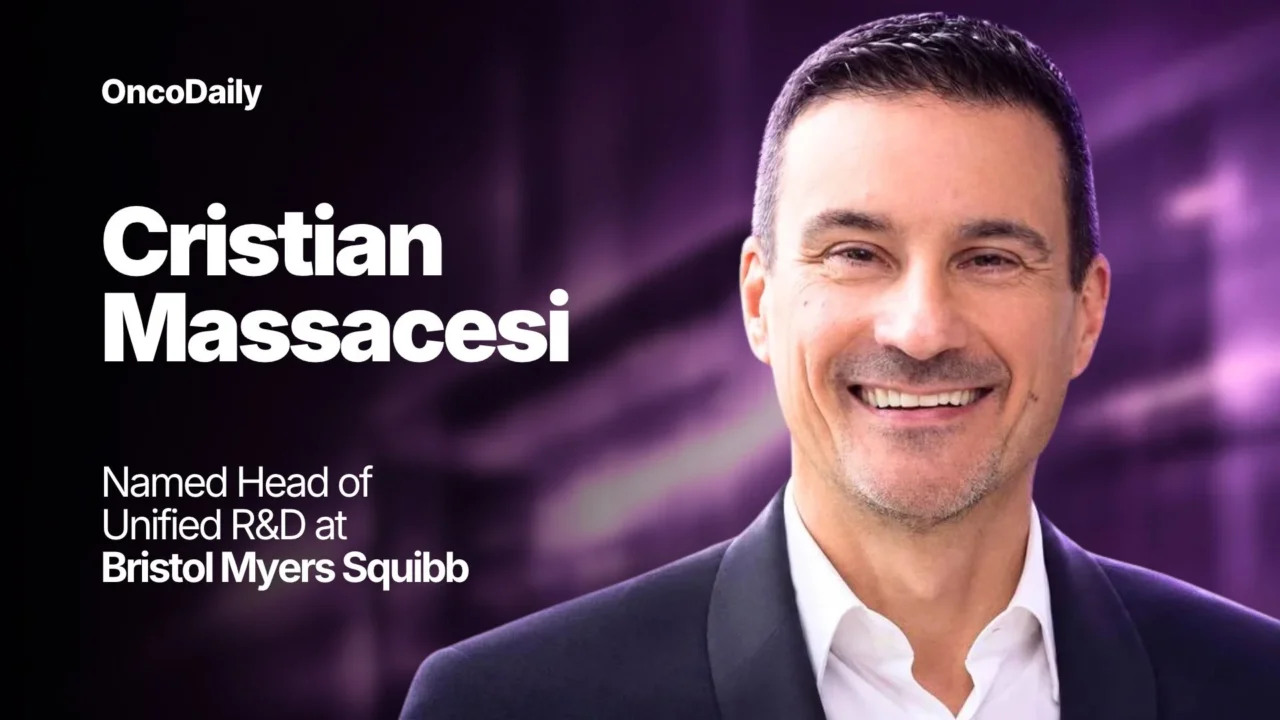
Bristol Myers Squibb (BMS) is bringing its research and drug development operations together under one organization, appointing Cristian Massacesi, MD, to lead the combined R&D division effective January 1, 2027.
The restructuring, announced November 12, 2026, marks a significant leadership transition at the pharmaceutical company as it seeks to accelerate decision-making, strengthen scientific collaboration and improve the execution of its drug development pipeline.
As part of the transition, Robert Plenge, MD, PhD, the company’s Executive Vice President and Chief Research Officer, will leave BMS after remaining in an advisory capacity through March 2027.
The announcement comes as BMS continues working to strengthen its pipeline amid increasing pressure from upcoming patent expirations and the need to develop new sources of growth.
Christopher Boerner: A New Approach to Research and Development
Christopher Boerner, PhD, Board Chair and Chief Executive Officer of Bristol Myers Squibb, described the reorganization as an important step in positioning the company for long-term growth.
Boerner said the unified structure would connect scientific and clinical expertise more closely, allowing the company to make faster decisions and improve the execution of its research portfolio. He emphasized that “traditional boundaries between research and development are collapsing”, reflecting the growing need for collaboration throughout the drug development process.
The CEO also pointed to the importance of attracting scientific talent, developing new capabilities and incorporating emerging technologies into pharmaceutical research.
The move brings BMS closer to the organizational model used by several other major pharmaceutical companies, where research and clinical development operate under a single leadership structure.
Cristian Massacesi to Lead the Next Phase of BMS R&D
Massacesi, currently Executive Vice President, Chief Medical Officer and Head of Development, will take responsibility for the unified organization at the beginning of 2027.
A medical oncologist with extensive international pharmaceutical experience, Massacesi previously held leadership positions at AstraZeneca, Pfizer and Novartis. Before joining BMS in August 2025, he served as Chief Medical Officer at AstraZeneca and Alexion.
Responding to his appointment, Massacesi highlighted the scientific opportunities ahead and the importance of maintaining momentum across BMS’s existing pipeline while developing future treatments. He said the integration would help the company “translate our most promising discoveries into medicines for patients” more efficiently.
Massacesi also acknowledged Plenge’s contribution to the research organization and expressed appreciation for their collaboration during the transition.
In a separate LinkedIn statement, Massacesi shared his personal perspective on the new role, emphasizing that the benefits of integration extend beyond organizational efficiency.
He wrote that closer collaboration between discovery and clinical development would improve decisions, accelerate progress and ultimately benefit patients.
His appointment places an experienced oncology development leader at the center of the company’s global R&D strategy, overseeing activities from early scientific discovery through clinical development.
Robert Plenge to Depart After Supporting the Transition
Plenge’s departure marks the end of an important chapter in BMS’s research leadership.
He joined Bristol Myers Squibb following its acquisition of Celgene in 2019 and became the company’s Chief Research Officer in July 2023. In his statement, Plenge expressed pride in the research team’s achievements and described his time working alongside BMS scientists as a professional honor.
Importantly, Plenge confirmed that he and Massacesi had “developed this new R&D structure in partnership”, presenting the reorganization as a collaborative effort rather than simply a leadership replacement.
He expressed confidence that the changes would serve both the company and patients, while reaffirming his support for the transition.
Plenge will continue advising the company through March 2027 to help ensure continuity as the two organizations come together.
What the Restructuring Means for Oncology Drug Development
The decision carries particular significance for Bristol Myers Squibb’s oncology and hematology pipeline, which includes immunotherapies, targeted treatments, cellular therapies and other investigational approaches.
Bringing research and clinical development under one leadership team could allow scientific discoveries to be evaluated alongside clinical feasibility, biomarker strategies and patient needs earlier in the development process.
For oncology, where increasingly complex clinical trials require coordination between laboratory scientists, translational researchers and clinical investigators, closer integration could help streamline development decisions.
The restructuring also comes at a critical period for BMS. The company faces growing pressure to replenish future revenue as major medicines, including nivolumab and apixaban, approach important patent and exclusivity milestones.
A more integrated research structure could support decisions about which investigational treatments deserve further investment and how promising candidates move through the development pipeline.
However, organizational integration does not automatically translate into faster drug approvals or better clinical outcomes. The effectiveness of the new model will depend on how successfully BMS implements the changes and whether they lead to measurable improvements in research productivity.
A New Chapter for Bristol Myers Squibb
Beginning January 1, 2027, Massacesi will oversee a unified organization intended to connect scientific discovery, clinical development, and strategic decision-making across BMS’s therapeutic portfolio.
The transition also reflects a wider shift within the pharmaceutical industry toward more closely integrated R&D operations, particularly as companies seek to manage increasingly complex scientific pipelines.
For Bristol Myers Squibb, the central challenge will be translating the anticipated operational benefits into meaningful progress for its investigational medicines.
With Massacesi preparing to assume leadership and Plenge supporting the transition, the restructuring marks a significant moment in the company’s research strategy, with potential implications for the future of its oncology and hematology programs.
Read further on OncoDaily: Bristol Myers Squibb to Invest $2.3 Billion in New Houston Manufacturing Campus