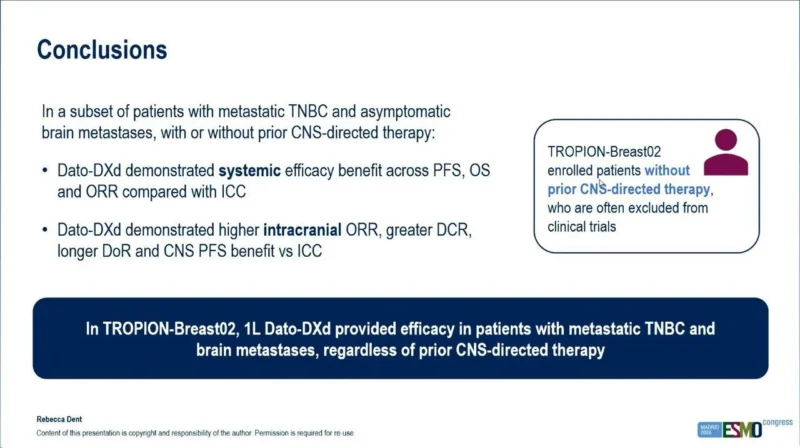
Datopotamab deruxtecan has shown clinically meaningful systemic and intracranial activity in patients with metastatic triple-negative breast cancer and baseline brain metastases, including patients who had not previously received CNS-directed therapy.
New exploratory results from the phase III TROPION-Breast02 trial, presented at ESMO Congress 2026, showed that first-line datopotamab deruxtecan (Dato-DXd) improved progression-free survival, response rates, and CNS disease control compared with investigator’s choice chemotherapy in patients with asymptomatic, stable brain metastases.
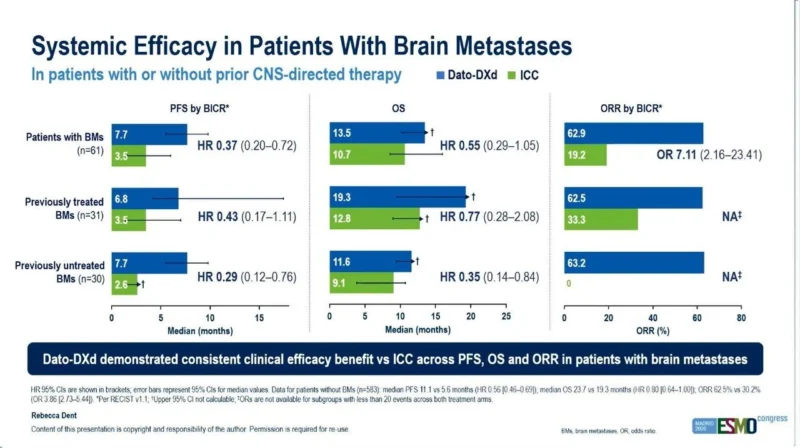
In the final presentation, 61 patients had baseline brain metastases. Median systemic progression-free survival was 7.7 months with Dato-DXd compared with 3.5 months with chemotherapy, corresponding to an HR of 0.37 (95% CI 0.20–0.72).
Median overall survival was 13.5 versus 10.7 months, with an HR of 0.55, while systemic objective response rate reached 62.9% with Dato-DXd compared with 19.2% with chemotherapy.
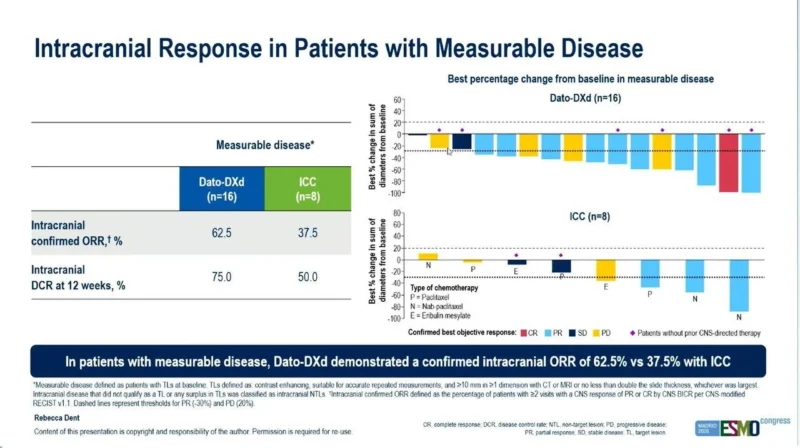
The CNS-specific analysis was also encouraging. Among patients with measurable intracranial disease, confirmed intracranial objective response rate was 62.5% with Dato-DXd versus 37.5% with chemotherapy, while 12-week intracranial disease control rates were 75.0% and 50.0%, respectively.
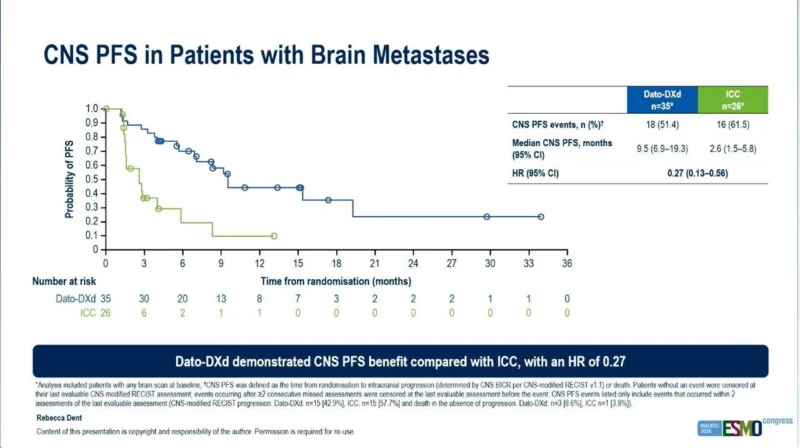
Perhaps most importantly, median CNS progression-free survival reached 9.5 months with Dato-DXd compared with 2.6 months with chemotherapy, corresponding to an HR of 0.27 (95% CI 0.13–0.56). The results suggest that Dato-DXd can produce meaningful CNS disease control in a population that remains difficult to treat and is frequently underrepresented in first-line metastatic breast cancer trials.
Brain Metastases Remain a Major Challenge in TNBC
Triple-negative breast cancer carries a particularly high risk of central nervous system involvement. Brain metastases may occur relatively early in the metastatic disease course and are associated with substantial morbidity, reduced quality of life, and poor prognosis.
Patients with brain metastases have historically been excluded from many registration trials, particularly when lesions have not yet been locally treated. That exclusion has created a persistent evidence gap.
A therapy may demonstrate strong extracranial activity but still have uncertain ability to penetrate or control disease within the CNS. For patients with TNBC, this distinction matters because systemic progression and intracranial progression may behave differently and may require different treatment strategies.
TROPION-Breast02 therefore provides important information beyond its overall phase III efficacy result because the trial permitted patients with asymptomatic, stable brain metastases, including some who had not previously received radiotherapy or another CNS-directed intervention.
TROPION-Breast02 Established Dato-DXd as an Active First-Line ADC Strategy
TROPION-Breast02 randomized patients with previously untreated locally recurrent inoperable or metastatic TNBC who were not candidates for immunotherapy to Dato-DXd or investigator’s choice chemotherapy.
Dato-DXd was administered at 6 mg/kg every three weeks, while chemotherapy options included paclitaxel, nab-paclitaxel, capecitabine, carboplatin, or eribulin.
In the overall 644-patient population, Dato-DXd had already demonstrated statistically significant improvements in both progression-free and overall survival. The overall PFS HR was 0.57, while the OS HR was 0.79. Confirmed objective response rate was approximately 63% with Dato-DXd versus 29% with chemotherapy.
Those results established the efficacy of Dato-DXd in first-line metastatic TNBC for patients who were not candidates for immune checkpoint inhibition. The ESMO 2026 analysis addressed a more difficult question: whether that benefit extends to patients whose disease has already reached the CNS.
Systemic PFS Benefit Was Maintained in Patients With Brain Metastases
Among the 61 patients with baseline brain metastases in the final ESMO presentation, Dato-DXd maintained a substantial systemic efficacy advantage. Median PFS was 7.7 months with Dato-DXd compared with 3.5 months with investigator’s choice chemotherapy.
The HR of 0.37 corresponds to an approximately 63% reduction in the hazard of systemic progression or death. The magnitude of the relative treatment effect was therefore at least directionally consistent with, and numerically greater than, that observed in the overall study population.
Objective response also strongly favored Dato-DXd. Systemic ORR was 62.9% with Dato-DXd versus 19.2% with chemotherapy, corresponding to an odds ratio of approximately 7.1.
The finding suggests that the presence of brain metastases did not eliminate the substantial extracranial antitumor activity of the ADC.
Patients With Untreated Brain Metastases Showed a Particularly Strong Signal
One of the most important features of the analysis was inclusion of patients whose brain metastases had not previously received CNS-directed treatment. Thirty patients in the final presentation had untreated brain metastases at baseline.
In this subgroup, median systemic PFS was 7.7 months with Dato-DXd compared with 2.6 months with chemotherapy. The HR was 0.29 (95% CI 0.12–0.76). Median overall survival was 11.6 versus 9.1 months, with an exploratory HR of 0.35 (95% CI 0.14–0.84).
Systemic ORR reached 63.2% with Dato-DXd, while no objective responses were reported with chemotherapy in this small subgroup. These numbers are striking, but they require caution.
The subgroup was small, analyses were exploratory, and patients had asymptomatic, stable CNS disease rather than symptomatic or neurologically unstable metastases.
Nevertheless, including untreated brain metastases is clinically important because such patients are commonly excluded from registration trials or required to undergo local therapy before receiving study treatment. The data therefore offer prospective evidence that Dato-DXd can produce clinically meaningful activity even before CNS-directed treatment in selected patients.
Benefit Was Also Seen After Prior CNS Treatment
Among 31 patients who had previously received CNS-directed therapy, Dato-DXd also demonstrated benefit. Median systemic PFS was 6.8 months with Dato-DXd versus 3.5 months with chemotherapy, with an HR of 0.43. Median OS was 19.3 versus 12.8 months, while systemic ORR was 62.5% versus 33.3%.
The confidence intervals were wide because of the small sample size, but the direction of treatment effect again favored Dato-DXd.
The consistency between previously treated and untreated CNS subgroups suggests that systemic activity was not restricted to patients whose intracranial disease had already been controlled by radiation or another local intervention.
Intracranial Response Provides Direct Evidence of CNS Activity
The most clinically compelling part of the ESMO update comes from patients with measurable intracranial disease. Sixteen Dato-DXd-treated patients and eight chemotherapy-treated patients had measurable CNS lesions suitable for response assessment.
Confirmed intracranial ORR was:
- 62.5% with Dato-DXd
compared with
- 37.5% with chemotherapy
The 12-week intracranial disease control rate was 75.0% versus 50.0%. Responses with Dato-DXd included deep reductions in measurable CNS tumor burden, including a confirmed complete response.
This is important because systemic efficacy alone cannot establish that a drug is directly controlling intracranial disease. A patient can experience extracranial tumor shrinkage while brain metastases remain stable or progress.
The measurable CNS response data therefore provide more direct evidence that Dato-DXd has activity against intracranial TNBC lesions.
CNS PFS Reached 9.5 Months
The CNS progression-free survival analysis strengthens that conclusion. Among patients with baseline brain imaging included in the CNS PFS analysis, median CNS PFS was:
- 9.5 months with Dato-DXd
versus
- 2.6 months with chemotherapy
The HR was:
- 0.27
- 95% CI 0.13–0.56
This represents an approximately 73% reduction in the hazard of intracranial progression or death. The separation between the curves appeared early and persisted over time, with a proportion of Dato-DXd-treated patients remaining free from CNS progression beyond one year.
For a disease such as metastatic TNBC, where CNS progression can rapidly affect neurological function and treatment options, prolonging intracranial disease control may have substantial clinical value.
Why ADC Activity in the Brain Matters
Historically, the blood-brain barrier was considered a major obstacle to delivery of large antibody-based therapies into the CNS. The biology of established brain metastases is more complex.
Tumor-associated disruption of the blood-tumor barrier can permit greater penetration of systemic therapies than would occur across an intact blood-brain barrier. Modern ADCs may therefore achieve clinically relevant intracranial exposure, particularly within established metastatic lesions.
Evidence of CNS activity has increasingly emerged across several ADC platforms in breast cancer. TROPION-Breast02 now adds Dato-DXd to that discussion and suggests that TROP2-directed ADC therapy can provide both systemic and intracranial benefit in metastatic TNBC.
The finding is especially relevant because TROP2 is broadly expressed across TNBC and does not require a rare genomic alteration or highly selected biomarker-defined subgroup.
The Analysis Does Not Establish That Local CNS Therapy Can Be Avoided
The untreated brain metastasis data are clinically provocative, but they should not be interpreted as demonstrating that radiotherapy or surgery can routinely be omitted. Patients enrolled in TROPION-Breast02 had asymptomatic and stable brain metastases.
The study did not test Dato-DXd against stereotactic radiosurgery, whole-brain radiotherapy, or neurosurgery, and it did not enroll the full spectrum of patients with symptomatic, rapidly progressing, or neurologically unstable CNS disease.
Local treatment remains essential for many patients based on lesion size, location, symptoms, edema, neurological risk, and number of metastases.
The more appropriate implication is that Dato-DXd may provide an effective systemic treatment backbone with meaningful CNS activity, potentially giving clinicians greater flexibility when treating selected patients with stable brain metastases.
Prospective trials specifically designed around CNS treatment sequencing will be required before defining when systemic ADC therapy can safely defer or reduce the need for local intervention.
Small Patient Numbers Remain the Main Limitation
The brain metastasis analysis was exploratory. Only 61 patients in the final ESMO presentation had baseline brain metastases, and the measurable intracranial disease analysis contained only 24 patients. Subgroups divided by previous CNS-directed therapy were even smaller.
As a result, hazard ratios and response rates can change substantially with relatively few additional events. These findings should therefore be interpreted as strong evidence of activity rather than definitive proof of the optimal CNS treatment strategy.
Importantly, the results are internally consistent. Systemic PFS, systemic ORR, CNS PFS, intracranial ORR, and disease control all moved in the same direction. That consistency makes the overall biological signal more persuasive despite the modest sample size.
Dato-DXd Is Expanding the Role of ADCs in CNS Disease
The treatment of brain metastases is becoming increasingly relevant to how breast cancer ADCs are differentiated. As systemic disease control improves, CNS progression may become a more prominent determinant of long-term outcomes.
An ADC that controls extracranial disease but has little intracranial activity may leave the brain as a sanctuary site. Conversely, therapies capable of controlling both compartments can potentially simplify treatment sequencing and delay neurological progression.
TROPION-Breast02 suggests that Dato-DXd belongs in the latter category, at least for selected patients with stable metastatic TNBC and brain involvement.
The next question is whether these results can be reproduced in larger cohorts and in patients with more active CNS disease.
OncoDaily Takeaway
The ESMO 2026 brain metastasis analysis adds an important new dimension to TROPION-Breast02. Dato-DXd had already demonstrated superior first-line PFS, OS, and response rate compared with chemotherapy in metastatic TNBC when immunotherapy was not an option.
The new data show that this benefit extends to patients with brain metastases. Among 61 patients with baseline CNS disease, median PFS was 7.7 months with Dato-DXd versus 3.5 months with chemotherapy, with an HR of 0.37. Systemic ORR was 62.9% versus 19.2%.
In patients with measurable intracranial disease, confirmed CNS ORR reached 62.5% compared with 37.5%, and CNS PFS increased from 2.6 to 9.5 months, with an HR of 0.27.
The signal was also evident in patients who had not previously received CNS-directed therapy, a population often excluded from clinical trials. The findings should remain hypothesis-generating because patient numbers were small and all enrolled CNS disease was asymptomatic and stable.
But taken together, the systemic and intracranial results suggest that Dato-DXd is not simply controlling extracranial TNBC while leaving the CNS untreated—it has clinically meaningful activity in both compartments.
That may become an increasingly important distinction as ADCs move earlier in metastatic TNBC and CNS disease becomes a central part of treatment selection and sequencing.
Source
- Dent RA, et al. First-line datopotamab deruxtecan versus chemotherapy in patients with locally recurrent inoperable or metastatic triple-negative breast cancer for whom immunotherapy was not an option: Exploratory analysis of patients with brain metastases in TROPION-Breast02. Presented at ESMO Congress 2026, October 24, 2026. Clinical trial identifier NCT05374512.