
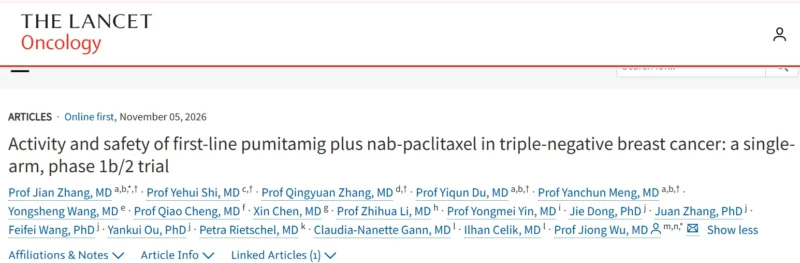
Pumitamig in triple-negative breast cancer may be the next step in moving immunotherapy beyond PD-L1 selection. In a single-arm phase 1b/2 trial published online in The Lancet Oncology on November 5, 2026, first-line pumitamig plus nab-paclitaxel produced a confirmed objective response rate of 73.8% in patients with advanced or metastatic triple-negative breast cancer (TNBC). The study was led by Jian Zhang and colleagues at ten centres in China.
The result comes from 42 patients. But it is the first peer-reviewed full report of a PD-L1 × VEGF-A bispecific antibody in breast cancer, and it arrives while the drug’s global phase III program is already under way.
Checkpoint Inhibition Still Leaves Many TNBC Patients Behind
Immune checkpoint inhibitors have improved outcomes in TNBC in both early and metastatic disease. In the metastatic setting, however, their benefit with chemotherapy is largely restricted to PD-L1–positive tumours. Most patients with advanced TNBC do not meet that threshold.
For these patients, first-line treatment has relied on chemotherapy and, more recently, antibody–drug conjugates. Sacituzumab govitecan (ASCENT-03) and datopotamab deruxtecan (TROPION-Breast02) both received FDA approval in 2026 for patients who are not candidates for immunotherapy. OncoDaily covered this in How Systemic Therapy Is Reshaping Breast Cancer Care in 2026.
The open question is whether immunotherapy can be made to work in tumours that are not inflamed enough to respond to PD-(L)1 blockade alone.
What Is Pumitamig?
Pumitamig (BNT327, PM8002, BMS986545) is an investigational bispecific antibody that targets PD-L1 and VEGF-A in a single molecule. It is co-developed by BioNTech and Bristol Myers Squibb.
The rationale combines two mechanisms. PD-L1 blockade restores T-cell activity. VEGF-A neutralisation normalises abnormal tumour vasculature and reduces VEGF-driven immune suppression, potentially making the tumour microenvironment more permissive to immune attack.
The hope is that this dual activity could extend immunotherapy benefit to tumours with low or absent PD-L1 expression. OncoDaily’s Biomarker Landscape of ADCs and Bispecific Antibodies in Breast Cancer places pumitamig within this emerging class of immune-modulating bispecifics.
A Single-Arm Study in Treatment-Naïve Advanced TNBC
The phase 1b/2 trial (NCT05918133; ChiCTR2200060400) enrolled adults aged 18–75 years with histologically documented, unresectable, locally advanced or metastatic TNBC. Patients had not received systemic therapy for advanced disease, had an ECOG performance status of 0 or 1, and had at least one measurable lesion according to RECIST version 1.1.
All patients received pumitamig 20 mg/kg intravenously every 2 weeks plus nab-paclitaxel 100 mg/m² intravenously on days 1, 8, and 15 of each 28-day cycle. Treatment continued until disease progression or unacceptable toxicity.
In phase 1b, six patients were monitored for treatment-emergent adverse events before enrolment continued into phase 2.
The primary endpoints were confirmed objective response rate and safety, assessed in the efficacy-evaluable population.
Between June 27, 2022, and March 15, 2023, 42 patients were enrolled. All had at least one tumour assessment. All patients were Chinese women. The median age was 53 years (IQR, 41–60). The median duration of exposure to treatment was 9.0 months (95% CI, 6.9–11.7). Three in Four Patients Achieved a Confirmed Response. At a median follow-up of 35.2 months (95% CI, 33.0–36.1), the confirmed objective response rate was 73.8% (95% CI, 58.0–86.1). 31 of 42 patients responded. This included one complete response and 30 partial responses. The wide confidence interval reflects the small sample size. Even at its lower bound, however, the response rate remains clinically notable for a first-line chemotherapy-based regimen in advanced TNBC.
Safety
The most frequent grade 3 or higher treatment-related adverse events were:
- Decreased neutrophil count: 13 patients (31%)
- Decreased white blood cell count: 11 patients (26%)
- Proteinuria: 6 patients (14%)
- Febrile neutropenia: 5 patients (12%)
The myelosuppression is consistent with weekly nab-paclitaxel. Febrile neutropenia in 12% of patients is not trivial, however, and supportive care, including growth-factor use, may matter in routine practice. There were no treatment-related deaths.
Proteinuria Reflects the VEGF Component. Grade 3 or higher proteinuria occurred in 14% of patients. This is a recognised class effect of VEGF pathway inhibition. Urine protein and blood pressure monitoring would likely be needed if this regimen reaches clinical practice.
Rare Serious Events Deserve Attention
Nine patients (21%) had 14 treatment-related serious adverse events. These included increased alanine aminotransferase (n=2), febrile neutropenia (n=2), and pancreatitis (n=2).
Single cases of ascites, increased aspartate aminotransferase, abdominal distension, increased γ-glutamyltransferase, increased alkaline phosphatase, cataract, macular oedema, and retinal vein occlusion were also reported. The ocular events stand out. Macular oedema and retinal vein occlusion are uncommon, but they are biologically plausible with anti-VEGF exposure and will need careful surveillance in larger trials.
Few Patients Stopped Treatment Because of Toxicity. Treatment-related adverse events led to discontinuation of both drugs in four patients (10%). Three patients (7%) stopped nab-paclitaxel only, and two (5%) stopped pumitamig only.
With a median exposure of 9 months, this suggests the combination was generally tolerable over long treatment periods.
Where Could Pumitamig Fit in First-Line Metastatic TNBC?
First-line treatment of metastatic TNBC now depends on PD-L1 status. For PD-L1–positive disease, pembrolizumab plus chemotherapy remains a backbone, and the sacituzumab govitecan–pembrolizumab data from ASCENT-04 are reshaping the field. For patients who are not candidates for immunotherapy, TROP2-directed ADCs have become the new reference.
Pumitamig is aimed at the space between these two groups. A regimen whose activity does not depend on PD-L1 expression could bring an immunotherapy-based approach to patients currently excluded from checkpoint inhibition.
The Global Program Is Already Moving Forward
The Lancet Oncology data are not an isolated signal. In a global randomised phase 2 trial (NCT06449222), pumitamig plus nab-paclitaxel was tested in first- and second-line advanced TNBC outside China. Cohort 1 reported an overall response rate of 69.4%, close to the Chinese results, as Minhua Chu highlighted ahead of the presentation.
The decisive test is the phase III ROSETTA Breast-01 trial, which is evaluating pumitamig plus chemotherapy in previously untreated, PD-L1–negative advanced TNBC.
Pumitamig is also being combined with BNT325, a TROP2-directed ADC, in first-line TNBC. Early results showed responses in around three of every four patients, though follow-up remains short, as Ahmed Alanazi noted.
Beyond breast cancer, the same molecule is being developed in lung cancer, including the ROSETTA Lung-107 study.
Without a control arm, the contribution of pumitamig cannot be separated from that of nab-paclitaxel.
Response rate is also an early endpoint.
All 42 patients were Chinese women aged 18–75 years with good performance status. Whether the same efficacy and safety profile holds in more diverse, global populations is not yet known. The global phase 2 data are reassuring on response, but randomised confirmation is still needed.
Takeaway
First-line pumitamig plus nab-paclitaxel produced a confirmed objective response rate of 73.8% in advanced TNBC, with one complete and 30 partial responses among 42 patients after a median follow-up of 35.2 months.
Toxicity was largely expected: myelosuppression from nab-paclitaxel and proteinuria from VEGF inhibition. Ocular and pancreatic events were rare but deserve monitoring, and there were no treatment-related deaths.
The study is small, single-arm, and limited to Chinese patients. It cannot establish superiority over current standards.
Still, it provides the first peer-reviewed evidence that a PD-L1 × VEGF-A bispecific can deliver high response rates in first-line TNBC. ROSETTA Breast-01 will now determine whether that activity becomes a new option for patients with PD-L1–negative disease.