
Breast cancer treatment has undergone a striking transformation over the past several years, moving increasingly from subtype-based therapy toward molecularly informed, biomarker-guided treatment. A new review by Sara Alsterlind Hurvitz, MD, published in The New England Journal of Medicine, examines advances in systemic breast cancer treatment since 2020 across hormone receptor (HR)-positive/HER2-negative, HER2-positive, and triple-negative breast cancer (TNBC).
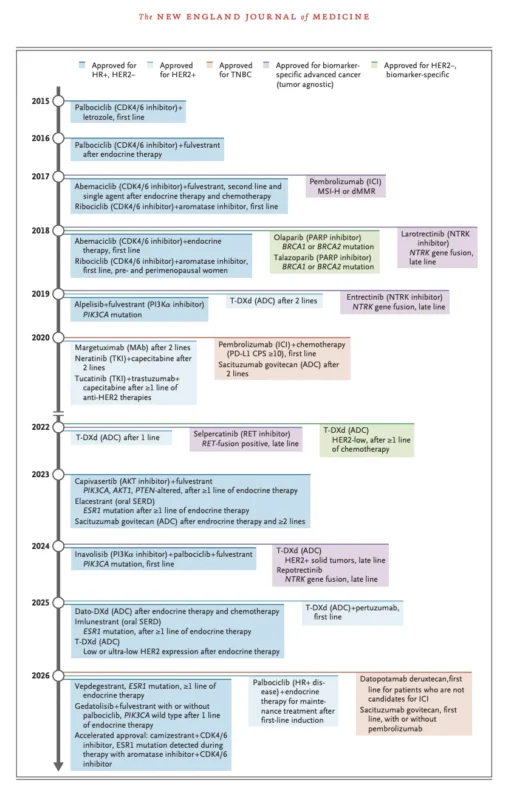
According to the review, 17 targeted therapies have either received approval or gained additional breast cancer indications since 2020, reflecting the rapid expansion of antibody-drug conjugates (ADCs), targeted therapies, immune checkpoint inhibitors, and oral endocrine agents.
From Breast Cancer Subtypes to Molecularly Guided Care
HR and HER2 status remain fundamental to treatment decisions, but molecular profiling now extends much further. Broader tumor profiling and germline genetic testing increasingly identify actionable alterations such as PIK3CA, AKT1, PTEN, ESR1, and BRCA1/2, enabling treatment to be selected according to both breast cancer phenotype and underlying molecular biology.
The review characterizes this evolution as a broader move toward individualized therapy, with treatment escalation or de-escalation increasingly based on recurrence risk, biomarkers, treatment response, and emerging resistance.
HR-Positive, HER2-Negative Disease: Beyond CDK4/6 Inhibition
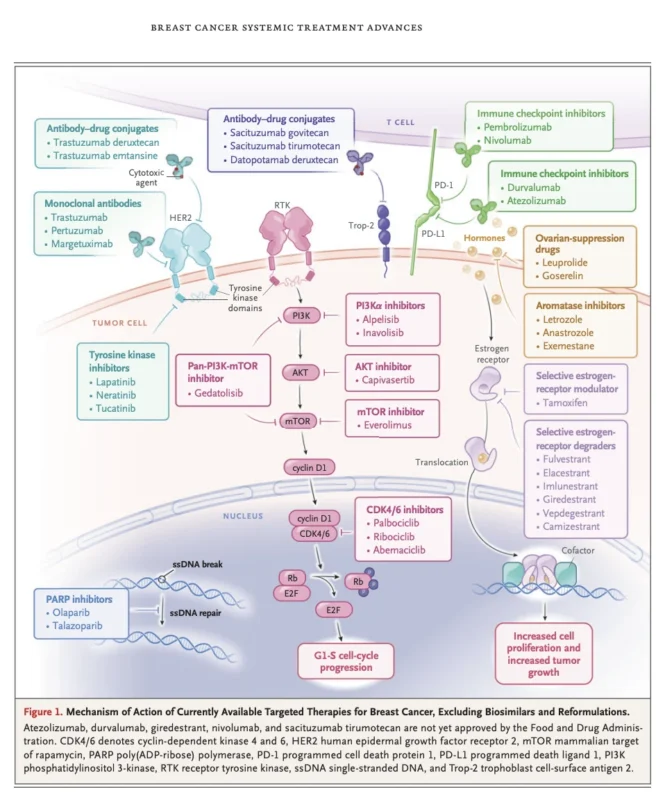
CDK4/6 inhibitors remain a cornerstone of treatment for HR-positive, HER2-negative breast cancer, but the therapeutic landscape after endocrine resistance has expanded substantially. PI3K–AKT–mTOR pathway targeting now provides multiple biomarker-defined options. Alpelisib, capivasertib, inavolisib, and gedatolisib have expanded the ability to target signaling pathways associated with endocrine resistance. The review notes that alterations involving PIK3CA, AKT1, or PTEN are found in more than 40% of HR-positive, HER2-negative tumors.
Oral selective estrogen receptor degraders have added another major therapeutic class. Elacestrant, imlunestrant, vepdegestrant, and camizestrant have increasingly established ESR1 mutation as an actionable biomarker.
One particularly important development highlighted in the review is the 2026 accelerated approval of camizestrant combined with a CDK4/6 inhibitor when an ESR1 mutation is detected in circulating tumor DNA during aromatase inhibitor plus CDK4/6 inhibitor therapy, before radiologic progression occurs. This represents a significant conceptual shift: treatment can potentially be changed on the basis of molecular evidence of emerging resistance before conventional imaging demonstrates progression.
Copyright © 2026 Massachusetts Medical Society.
ADCs Are Moving Earlier
Antibody-drug conjugates have also substantially changed HR-positive metastatic breast cancer treatment. Trastuzumab deruxtecan demonstrated benefit not only in HER2-low disease but also in HER2-ultra-low tumors, expanding the clinical relevance of HER2 expression far beyond the traditional HER2-positive population.
The DESTINY-Breast06 findings supported trastuzumab deruxtecan in patients with HR-positive, HER2-low or HER2-ultra-low metastatic disease who had not yet received chemotherapy for metastatic disease. Meanwhile, sacituzumab govitecan and datopotamab deruxtecan provide additional ADC options after endocrine therapy and chemotherapy.
The growing availability of ADCs also introduces a new unresolved issue: how should agents with similar cytotoxic payloads be sequenced?
HER2-Positive Disease: T-DXd Reshapes the Treatment Algorithm
Few areas of breast oncology have changed as rapidly as HER2-positive disease. Trastuzumab deruxtecan (T-DXd) has steadily moved from later-line therapy into earlier treatment settings. In DESTINY-Breast03, T-DXd substantially improved outcomes compared with trastuzumab emtansine in previously treated metastatic disease.
More recently, DESTINY-Breast09 evaluated T-DXd plus pertuzumab as first-line treatment. The review reports a median progression-free survival of 40.7 months with T-DXd plus pertuzumab versus 26.9 months with standard THP therapy, leading to regulatory approval of the regimen in late 2025.
However, the review also emphasizes important considerations: overall survival remains immature, continuous T-DXd exposes patients to prolonged cytotoxic therapy, and interstitial lung disease remains a clinically important toxicity. This means that the longest PFS does not necessarily make one regimen optimal for every patient.
CDK4/6 Inhibition Reaches HER2-Positive Disease
HR-positive/HER2-positive metastatic disease has also gained a new maintenance strategy. In the phase III PATINA trial, adding palbociclib to trastuzumab, pertuzumab, and endocrine therapy after first-line induction chemotherapy increased median PFS from 29.1 months to 44.3 months.
The regimen was subsequently incorporated into treatment guidelines and received FDA approval in June 2026. The finding strengthens the concept of simultaneously targeting HER2 signaling, estrogen receptor signaling, and cell-cycle progression in tumors expressing both HR and HER2.
Brain Metastases Are No Longer an Afterthought
Central nervous system disease remains particularly relevant in HER2-positive metastatic breast cancer. The review notes that approximately 30–50% of patients with HER2-positive metastatic disease develop CNS involvement. Tucatinib established an important precedent through HER2CLIMB, which included patients with active brain metastases and demonstrated improvements in intracranial response and survival.
T-DXd has also shown meaningful intracranial activity, with prospective trials reporting intracranial objective responses ranging from approximately 45% to more than 70%. These developments are increasingly making CNS efficacy an important consideration when selecting HER2-targeted therapy.
Early HER2-Positive Disease Is Becoming More Risk Adapted
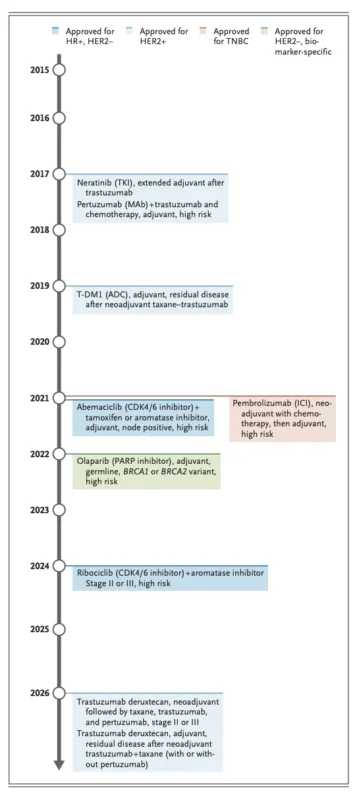
Treatment escalation based on response to neoadjuvant therapy is also evolving. T-DM1 established the principle that residual invasive disease after neoadjuvant HER2-directed therapy can guide postoperative treatment.
The review describes newer T-DXd strategies moving into both the neoadjuvant and post-neoadjuvant settings, including regulatory approvals in 2026 for stage II–III HER2-positive breast cancer and residual disease after neoadjuvant HER2-targeted treatment.
At the same time, the review cautions that ADCs have not yet eliminated the need for conventional multiagent chemotherapy with curative intent.
Copyright © 2026 Massachusetts Medical Society.
Triple-Negative Breast Cancer: Immunotherapy and ADCs Transform First-Line Treatment
TNBC has also moved rapidly beyond chemotherapy alone. Pembrolizumab plus chemotherapy became standard first-line therapy for metastatic PD-L1-positive TNBC after KEYNOTE-355 demonstrated significant improvements in PFS and OS. But first-line treatment is evolving again.
In ASCENT-04/KEYNOTE-D19, sacituzumab govitecan plus pembrolizumab produced a 35% relative improvement in median PFS compared with chemotherapy plus pembrolizumab in PD-L1-positive metastatic TNBC. Overall survival data remained immature, but the regimen has become an FDA-approved first-line option.
For patients with PD-L1-negative tumors or those unable to receive immune checkpoint inhibition, both sacituzumab govitecan and datopotamab deruxtecan have demonstrated benefit as first-line treatments.
Immunotherapy Has Also Changed Curative TNBC Treatment
Pembrolizumab has simultaneously changed the management of high-risk early-stage TNBC. In KEYNOTE-522, pembrolizumab added to neoadjuvant chemotherapy and continued after surgery significantly improved pathologic complete response, event-free survival, and overall survival in stage II–III disease.
Importantly, the benefit was observed irrespective of PD-L1 status. DCs are already established in advanced TNBC, but the review emphasizes that their role as curative therapy remains under investigation.
The Next Challenge Is No Longer Finding More Drugs
The rapid expansion of available therapies creates a different challenge: determining which therapy should come first, what should follow it, and which patients truly require treatment intensification. The review identifies several major unresolved questions:
Treatment sequencing after previous ADC exposure remains poorly defined, particularly because cross-resistance between agents carrying similar payloads is uncertain. Better predictive biomarkers are needed beyond current actionable alterations such as BRCA and PIK3CA. The role of ctDNA in guiding treatment escalation or de-escalation requires further validation.
Equitable access represents another increasingly important challenge. Highly effective targeted agents and ADCs can carry substantial costs, raising questions regarding sustainability as these therapies move from metastatic disease into potentially curative treatment settings.
Copyright © 2026 Massachusetts Medical Society.
OncoDaily Takeaway
The modern breast cancer treatment algorithm increasingly looks less like a fixed sequence based on three broad subtypes and more like a continuously evolving molecular map.
CDK4/6 inhibitors remain foundational. ADCs are moving earlier. ESR1 and PI3K-pathway alterations are becoming routine therapeutic targets. ctDNA can now identify resistance before imaging progression in selected settings. HER2-directed ADCs are redefining HER2-positive and HER2-low disease, while immunotherapy and ADCs continue to reshape TNBC.
The next phase of progress may therefore depend as much on optimal sequencing, biomarker selection, toxicity management, treatment de-escalation, and equitable access as on the development of additional drugs. As Hurvitz concludes, breast cancer has entered an era of unprecedented therapeutic expansion, but converting that expansion into truly personalized and sustainable care will be the next challenge.
- Source: Hurvitz SA. Advances in Systemic Treatment of Breast Cancer. N Engl J Med. 2026;395:1409-1425. DOI: 10.1056/.