Continuing to target the CDK4/6 pathway after progression on a prior CDK4/6 inhibitor remains clinically active in hormone receptor-positive, HER2-negative advanced breast cancer, but the final postMONARCH analysis stops short of proving an overall survival advantage.
At ESMO Congress 2026, final overall survival results from the phase III postMONARCH trial showed that abemaciclib plus fulvestrant produced a numerically longer median overall survival than fulvestrant alone after progression on previous CDK4/6 inhibitor plus endocrine therapy.
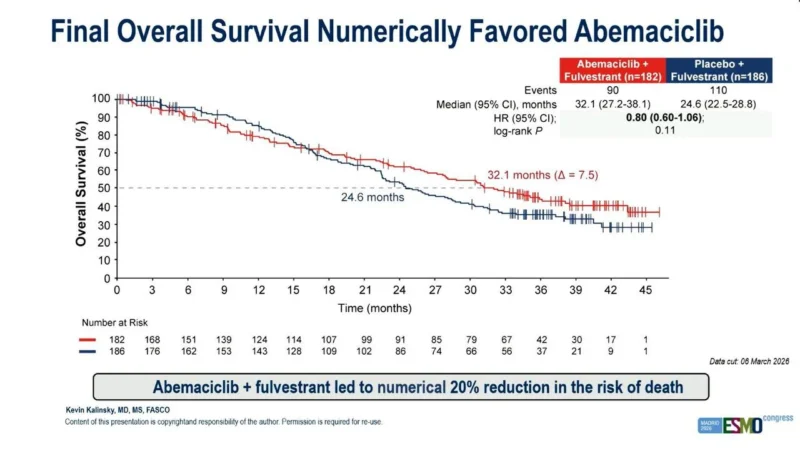
Median OS was 32.1 months with abemaciclib plus fulvestrant compared with 24.6 months with placebo plus fulvestrant, an absolute difference of 7.5 months.
The hazard ratio for death was 0.80 (95% CI 0.60–1.06; P=0.1145), corresponding to a numerical 20% reduction in the risk of death. However, the difference did not reach the prespecified threshold for statistical significance, meaning postMONARCH cannot be described as demonstrating a definitive overall survival benefit.
The updated analysis nevertheless reinforces the earlier progression-free survival findings and supports the broader concept that switching endocrine therapy while maintaining CDK4/6 pathway inhibition with abemaciclib can provide additional disease control after progression on a previous CDK4/6 inhibitor.
postMONARCH Tested a Central Question After CDK4/6 Progression
CDK4/6 inhibitors combined with endocrine therapy have become foundational treatment for HR-positive, HER2-negative advanced breast cancer. The challenge is what to do once resistance develops.
Progression on a CDK4/6 inhibitor does not necessarily mean that all tumors have become completely independent of the cyclin D–CDK4/6–Rb pathway. Resistance can emerge through multiple biological mechanisms, and some cancers may retain sufficient dependence on cell-cycle signaling to remain sensitive to a different CDK4/6 inhibitor strategy.
postMONARCH was designed to test that hypothesis prospectively. The trial enrolled patients whose disease had progressed on a CDK4/6 inhibitor plus an aromatase inhibitor as initial therapy for advanced breast cancer, or who had experienced recurrence during or after adjuvant CDK4/6 inhibitor plus endocrine therapy.
Importantly, patients were not permitted to receive intervening systemic therapy for advanced disease before enrollment.
They were randomized to abemaciclib plus fulvestrant or placebo plus fulvestrant, creating a clean test of whether adding another CDK4/6 inhibitor after prior CDK4/6 exposure could improve outcomes beyond endocrine therapy alone.
The Primary PFS Analysis Had Already Been Positive
The original postMONARCH analysis established a statistically significant PFS advantage. Among 368 randomized patients, median investigator-assessed PFS was 6.0 months with abemaciclib plus fulvestrant versus 5.3 months with fulvestrant alone, with an HR of 0.73 (95% CI 0.57–0.95).
The numerical difference in median PFS was modest, but the hazard ratio reflected a more sustained separation across the full time-to-event analysis. At six months, approximately 50% of patients receiving abemaciclib remained progression free compared with 37% in the control group.
Blinded independent central review also supported the treatment effect, with an HR of 0.55 in the original analysis. Objective response rate among patients with measurable disease was 17% with abemaciclib plus fulvestrant versus 7% with fulvestrant alone.
The treatment effect was also observed across major clinical and genomic subgroups, including patients with and without ESR1 or PIK3CA alterations. The ESMO 2026 update now provides the mature survival picture.
Final Overall Survival Numerically Favored Abemaciclib
At the March 6, 2026 data cutoff, median follow-up was approximately 36 months and the prespecified 200 overall survival events had occurred.
There were 90 deaths among 182 patients receiving abemaciclib plus fulvestrant and 110 deaths among 186 receiving placebo plus fulvestrant. Median overall survival was:
- 32.1 months with abemaciclib plus fulvestrant
versus
- 24.6 months with placebo plus fulvestrant.
The HR was 0.80, corresponding to a numerical 20% reduction in mortality. The absolute median difference of 7.5 months is clinically notable. But statistical interpretation is equally important.
The final OS analysis had a prespecified one-sided significance boundary of P=0.023. The observed P value was 0.1145, meaning the study did not formally establish superiority for overall survival. This result should therefore be described as a numerical OS advantage, not a positive OS endpoint.
Why the Negative OS Test Still Matters
The distinction between a clinically interesting numerical difference and a statistically confirmed survival benefit is particularly important in oncology reporting. A 7.5-month difference in median survival may appear large, but the confidence interval around the HR extended from 0.60 to 1.06 and therefore included the possibility of no true mortality benefit.
The trial was also relatively small for an OS endpoint, with only 368 patients. postMONARCH was originally powered around progression-free survival rather than detecting modest differences in overall survival.
As a result, the final OS data are compatible with a potentially meaningful treatment effect but do not provide the level of statistical certainty required to claim that abemaciclib definitively prolongs life in this setting.
Updated PFS Remained Consistent With the Original Analysis
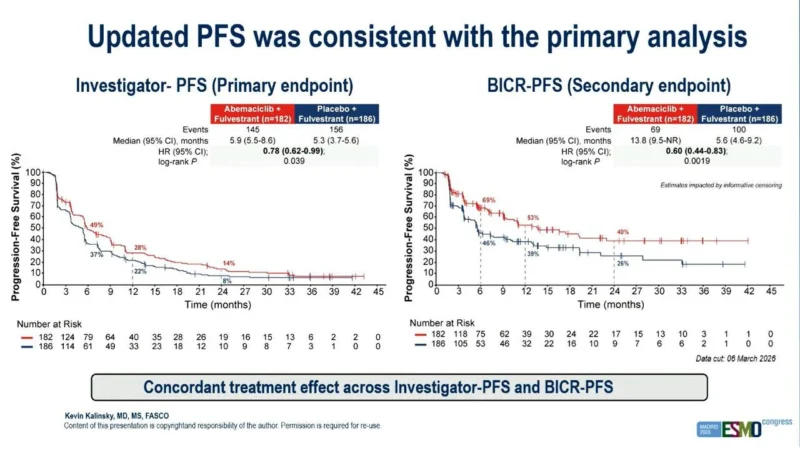
The longer follow-up did not materially change the investigator-assessed PFS result. Median updated PFS was 5.9 months with abemaciclib plus fulvestrant compared with 5.3 months with placebo plus fulvestrant, with an HR of 0.78 (95% CI 0.62–0.99; nominal P=0.039).
At six months, approximately 49% versus 37% of patients remained progression free. At 12 months, the corresponding rates were approximately 28% versus 22%, while at 24 months they were approximately 14% versus 8%.
These later landmark differences help explain why the hazard ratio may provide a more informative view of treatment benefit than the relatively small difference in median PFS. A minority of patients appears to experience more prolonged disease control with continued CDK4/6 pathway inhibition.
Central Review Also Favored Abemaciclib, but Requires Caution
Blinded independent central review showed a larger numerical treatment effect. Median BICR-assessed PFS was reported as 13.8 months with abemaciclib plus fulvestrant versus 5.6 months with placebo plus fulvestrant, with an HR of 0.60 (95% CI 0.44–0.83; P=0.0019).
However, the ESMO presentation specifically cautioned that these median estimates were affected by informative censoring. That means the striking difference in median BICR PFS should not be interpreted at face value as demonstrating an eight-month treatment advantage.
The more reliable conclusion is that both investigator assessment and blinded central review favored abemaciclib, while the exact magnitude of the BICR median difference is uncertain.
Overall Survival Direction Was Generally Consistent Across Subgroups
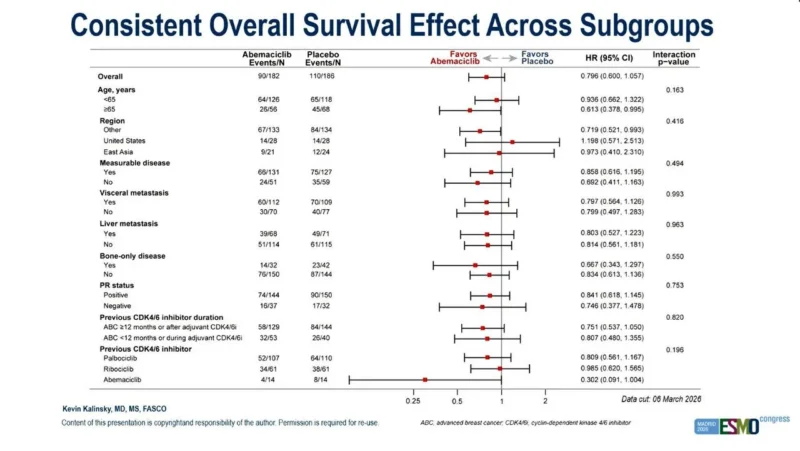
The OS point estimates generally favored abemaciclib across the major prespecified clinical subgroups. No convincing interaction suggested that the overall treatment effect was restricted to a single subgroup defined by visceral metastases, liver involvement, bone-only disease, progesterone receptor status, age, or duration of prior CDK4/6 inhibitor treatment.
The subgroup analysis also included patients previously treated with palbociclib, ribociclib, or abemaciclib. However, those analyses require careful interpretation.
Only a small number of patients had previously received abemaciclib, making the apparently favorable HR in that subgroup highly unstable and unsuitable for clinical decision-making.
The study therefore provides stronger evidence for switching to abemaciclib after another CDK4/6 inhibitor, particularly palbociclib or ribociclib, than it does for abemaciclib rechallenge after progression on abemaciclib itself.
The original postMONARCH population reflected this pattern: palbociclib and ribociclib were the most common previous CDK4/6 inhibitors, while only around 8% had previously received abemaciclib.
Subsequent Therapy Was Balanced Between Treatment Arms
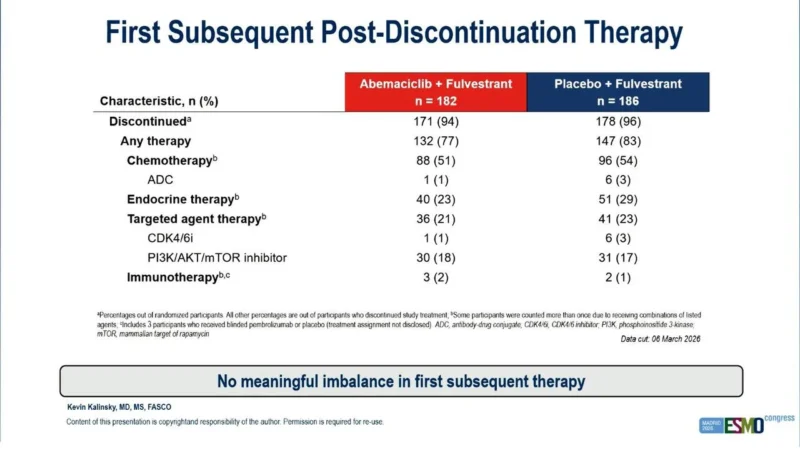
One possible explanation for differences in overall survival could be unequal access to effective treatment after study discontinuation. The ESMO analysis did not identify a meaningful imbalance.
Among patients who discontinued study therapy, subsequent systemic treatment was common in both arms. Chemotherapy was used in approximately 51% of patients discontinuing abemaciclib plus fulvestrant and 54% discontinuing placebo plus fulvestrant.
Subsequent endocrine therapy was used in approximately 23% versus 29%, while targeted therapies were used in 21% versus 23%. Use of PI3K, AKT, or mTOR pathway inhibitors was also similar.
These data reduce concern that the numerical OS difference was primarily created by substantially different post-progression treatment patterns.
postMONARCH Supports CDK4/6 Continuation, but Not for Everyone
The clinical implications of postMONARCH have become more complicated as the post-CDK4/6 treatment landscape has expanded.
After progression on first-line CDK4/6 plus endocrine therapy, treatment can now be influenced by ESR1 mutation status, PIK3CA alterations, AKT1 or PTEN changes, germline BRCA status, HER2-low expression, disease tempo, visceral involvement, and previous endocrine sensitivity.
Oral SERDs, PI3K- and AKT-pathway inhibitors, PARP inhibitors, antibody-drug conjugates, and other targeted approaches can all compete for treatment position depending on tumor biology.
postMONARCH therefore does not establish abemaciclib plus fulvestrant as the universal next treatment after CDK4/6 progression. Rather, it establishes that continuing CDK4/6 pathway inhibition with a different inhibitor remains a valid endocrine-based strategy for selected patients.
That distinction matters. The therapeutic question is increasingly not whether CDK4/6 continuation works at all, but which patients are most likely to benefit compared with biomarker-matched alternatives.
The Magnitude of PFS Benefit Remains Modest
The final analysis also reinforces the main limitation of the strategy. The investigator-assessed median PFS improvement remained modest, at approximately 0.6 months.
A hazard ratio of 0.78 indicates a meaningful reduction in progression risk over time, but the absolute benefit for the average patient is not dramatic. The value of the approach may therefore lie disproportionately in a subgroup capable of achieving prolonged disease control.
Identifying that subgroup remains an unresolved challenge. Genomic analyses from the initial study suggested treatment activity across ESR1 and PIK3CA categories, but no biomarker has yet emerged that clearly identifies patients whose tumors remain particularly dependent on CDK4/6 signaling after prior inhibitor exposure. That remains a major research priority.
The Result Fits Into a Broader CDK4 Resistance Story
postMONARCH is increasingly relevant in the context of next-generation cell-cycle therapies. At the same ESMO Congress, FOURLIGHT-1 demonstrated randomized PFS activity with the selective CDK4 inhibitor atirmociclib after prior CDK4/6 inhibition.
Together, these studies challenge the idea that progression on a CDK4/6 inhibitor necessarily marks the end of therapeutically meaningful cell-cycle inhibition. Instead, resistance appears heterogeneous.
Some tumors may remain sufficiently dependent on CDK4 signaling to benefit from continued or more selective inhibition, while others transition toward alternative resistance pathways.
The future of this treatment strategy is likely to depend on matching the type of cell-cycle intervention to the biological mechanism of resistance.
OncoDaily Takeaway
The final postMONARCH analysis strengthens, but does not dramatically change, the case for abemaciclib plus fulvestrant after prior CDK4/6 inhibitor progression.
Median overall survival was 32.1 months with abemaciclib plus fulvestrant versus 24.6 months with fulvestrant alone, corresponding to an HR of 0.80. The 7.5-month numerical difference is clinically notable, but the final OS endpoint was not statistically significant, with P=0.1145.
Updated investigator-assessed PFS remained consistent with the primary analysis, with an HR of 0.78, while central review also favored abemaciclib. Subsequent treatment patterns were broadly balanced, reducing concern that the survival difference was driven mainly by post-study therapy.
The key message is therefore not that postMONARCH has now proven an overall survival advantage.
It has not.
Rather, the study confirms that switching endocrine therapy and continuing CDK4/6 pathway inhibition with abemaciclib can provide additional disease control after progression on a previous CDK4/6 inhibitor. The remaining challenge is patient selection.
With multiple biomarker-directed treatments and ADCs now competing in the post-CDK4/6 setting, the clinical value of abemaciclib continuation will depend increasingly on identifying which tumors retain meaningful CDK4 dependence and which are better served by another therapeutic pathway.
Source
- Kalinsky K, et al. Overall survival from the phase III postMONARCH trial of abemaciclib plus fulvestrant versus placebo plus fulvestrant for HR-positive/HER2-negative advanced breast cancer following progression on a prior CDK4/6 inhibitor plus endocrine therapy. Presented at ESMO Congress 2026, October 24, 2026. Clinical trial identifier NCT05169567.