
The number of involved axillary lymph nodes remains one of the strongest prognostic factors in early breast cancer, but nodal burden alone does not fully define recurrence risk.
A new analysis from monarchE, published in ESMO Open, provides long-term efficacy data for adjuvant abemaciclib plus endocrine therapy according to nodal involvement in patients with hormone receptor-positive, HER2-negative high-risk early breast cancer. With a median follow-up of 76.8 months, the analysis shows that the benefit of two years of abemaciclib remains consistent across patients with N1 high-risk, N2 and N3 disease.
One of the most clinically relevant observations is that patients with only one to three positive lymph nodes but additional high-risk pathological features had a recurrence risk on endocrine therapy alone that was surprisingly close to that of patients with four to nine positive nodes.
This reinforces an important message from monarchE: limited nodal involvement should not automatically be interpreted as limited recurrence risk when grade 3 disease or a large primary tumor is present.
Why This Analysis Matters
Patients with HR-positive, HER2-negative early breast cancer can remain at risk of recurrence for many years after diagnosis. Nodal involvement is an established prognostic marker, and patients with four or more positive lymph nodes are generally recognized as having high-risk disease.
Clinical decision-making is less straightforward for patients with one to three positive nodes. Within this group, risk can vary substantially according to tumor size, grade, proliferative characteristics and other pathological features. The monarchE trial therefore did not define high risk exclusively according to the number of involved nodes.
Within cohort 1, patients with one to three positive nodes were eligible if they also had:
- grade 3 disease and/or a tumor measuring at least 5 cm.
The new analysis asks whether those N1 high-risk patients truly behave like a clinically lower-risk population, or whether their recurrence risk more closely resembles patients with greater nodal burden.
More Than 5,000 Patients Were Included in the Nodal Analysis
The analysis focused on monarchE cohort 1, which represented approximately 91% of the overall trial population.
Among 5,120 patients in cohort 1:
- 1,761 patients (34.4%) had N1 high-risk disease
- 2,223 patients (43.4%) had N2 disease
- 1,123 patients (21.9%) had N3 disease
The nodal groups were defined as:
- N1 high-risk: 1–3 positive axillary lymph nodes plus grade 3 disease and/or tumor size ≥5 cm
- N2: 4–9 positive axillary lymph nodes
- N3: ≥10 positive axillary lymph nodes
Patients had received adjuvant endocrine therapy alone or endocrine therapy plus two years of abemaciclib. The major efficacy outcomes were invasive disease-free survival and distant recurrence-free survival.
High-Risk N1 Disease Was Biologically Different From Conventional N1 Disease
The N1 high-risk group contained a particularly high proportion of biologically aggressive tumors.
Approximately:
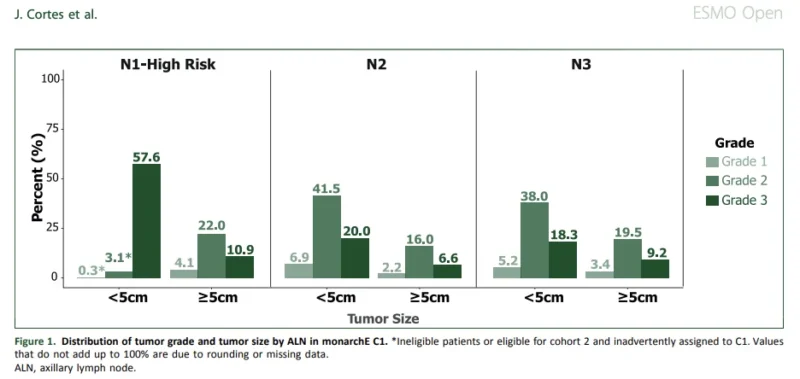
- 68.6% of N1 high-risk tumors were grade 3
Importantly, most of these grade 3 cancers were not simply large tumors. Among N1 high-risk patients, 57.6% had grade 3 tumors smaller than 5 cm, while another 10.9% had grade 3 tumors measuring at least 5 cm. High Ki-67 was also more common in the N1 high-risk population.
Ki-67 ≥20% was reported in:
- 48.8% of N1 high-risk patients
compared with
- 33.3% in N2
- 35.6% in N3
These findings help explain why one to three positive nodes did not necessarily translate into substantially lower recurrence risk.
N1 High-Risk Patients Had Recurrence Risk Similar to N2 on Endocrine Therapy Alone
This is perhaps the most important finding of the analysis.
Among patients receiving endocrine therapy alone, the 6-year invasive disease-free survival event rate was:
- 21.6% in N1 high-risk disease
- 25.4% in N2 disease
- 38.1% in N3 disease.
The same pattern appeared for distant recurrence.
Six-year DRFS event rates with endocrine therapy alone were:
- 17.7% for N1 high-risk
- 22.3% for N2
- 34.9% for N3
N3 disease clearly remained the poorest-prognosis subgroup. But the difference between N1 high-risk and N2 was considerably smaller than a nodal-count-only interpretation might suggest.
That finding is clinically important because patients with one to three nodes are sometimes perceived as having relatively modest recurrence risk simply because their anatomical nodal stage is lower. monarchE shows that grade and tumor size substantially modify the meaning of N1 disease.
Abemaciclib Produced Durable IDFS Benefit Across All Three Nodal Groups
The efficacy of abemaciclib plus endocrine therapy remained consistent irrespective of nodal burden.
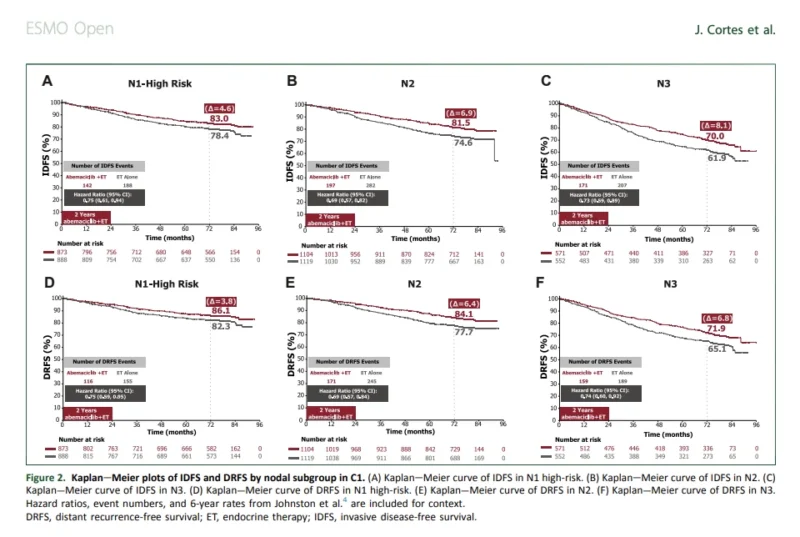
At six years, IDFS was approximately:
- N1 high-risk
- 83.0% with abemaciclib + ET
versus
- 78.4% with ET alone
Absolute difference: 4.6 percentage points
- N2
- 81.5% versus 74.6%
Absolute difference: 6.9 percentage points
- N3
- 70.0% versus 61.9%
Absolute difference: 8.1 percentage points
The increasing absolute separation with higher nodal burden is clinically intuitive: when baseline recurrence risk is greater, a relatively consistent treatment effect can translate into a larger absolute benefit. Importantly, the statistical test for treatment interaction did not suggest that abemaciclib efficacy differed meaningfully according to nodal subgroup.
The interaction P value for IDFS was:
- P=0.82
- supporting consistency of treatment effect across N1 high-risk, N2 and N3 disease
Distant Recurrence Was Also Reduced Across Nodal Groups
The same pattern was seen for distant recurrence-free survival.
At six years, DRFS was approximately:
- N1 high-risk
- 86.1% with abemaciclib + ET
versus
- 82.3% with ET alone
Absolute difference: 3.8 percentage points
- N2
- 84.1% versus 77.7%
Absolute difference: 6.4 percentage points
- N3
- approximately 71.9% versus 65.1%
Absolute difference: approximately 6.8 percentage points. Again, there was no meaningful evidence of heterogeneity in treatment effect according to nodal category.
The interaction P value for DRFS was:
- P=0.85.
This consistency is important because prevention of distant metastatic recurrence remains one of the principal objectives of adjuvant systemic therapy in HR-positive early breast cancer.
Overall Survival Benefit Was Also Consistent
The broader monarchE population has now demonstrated an overall survival benefit with adjuvant abemaciclib. At approximately 76 months of follow-up, the previously reported OS hazard ratio in the intent-to-treat population was:
- HR 0.842
- 95% CI 0.722–0.981
- P=0.027
The nodal subgroup analysis also showed broadly consistent OS effects. Hazard ratios for overall survival were:
- 0.88 in N1 high-risk disease
- 0.85 in N2
- 0.73 in N3
Only the N3 confidence interval individually excluded 1, but subgroup analyses are not designed to establish separate statistical significance within each nodal category.
The more relevant observation is that there was no indication that the benefit of abemaciclib was restricted to patients with very extensive nodal disease.
N3 Disease Still Carries the Greatest Absolute Risk
Although treatment benefit was consistent, baseline prognosis was not. Patients with N3 disease remained at substantially higher risk of recurrence and mortality than those with N1 high-risk or N2 disease.
Among patients receiving endocrine therapy alone, six-year mortality risk was:
- 10.6% in N1 high-risk
- 11.2% in N2
- 20.0% in N3
Again, the near overlap between N1 high-risk and N2 is noteworthy. It suggests that pathological factors can effectively move selected N1 patients into a recurrence-risk category that clinically resembles patients with substantially greater nodal involvement.
Grade 3 Disease Appears Particularly Important in N1 Patients
Grade was one of the dominant characteristics of the N1 high-risk population. This is consistent with real-world evidence cited by the investigators showing that grade 3 disease is a particularly important adverse prognostic factor in HR-positive, HER2-negative early breast cancer.
Real-world analyses have also found that patients with one to three involved nodes who meet monarchE high-risk criteria have approximately twice the recurrence and mortality risk at five years compared with N1 patients who lack those high-risk features.
The implication is practical: N1 disease should not be treated as one uniform risk category. An individual with one positive node and a small low-grade tumor is biologically and prognostically very different from a patient with two or three positive nodes and grade 3 disease.
The Findings Support Clinicopathological Risk Assessment Beyond Node Count
This analysis reinforces the reasoning behind the monarchE eligibility criteria. For N2 and N3 disease, nodal burden itself was sufficient to establish high risk. For N1 disease, additional pathological criteria were required.
The new long-term data suggest that this approach successfully identified an N1 population whose recurrence risk on endocrine therapy alone approached that of N2 disease. This is particularly relevant when clinicians are deciding whether the additional treatment burden of two years of adjuvant abemaciclib is justified.
The decision should not be based on lymph-node count in isolation. Tumor grade, primary tumor size and the overall clinicopathological risk profile matter.
Underuse of Adjuvant Abemaciclib May Be Greatest in N1 High-Risk Disease
The study also highlights an important real-world treatment gap. A US Flatiron Health analysis cited by the investigators found that, during a period when abemaciclib was the only approved adjuvant CDK4/6 inhibitor, approximately:
- 60.0% of patients meeting monarchE cohort 1 criteria and eligible for adjuvant abemaciclib were not receiving it.
Underutilization was even greater among N1 high-risk patients:
- 69.1%
That figure is particularly notable in light of the current analysis. If N1 high-risk patients have recurrence and mortality risks similar to those with N2 disease, undertreatment based on a perception that “only one to three nodes are positive” could deny clinically meaningful benefit to an important subgroup.
Toxicity Should Be Managed Rather Than Automatically Leading to Treatment Abandonment
Tolerability remains central to adjuvant treatment decisions. Abemaciclib can produce diarrhea, neutropenia, fatigue and other adverse effects, and treatment is given for two years in patients who may otherwise feel well following definitive local therapy.
However, previous monarchE analyses have shown that adverse events are generally reversible and manageable. Importantly, dose reductions have not been shown to compromise efficacy. This supports an approach based on early toxicity recognition and proactive dose modification rather than premature permanent discontinuation.
Dose-escalation strategies have also been investigated to improve early tolerability and adherence. In the adjuvant setting, where treatment duration is long, maintaining patients on effective therapy at a tolerable dose may be more important than maintaining the starting dose at all costs.
Nodal Burden Predicts Prognosis, but Does Not Define Who Benefits
The long-term monarchE analysis helps separate two concepts that are sometimes conflated prognostic risk and relative treatment benefit. N3 disease carries substantially greater absolute recurrence risk than N1 or N2. But the relative efficacy of abemaciclib appears broadly consistent across nodal categories.
This means patients with greater nodal burden may achieve a larger absolute benefit because they start with higher baseline risk, not because abemaciclib works only in more extensively node-positive disease.
Conversely, a patient with N1 disease who meets high-risk clinicopathological criteria should not be assumed to derive little benefit simply because fewer nodes are involved.
What This Means for Clinical Practice
The current analysis reinforces three practical principles. First, N1 HR+/HER2− early breast cancer is heterogeneous. One to three positive nodes alone do not adequately describe recurrence risk.
Second, grade 3 disease and large tumor size identify an N1 subgroup with substantial long-term risk, approaching that seen in N2 disease. Third, the benefit of adjuvant abemaciclib appears durable and consistent across N1 high-risk, N2 and N3 disease.
That makes accurate clinicopathological risk assessment essential when discussing adjuvant CDK4/6 inhibition.
OncoDaily Takeaway
The latest monarchE nodal analysis strengthens the evidence that adjuvant abemaciclib should not be reserved conceptually for patients with the greatest number of positive lymph nodes.
With median follow-up approaching 6.5 years, two years of abemaciclib plus endocrine therapy continued to reduce invasive and distant recurrence across N1 high-risk, N2 and N3 HR+/HER2− early breast cancer. The most clinically important finding may involve N1 disease.
Patients with only one to three positive nodes but grade 3 tumors and/or tumors ≥5 cm had recurrence and mortality risks on endocrine therapy alone that were remarkably similar to those of patients with four to nine positive nodes.
At six years, IDFS with endocrine therapy alone was approximately 78.4% in N1 high-risk disease and 74.6% in N2, while six-year mortality risks were 10.6% and 11.2%, respectively.
Abemaciclib improved outcomes across both groups and also provided substantial absolute benefit in N3 disease, where baseline risk remained highest. The clinical message is therefore not simply that “more nodes mean more benefit.”
It is that nodal count must be interpreted alongside tumor biology and pathology. For patients meeting monarchE cohort 1 criteria, high-risk N1 disease should be taken as seriously as more extensive nodal involvement when considering adjuvant abemaciclib.
Source
- Cortes J, Johnston SRD, Martin M, Tolaney SM, Goetz MP, Rugo HS, et al. Abemaciclib plus endocrine therapy in HR-positive, HER2-negative high-risk early breast cancer: efficacy in nodal subgroups. ESMO Open. 2026;11(10):108549. DOI: 10.1016/j.esmoop.2026.108549.