
Pembrolizumab has demonstrated a statistically significant progression-free survival benefit in PD-L1–positive hormone receptor-positive, HER2-negative advanced breast cancer, but the improvement did not translate into longer overall survival.
At ESMO Congress 2026, final results from the phase III KEYNOTE-B49 trial showed that adding pembrolizumab to chemotherapy reduced the hazard of progression or death by 26% compared with chemotherapy alone in patients with PD-L1 combined positive score of at least 1 whose disease had progressed after endocrine-based treatment.
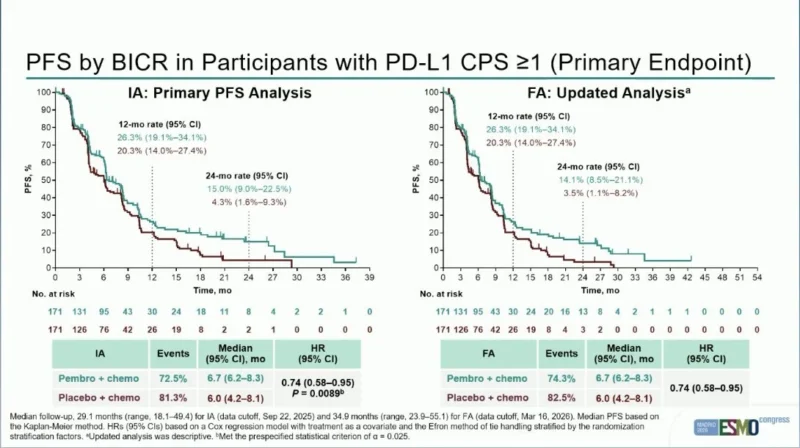
Median progression-free survival was 6.7 months with pembrolizumab plus chemotherapy compared with 6.0 months with chemotherapy alone, corresponding to an HR of 0.74 (95% CI 0.58–0.95; P=0.0089).
However, at the final analysis after a median follow-up of 34.9 months, median overall survival was 21.0 months with pembrolizumab plus chemotherapy and 22.2 months with placebo plus chemotherapy. The OS HR was 1.04 (95% CI 0.81–1.33; P=0.6185), demonstrating no survival advantage.
The findings establish that checkpoint inhibition can modestly delay progression in a molecularly selected subset of endocrine-resistant HR+/HER2− advanced breast cancer, but they also highlight the difficulty of translating that signal into a meaningful survival improvement.
Immunotherapy Has Had a Limited Role in HR+/HER2− Breast Cancer
Immune checkpoint inhibition has become an established therapeutic strategy in several breast cancer settings, particularly triple-negative disease. HR-positive/HER2-negative breast cancer has been more difficult.
These tumors are generally less immunogenic, with lower levels of tumor-infiltrating lymphocytes and less frequent clinically meaningful PD-L1 expression than triple-negative breast cancer. Endocrine-resistant disease may acquire additional biological complexity, but whether immune checkpoint inhibition can meaningfully alter outcomes after endocrine therapy has remained uncertain.
KEYNOTE-B49 was designed to answer that question in patients whose cancers expressed PD-L1 and who were ready to transition from endocrine-based treatment to chemotherapy. The trial therefore examined immunotherapy at a clinically important point in the treatment sequence: after failure of endocrine strategies but before previous chemotherapy for metastatic disease.
KEYNOTE-B49 Used a Randomized, Double-Blind Phase III Design
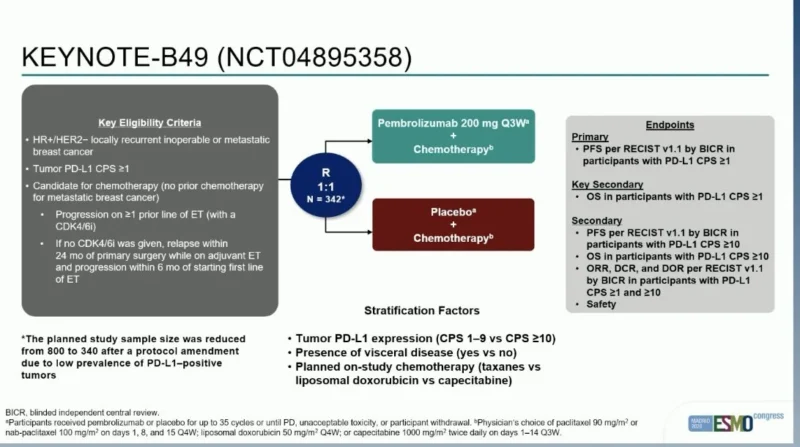
KEYNOTE-B49 enrolled patients with locally recurrent inoperable or metastatic HR-positive/HER2-negative breast cancer with PD-L1 CPS ≥1. Patients had previously received endocrine therapy and were considered candidates for first-line chemotherapy in the advanced-disease setting.
They were randomized 1:1 to receive pembrolizumab 200 mg every three weeks plus chemotherapy or placebo plus the same chemotherapy options. Available cytotoxic treatment included paclitaxel, nab-paclitaxel, liposomal doxorubicin, or capecitabine.
Pembrolizumab or placebo could be administered for up to 35 cycles unless disease progression, unacceptable toxicity, or another discontinuation criterion occurred.
The primary endpoint was PFS by blinded independent central review in patients with PD-L1 CPS ≥1. Overall survival in this population was the key secondary endpoint.
PD-L1–Positive Disease Was Less Common Than Expected
One of the most informative aspects of KEYNOTE-B49 emerged before treatment even began. The original planned sample size was approximately 800 patients, but the trial was amended and reduced to around 340 participants because PD-L1–positive disease proved less common than expected.
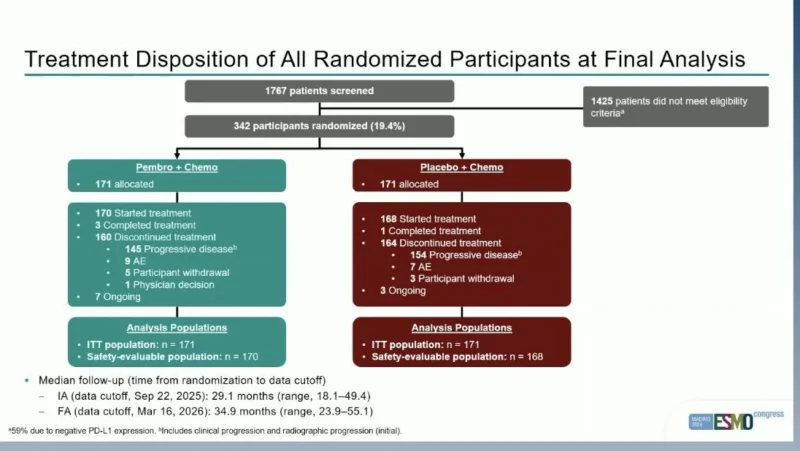
A total of 1,767 patients were screened, but only 342 were randomized. The presentation reported that approximately 59% of screen failures were attributable to negative PD-L1 expression.
This finding reinforces an important biological feature of HR+/HER2− breast cancer: PD-L1 positivity defines only a subset of patients, even after endocrine resistance has developed.
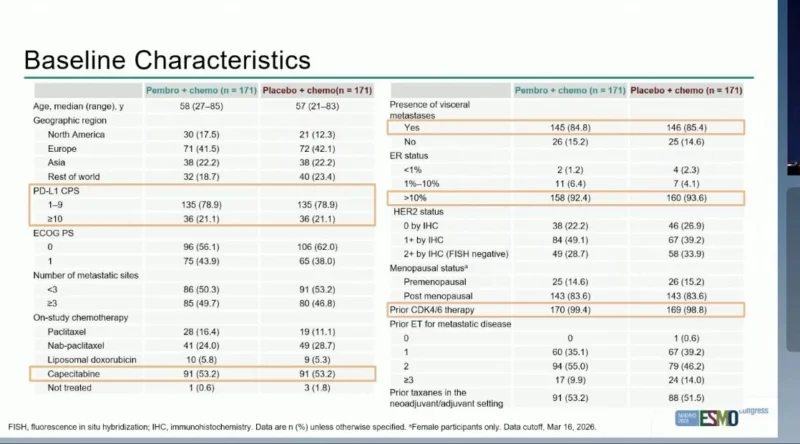
Among the 342 randomized patients, 171 received pembrolizumab plus chemotherapy and 171 received placebo plus chemotherapy. Within each arm, approximately 79% had PD-L1 CPS 1–9, while only about 21% had CPS ≥10.
The trial therefore predominantly evaluated tumors with relatively low-positive PD-L1 expression rather than a strongly PD-L1-enriched population.
Nearly All Patients Had Previously Received CDK4/6 Inhibition
KEYNOTE-B49 was highly relevant to contemporary practice because prior CDK4/6 inhibitor exposure was nearly universal. Approximately 99.4% of patients in the pembrolizumab arm and 98.8% in the control arm had previously received a CDK4/6 inhibitor.
Most patients had also received multiple endocrine treatment lines. Visceral metastatic disease was present in approximately 85% of participants, reflecting a population in which endocrine-based strategies had largely been exhausted and chemotherapy was clinically appropriate.
Capecitabine was the most commonly selected chemotherapy and was used in just over half of patients in each treatment arm. These characteristics place KEYNOTE-B49 squarely within the post-endocrine, post-CDK4/6 treatment setting rather than an earlier endocrine-sensitive population.
Pembrolizumab Met the Primary PFS Endpoint
At the primary analysis, with median follow-up of 29.1 months, pembrolizumab plus chemotherapy significantly improved PFS.
Median PFS was:
- 6.7 months with pembrolizumab plus chemotherapy
compared with:
- 6.0 months with placebo plus chemotherapy
The HR was 0.74, corresponding to a 26% relative reduction in the hazard of progression or death. The statistical criterion for the primary endpoint was met. The PFS result remained unchanged at the final analysis, with the HR still 0.74 after longer follow-up.
The absolute difference in median PFS, however, was only 0.7 months. That creates an important distinction between relative and absolute measures of benefit.
The hazard ratio indicates that the risk of progression or death over the full observation period was reduced, but the median alone suggests that the typical patient experienced only a modest extension before progression.
The PFS Curves Suggest a More Complex Treatment Effect
The median PFS values do not fully describe the pattern of benefit. At 12 months, approximately 26.3% of patients receiving pembrolizumab plus chemotherapy remained progression free compared with 20.3% receiving chemotherapy alone.
At 24 months in the final analysis, the difference became more pronounced:
- 14.1% versus 3.5%
This suggests that pembrolizumab may provide more durable disease control for a relatively small subgroup of patients rather than producing a large uniform benefit across the entire PD-L1 CPS ≥1 population.
That pattern is biologically plausible for immunotherapy, where a minority of patients can sometimes experience prolonged benefit despite relatively modest differences in median outcomes.
For KEYNOTE-B49, identifying those patients becomes particularly important because the overall median PFS improvement was small.
Higher PD-L1 Expression May Identify Greater Benefit
The PD-L1 CPS ≥10 subgroup showed a stronger numerical PFS signal. Median PFS in this group was 7.5 months with pembrolizumab plus chemotherapy compared with 4.4 months with chemotherapy alone.
The HR was:
- 0.59 (95% CI 0.35–0.98)
This corresponds to an approximately 41% reduction in the hazard of progression or death. The result suggests that greater PD-L1 expression may enrich for immunotherapy benefit. However, only approximately 21% of randomized patients had CPS ≥10, corresponding to around 36 patients in each treatment arm.
The subgroup is therefore relatively small, and the investigators appropriately described the finding as a numerical effect rather than establishing CPS ≥10 as a definitive new treatment-selection threshold. Additional biomarker work will be needed before this subgroup can define routine clinical use.
No Overall Survival Benefit Emerged
The major limitation of KEYNOTE-B49 became clear at the final OS analysis. After median follow-up of 34.9 months, there were 126 deaths among 171 patients receiving pembrolizumab plus chemotherapy and 124 deaths among 171 patients receiving placebo plus chemotherapy.
Median OS was:
- 21.0 months with pembrolizumab plus chemotherapy
versus
- 22.2 months with chemotherapy alone
The HR was 1.04, with a 95% confidence interval of 0.81–1.33. There was therefore no evidence of improved survival. This is more than a question of statistical maturity. The point estimate itself was essentially neutral and slightly numerically favored the control arm.
KEYNOTE-B49 should therefore not be described as demonstrating an OS trend that simply needs additional follow-up. The final analysis showed no survival benefit.
Why Might PFS Improve Without OS?
Several explanations are possible. The PFS benefit itself was modest in absolute terms, particularly in the overall CPS ≥1 population. Patients also received subsequent systemic therapies after progression, potentially diluting differences in OS.
More fundamentally, PD-L1 CPS ≥1 may be too broad a biomarker to identify a sufficiently immunotherapy-sensitive HR-positive population. Approximately four in five patients had CPS values between 1 and 9.
The stronger numerical PFS result among patients with CPS ≥10 raises the possibility that the overall population included many tumors with insufficient immune activation to derive substantial benefit from checkpoint blockade.
Other biological markers, including tumor-infiltrating lymphocytes, genomic characteristics, immune gene-expression signatures, or features of endocrine resistance, may eventually provide better selection than PD-L1 alone.
Safety Reflects the Addition of Immune Checkpoint Therapy
The PFS improvement came with additional toxicity. Grade 3 or higher treatment-related adverse events occurred in 37.6% of patients receiving pembrolizumab plus chemotherapy compared with 32.7% receiving chemotherapy alone.
Treatment-related adverse events led to treatment discontinuation in 11.2% versus 5.4%, approximately doubling the discontinuation rate when pembrolizumab was added. This safety difference becomes important when the absolute median PFS benefit is only 0.7 months.
The risk-benefit calculation may look more favorable in a biomarker-defined subgroup with a larger treatment effect, but KEYNOTE-B49 does not yet establish which patients reliably fall into that category.
KEYNOTE-B49 Is Not the HR-Positive Equivalent of the TNBC Immunotherapy Story
The results should not be extrapolated directly from the established role of pembrolizumab in PD-L1-positive triple-negative breast cancer. HR-positive and triple-negative tumors have fundamentally different immune biology.
In KEYNOTE-B49, even biomarker selection for PD-L1 CPS ≥1 yielded a modest overall PFS improvement and no OS advantage. This suggests that PD-L1 expression alone may not be sufficient to reproduce the magnitude of benefit observed in more immunogenic breast cancer subtypes.
The trial does, however, establish proof that immune checkpoint inhibition can influence disease control in at least some endocrine-resistant HR-positive cancers. The next challenge is identifying those tumors more precisely.
The Treatment Landscape Has Also Changed
Another issue is the increasingly complex treatment environment after CDK4/6 inhibitor progression. Modern HR+/HER2− advanced breast cancer treatment may involve ESR1-directed therapy, PI3K/AKT-pathway inhibitors, PARP inhibitors in selected patients, and multiple antibody-drug conjugates depending on tumor biology and prior therapy.
That evolving landscape raises the bar for adding immunotherapy to conventional chemotherapy. A regimen producing a statistically significant PFS advantage must also demonstrate that the absolute magnitude of benefit, toxicity, biomarker selection, and sequencing make it preferable to alternative targeted or ADC-based strategies. KEYNOTE-B49 alone does not resolve that question.
The Most Important Next Step Is Better Patient Selection
KEYNOTE-B49 may ultimately be more informative biologically than immediately practice changing. The trial demonstrates that there is likely an immunotherapy-sensitive subgroup within HR-positive/HER2-negative advanced breast cancer.
But CPS ≥1 appears to be too broad a definition to isolate that group efficiently. The stronger signal among CPS ≥10 tumors and the more pronounced separation in longer-term PFS suggest that a minority of patients may derive durable benefit.
Future analyses should therefore focus less on whether pembrolizumab has any activity in HR-positive disease and more on which tumors have sufficient immune susceptibility to justify treatment. That may require combining PD-L1 with other clinical, genomic, and immune biomarkers.
OncoDaily Takeaway
KEYNOTE-B49 provides the first phase III evidence that adding pembrolizumab to chemotherapy can significantly delay progression in PD-L1–positive HR+/HER2− advanced breast cancer after endocrine-based therapy.
Pembrolizumab plus chemotherapy reduced the hazard of progression or death by 26%, with median PFS of 6.7 versus 6.0 months. The PFS curves showed greater separation over time, with 24-month PFS of approximately 14.1% versus 3.5%, suggesting that a minority of patients may experience more durable benefit.
The signal was also numerically stronger in patients with PD-L1 CPS ≥10, where median PFS was 7.5 versus 4.4 months and the HR was 0.59. However, the final overall survival analysis was unequivocally negative.
Median OS was 21.0 months with pembrolizumab plus chemotherapy versus 22.2 months with chemotherapy alone, with an HR of 1.04. Treatment-related toxicity and treatment discontinuation were also higher with pembrolizumab.
KEYNOTE-B49 therefore should not be interpreted as establishing a new immunotherapy standard across PD-L1–positive HR+/HER2− advanced breast cancer.
Instead, it provides evidence that immunotherapy can influence disease control in a subset of endocrine-resistant HR-positive tumors, but current PD-L1 selection does not yet identify that population precisely enough to deliver a survival advantage. The next step is not simply broader use of pembrolizumab. It is better biomarker selection.
Source
- Rugo HS, et al. Results from KEYNOTE-B49: A phase III, randomized, double-blind study of pembrolizumab versus placebo plus chemotherapy in participants with HR-positive/HER2-negative advanced breast cancer. Presented at ESMO Congress 2026, October 24, 2026. Clinical trial identifier NCT04895358.