The HER2-low breast cancer landscape may be preparing for another major antibody-drug conjugate entrant. At ESMO Congress 2026, the phase III HORIZON-Breast06 trial showed that trastuzumab rezetecan (SHR-A1811) produced a substantial progression-free survival advantage over physician’s choice of chemotherapy in patients with HER2-low advanced breast cancer, including patients who had not previously received chemotherapy for metastatic disease.
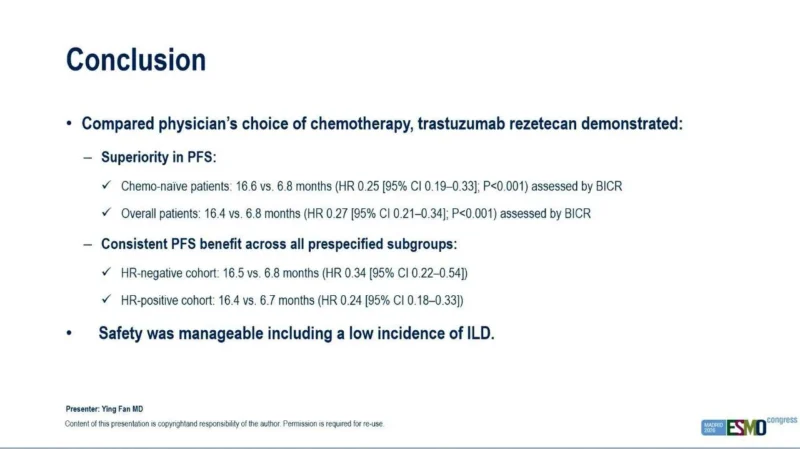
In the overall population, median blinded independent central review-assessed progression-free survival reached:
- 16.4 months with trastuzumab rezetecan
versus
- 6.8 months with chemotherapy
corresponding to:
- HR 0.27
- 95% CI 0.21–0.34; P<0.0001
This represents an approximately 73% relative reduction in the hazard of progression or death.
Among chemotherapy-naïve patients, the difference was similarly pronounced:
- 16.6 vs 6.8 months
with an HR of:
- 0.25
- 95% CI 0.19–0.33; P<0.0001
The efficacy signal extended across hormone receptor status, with major PFS improvements observed in both HR-positive and HR-negative HER2-low disease. The findings were simultaneously published in JAMA on October 23, 2026, alongside their presentation at ESMO Congress 2026.
HER2-Low Disease Has Become a Therapeutically Actionable Phenotype
HER2-low breast cancer is generally defined as HER2 IHC 1+ or IHC 2+/ISH-negative disease. Historically, these tumors were classified and treated as HER2-negative because conventional HER2-directed therapies did not provide meaningful benefit in tumors without HER2 amplification or strong HER2 overexpression.
The development of HER2-directed ADCs changed that paradigm. Unlike traditional HER2-targeted agents that primarily depend on strong target signaling, modern ADCs can use relatively low HER2 expression as an entry point to deliver a highly potent cytotoxic payload into tumor cells.
Trastuzumab deruxtecan established the clinical relevance of HER2-low disease through DESTINY-Breast04 and subsequently moved even earlier in HR-positive disease through DESTINY-Breast06.
HORIZON-Breast06 now provides randomized phase III evidence for a second HER2-directed ADC in this increasingly important population.
But the two drugs have not been compared head-to-head, making direct efficacy or safety comparisons inappropriate.
What Is Trastuzumab Rezetecan?
Trastuzumab rezetecan, previously known as SHR-A1811, is a HER2-targeted antibody-drug conjugate comprising a humanized anti-HER2 monoclonal antibody linked through a cleavable linker to a potent topoisomerase I inhibitor payload.
The drug has an optimized drug-to-antibody ratio of approximately six and is designed to generate a bystander effect that may allow cytotoxic activity even when HER2 expression is heterogeneous or relatively low.
Earlier clinical development had already suggested activity in heavily pretreated HER2-low metastatic breast cancer. In a phase I population, trastuzumab rezetecan achieved an objective response rate of approximately 60.9%, median duration of response of 12.4 months and median PFS of 11.0 months, providing the rationale for the 6.4 mg/kg dose selected for phase III development.
The drug has also demonstrated substantial activity in HER2-positive breast cancer and has been approved in China in that setting.
HORIZON-Breast06 Tested the ADC Against Active Chemotherapy
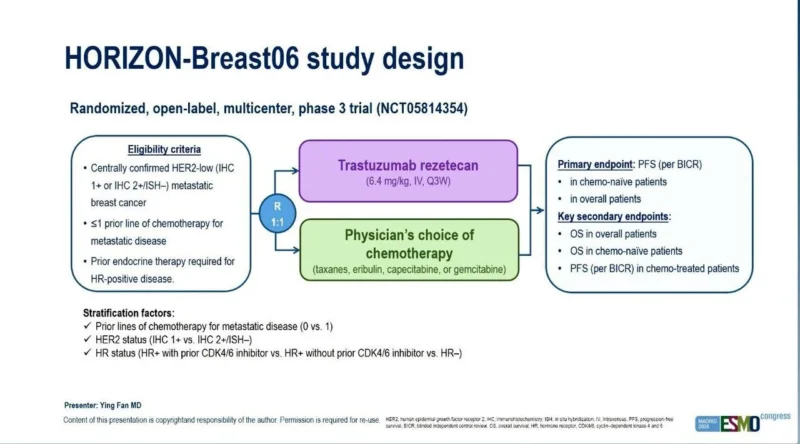
HORIZON-Breast06 was a randomized, open-label, multicenter phase III trial conducted across 73 hospitals in China. A total of 551 patients, with centrally confirmed HER2-low unresectable locally recurrent or metastatic breast cancer were randomized 1:1.
Patients received:
- Trastuzumab rezetecan 6.4 mg/kg intravenously every three weeks
or
- Physician’s choice of chemotherapy including taxanes, eribulin, capecitabine or gemcitabine
Patients could have received no more than one previous line of chemotherapy for metastatic disease. For patients with HR-positive disease, previous endocrine therapy was required.
The dual primary endpoints were PFS assessed by blinded independent central review in patients who had received no previous chemotherapy for metastatic disease, and the overall randomized population. This independent central assessment is important because the study itself was open label.
Most Patients Had Not Yet Received Metastatic Chemotherapy
The population was weighted toward relatively earlier treatment.
Of the 551 randomized patients:
- 81.5% were chemotherapy-naïve in the metastatic setting
Approximately:
- 73% had HR-positive disease
while:
- 27% had HR-negative disease
Most HR-positive patients had already received substantial endocrine-based treatment. In the published population, more than 60% had previously received a CDK4/6 inhibitor, and many had already been exposed to aromatase inhibitors and fulvestrant.
Visceral disease was also common, with more than three-quarters of patients having visceral metastases and approximately 54% having liver involvement.
Patients with active CNS metastases were excluded, as were patients with prior HER2-directed therapy, previous treatment with an exatecan-derived topoisomerase I ADC or a history of interstitial lung disease.
PFS More Than Doubled in Chemotherapy-Naïve Patients
The magnitude of benefit in patients who had not previously received chemotherapy for metastatic disease was one of the most striking findings.
Median BICR-assessed PFS was:
- 16.6 months with trastuzumab rezetecan
versus
- 6.8 months with physician’s choice chemotherapy
The hazard ratio was:
- 0.25
- 95% CI 0.19–0.33; P<0.0001.
At 12 months, approximately:
- 65.2%
- of patients receiving trastuzumab rezetecan remained progression free
compared with:
- 18.9% with chemotherapy
That separation suggests that the benefit was not simply a modest delay in progression but a substantial extension of disease control in this population.
The Benefit Was Maintained Across the Overall Population
When all 551 patients were analyzed together, median PFS remained:
- 16.4 vs 6.8 months.
The hazard ratio was:
- 0.27
- 95% CI 0.21–0.34; P<0.0001
Twelve-month PFS was:
- 63.1% with trastuzumab rezetecan
versus
- 18.0% with chemotherapy
The trial therefore met both of its primary efficacy objectives. The peer-reviewed publication confirmed statistically significant BICR-assessed PFS improvement in both the chemotherapy-naïve and overall populations.
HR-Positive Disease: PFS Reached 16.4 Months
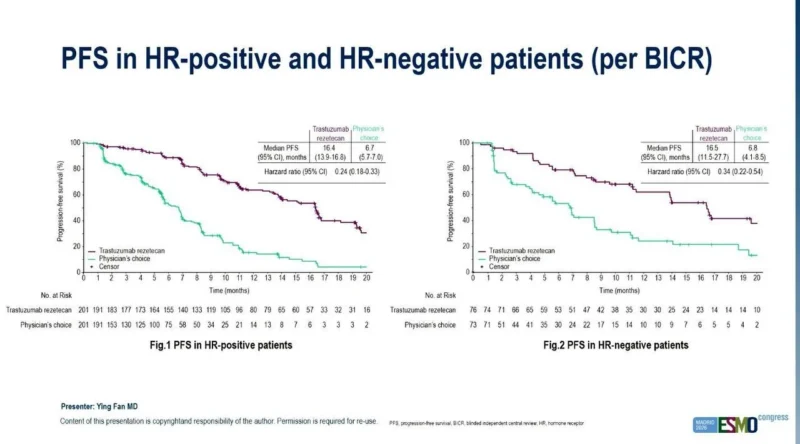
The majority of HORIZON-Breast06 participants had HR-positive disease. In this subgroup, median PFS was:
- 16.4 months with trastuzumab rezetecan
versus
- 6.7 months with chemotherapy
The hazard ratio was:
- 0.24 95% CI 0.18–0.33
This corresponds to an approximately 76% relative reduction in the hazard of progression or death. The result is particularly relevant because many patients had already exhausted standard endocrine strategies. The published analysis notes that a large proportion of HR-positive patients had received previous CDK4/6 inhibition and other endocrine therapies before enrollment.
The data therefore support substantial ADC activity in endocrine-resistant HER2-low disease.
HR-Negative HER2-Low Disease May Be an Equally Important Finding
The HR-negative population represents a smaller but potentially very important subgroup.
Median PFS was:
- 16.5 monthsn with trastuzumab rezetecan
versus
- 6.8 months with chemotherapy
The hazard ratio was:
- 0.34 95% CI 0.22–0.54
This represents an approximately 66% reduction in the hazard of progression or death. The significance of this finding extends beyond the numerical result.
DESTINY-Breast06 focused on HR-positive HER2-low or HER2-ultralow breast cancer, while patients with HR-negative HER2-low disease have had fewer randomized data supporting early use of HER2-directed ADC therapy.
HORIZON-Breast06 therefore expands the discussion around HER2-low targeting into a population that biologically overlaps with triple-negative breast cancer. The peer-reviewed analysis specifically highlighted activity in HR-negative HER2-low disease as a clinically important aspect of the trial.
Response Rates Were Also Substantially Higher
PFS was not the only endpoint favoring trastuzumab rezetecan. In the overall population, the objective response rate was:
- 75.5% with trastuzumab rezetecan
versus
- 41.2% with chemotherapy
Among chemotherapy-naïve patients:
- 76.0% vs 43.3%
Responses were similarly observed across hormone receptor subgroups.
In HR-positive disease:
- 74.6% vs 40.8%
In HR-negative disease:
- 77.6% vs 42.5%
Median duration of response in the overall population reached:
- 15.0 months with trastuzumab rezetecan
versus
- 6.8 months with chemotherapy
These response data strengthen the PFS findings by showing that trastuzumab rezetecan not only delayed progression but generated substantially more tumor responses and maintained them considerably longer.
Even Previously Chemotherapy-Treated Patients Benefited
Approximately 18.5% of the population had received one previous line of chemotherapy for metastatic disease. In this subgroup, median PFS was:
- 13.9 months with trastuzumab rezetecan
versus
- 5.6 months with chemotherapy
The hazard ratio was:
- 0.32
- 95% CI 0.19–0.54
The consistency between chemotherapy-naïve and chemotherapy-exposed patients suggests that the ADC retained substantial activity across different levels of previous cytotoxic treatment exposure.
Overall Survival Is Encouraging, but Still Immature
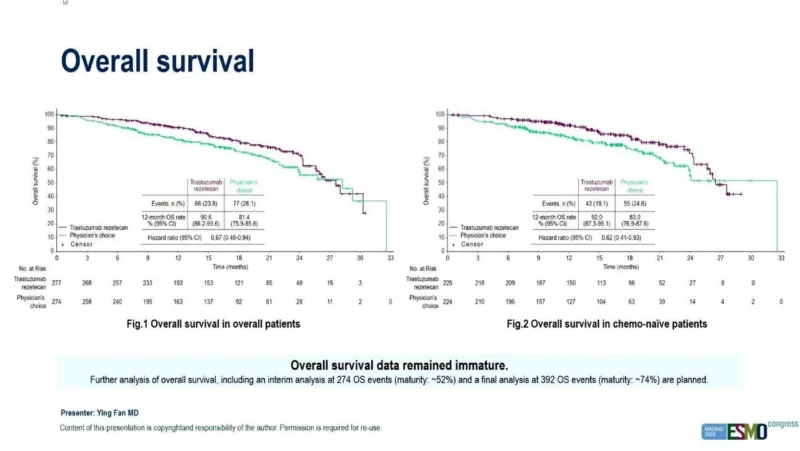
Overall survival currently requires considerably more caution. At the March 20, 2026 data cutoff, OS data had not reached the level of maturity required for definitive conclusions.
There were:
- 66 deaths among 277 patients receiving trastuzumab rezetecan
and
- 77 deaths among 274 patients receiving chemotherapy
The 12-month OS rate in the overall population was:
- 90.6% with trastuzumab rezetecan
versus
- 81.4% with chemotherapy
The exploratory hazard ratio was:
- 0.67
- 95% CI 0.48–0.94
Among chemotherapy-naïve patients, 12-month OS was:
- 92.0% vs 83.0% with an HR of approximately 0.62.
These findings suggest a favorable survival trend, but HORIZON-Breast06 cannot yet be described as demonstrating an OS benefit. Further prespecified OS analyses are planned as additional deaths accumulate.
Safety Is Manageable, but the Hematologic Burden Is Substantial
The strong efficacy signal should not obscure an important feature of trastuzumab rezetecan, this is a hematologically intensive ADC at the 6.4 mg/kg dose.
Grade 3 or higher treatment-related adverse events occurred in:
- 84.1% of patients receiving trastuzumab rezetecan
versus
- 67.9% with chemotherapy
The most important toxicities were hematologic. Grade ≥3 decreased neutrophil count occurred in:
- 65.2% vs 54.2%
Grade ≥3 anemia occurred in:
- 42.8% vs 4.8%
Grade ≥3 thrombocytopenia occurred in:
- 35.9% vs 1.8%.
Febrile neutropenia occurred in:
9.8% with trastuzumab rezetecan
versus
- 0.4% with chemotherapy
These rates make proactive hematologic monitoring an important component of treatment. Approximately half of patients receiving trastuzumab rezetecan required a dose reduction because of adverse events, emphasizing that efficacy was accompanied by a meaningful treatment-management burden.
Growth-Factor Support May Be Important
Exploratory experience in the study suggested that prophylactic granulocyte colony-stimulating factor could reduce both the incidence and severity of neutropenia. Because prophylaxis was not randomized, these findings cannot establish a definitive preventive strategy.
Nevertheless, they suggest that supportive care may become particularly important if trastuzumab rezetecan enters routine clinical practice.
ILD Incidence Was Relatively Low
Interstitial lung disease is an important class concern with HER2-directed topoisomerase I ADCs. In HORIZON-Breast06, ILD occurred in:
- 7 patients — 2.5% receiving trastuzumab rezetecan
The reported events included:
- one grade 1 event
- three grade 2 events
- two grade 3 events
- one grade 4 event
- No grade 5 ILD event was reported
The median time to onset was approximately 316 days, suggesting that surveillance needs to continue well beyond the first treatment cycles.
A 2.5% incidence is encouraging, particularly for a HER2-directed ADC carrying a topoisomerase I payload.
However, comparisons with ILD rates from other ADC trials should be interpreted cautiously because differences in populations, follow-up, adjudication, exclusion criteria and monitoring can substantially influence observed incidence.
HORIZON-Breast06 Creates an Important Question for T-DXd Sequencing
The most clinically relevant question now may not be whether trastuzumab rezetecan is active. The phase III trial makes that clear. The difficult question is: Where would it fit relative to trastuzumab deruxtecan?
T-DXd has already transformed treatment of HER2-low metastatic breast cancer. DESTINY-Breast04 established its efficacy after prior chemotherapy, while DESTINY-Breast06 moved T-DXd earlier for HR-positive HER2-low and HER2-ultralow disease following endocrine therapy.
In DESTINY-Breast06, median PFS with T-DXd in the HER2-low population was approximately 13.2 months versus 8.1 months with chemotherapy. HORIZON-Breast06 reports median PFS of approximately 16.4–16.6 months versus 6.8 months.
But these numbers should not be compared as though the trials randomized the same patients under identical conditions.
They did not.
Patient populations, geography, endocrine treatment exposure, control regimens, assessment schedules and eligibility criteria differed.
The HORIZON-Breast06 investigators themselves conclude that a future head-to-head comparison of trastuzumab rezetecan and trastuzumab deruxtecan would be needed to determine their relative clinical value.
ADC Sequencing Will Become Increasingly Important
If trastuzumab rezetecan eventually enters global practice, another unanswered question will be how to sequence two HER2-directed ADCs that both use topoisomerase I payloads.
HORIZON-Breast06 excluded patients previously treated with an exatecan derivative-based topoisomerase I ADC. The trial therefore does not tell us how effective trastuzumab rezetecan would be after T-DXd.
That distinction is critical. Cross-resistance between ADCs can arise through several mechanisms:
- reduced target expression
- altered internalization
- drug-efflux mechanisms
- payload resistance
- impaired lysosomal processing
or changes in DNA damage-response pathways. Switching from one HER2-directed topoisomerase I ADC to another may therefore not necessarily reproduce the efficacy seen in ADC-naïve populations.
Future studies will need to determine whether trastuzumab rezetecan can remain effective following prior T-DXd or whether its optimal clinical position is earlier in the sequence.
The HR-Negative Population Could Offer a Distinct Development Opportunity
The HR-negative findings deserve particular attention. For HER2-low HR-negative metastatic disease, treatment is generally approached through the therapeutic framework of triple-negative breast cancer. Depending on PD-L1 status, treatment history and geography, options can include chemotherapy, pembrolizumab-based therapy and TROP2-directed ADCs.
HORIZON-Breast06 suggests that HER2 expression may provide another actionable therapeutic vulnerability in this population even before metastatic chemotherapy. Among chemotherapy-naïve HR-negative patients, published analyses reported median PFS approaching 16.8 months versus 6.8 months, with an HR around 0.31.
That is an important signal. However, only a small number of patients in HORIZON-Breast06 had previously received immunotherapy.
The results therefore need to be interpreted in the context of modern global TNBC practice, where PD-1-directed therapy plays a major first-line role for PD-L1-positive disease.
Generalizability Is an Important Limitation
HORIZON-Breast06 was conducted entirely in China. Approximately 97% of participants were Han Chinese. That does not diminish the internal validity of the randomized comparison, but it does create uncertainty about global generalizability.
A multinational study would help establish whether efficacy and toxicity are similar across broader racial, ethnic and geographic populations. This matters particularly for toxicity because drug metabolism, supportive-care practices and treatment patterns may vary between populations.
The investigators specifically identify the China-only population as an important limitation requiring further global validation.
The Control Arm Is Also Becoming Outdated
Another limitation reflects how quickly HER2-low breast cancer treatment is evolving. When HORIZON-Breast06 was designed in early 2023, physician’s choice chemotherapy was an appropriate comparator for this population.
Since then, HER2-low therapy has changed substantially. T-DXd has moved earlier, and additional ADCs are entering clinical development. As a result, the most important future question is no longer simply whether trastuzumab rezetecan is superior to conventional chemotherapy.
It is whether it can provide a clinically meaningful advantage compared with, or after, other modern ADC strategies. The published investigators explicitly note that evolving standards and heterogeneous chemotherapy comparators require additional validation in contemporary trials.
A Potential New Competitor in the HER2-Low ADC Space
Despite those limitations, the magnitude and consistency of HORIZON-Breast06 are difficult to ignore.
The trial demonstrated:
- 16.6 vs 6.8 months PFS in chemotherapy-naïve disease
- HR 0.25
- 16.4 vs 6.8 months PFS
in the overall population
- HR 0.27
- 75.5% vs 41.2% ORR
substantial benefit in both:
- HR-positive disease – HR 0.24
- HR-negative disease – HR 0.34
Importantly, the primary endpoints were assessed by blinded independent central review, strengthening confidence that the large PFS effect was not primarily attributable to the open-label design.
The price of that efficacy is a substantial hematologic toxicity burden, particularly neutropenia, anemia and thrombocytopenia, with approximately half of treated patients requiring dose reductions.
But the relatively low observed ILD incidence is encouraging and may become an important differentiating factor if confirmed with longer follow-up and broader global experience.
OncoDaily Takeaway
HORIZON-Breast06 establishes trastuzumab rezetecan as one of the most important emerging HER2-directed ADCs in advanced HER2-low breast cancer.
In the randomized phase III study, trastuzumab rezetecan reduced the hazard of progression or death by approximately 75% among chemotherapy-naïve patients and 73% in the overall population compared with physician’s choice chemotherapy.
Median PFS reached 16.6 months versus 6.8 months in chemotherapy-naïve patients and 16.4 versus 6.8 months overall. The benefit was not limited to HR-positive disease.
Patients with HR-negative HER2-low breast cancer also experienced a major PFS improvement, with median PFS of 16.5 versus 6.8 months and an HR of 0.34.
That finding could prove particularly important because prospective randomized evidence for HER2-directed ADC therapy before metastatic chemotherapy in HR-negative HER2-low disease has been limited. However, several issues remain unresolved.
Overall survival is still immature. The trial was conducted exclusively in China. The hematologic toxicity burden was substantial, with 84.1% experiencing grade ≥3 treatment-related adverse events and approximately half requiring dose reduction.
And most importantly, HORIZON-Breast06 does not establish superiority over trastuzumab deruxtecan. The two ADCs have never been directly compared, and trastuzumab rezetecan has not yet demonstrated efficacy after prior T-DXd.
The clinical importance of HORIZON-Breast06 is therefore not that it identifies a new winner in the HER2-low ADC race.
It shows that HER2-low disease can support more than one highly active ADC platform, potentially opening a new era in which ADC selection and sequencing become as important as HER2-low identification itself.
HORIZON-Breast06 was presented as late-breaking abstract LBA13 at ESMO Congress 2026 by Ying Fan.
Source
- Fan Y, Liu Y, Wang Y, et al. Trastuzumab Rezetecan in ERBB2-Low Advanced Breast Cancer: The HORIZON-Breast06 Randomized Clinical Trial. JAMA. Published online October 23, 2026. doi:10.1001/jama.2026.21372.