Selective CDK4 inhibition has produced its first randomized efficacy signal after progression on conventional CDK4/6 inhibitor therapy in hormone receptor-positive, HER2-negative advanced breast cancer.
At ESMO Congress 2026, the randomized phase II FOURLIGHT-1 trial showed that atirmociclib plus fulvestrant significantly improved progression-free survival compared with investigator’s choice of fulvestrant alone or everolimus plus exemestane in patients whose disease had progressed after previous CDK4/6 inhibitor-based treatment.
Median investigator-assessed PFS was 9.4 months with atirmociclib plus fulvestrant compared with 6.6 months with investigator’s choice therapy, corresponding to an HR of 0.60 (95% CI 0.440–0.825; one-sided P=0.0007).
The result represents an approximately 40% reduction in the hazard of progression or death and provides prospective randomized evidence that continued targeting of the cell-cycle pathway can remain clinically relevant even after resistance to a previous CDK4/6 inhibitor.
Objective response rate was also higher with atirmociclib, while clinical benefit rate reached 61.9% compared with 46.0% in the control arm. Overall survival remains immature.
Why Selective CDK4 Inhibition Is Different
CDK4/6 inhibitors combined with endocrine therapy have been the foundation of first-line treatment for HR-positive/HER2-negative metastatic breast cancer for nearly a decade. The major challenge begins when resistance develops.
Tumors can escape CDK4/6 inhibition through multiple mechanisms, including alterations in cyclin E–CDK2 signaling, changes in CDK6 expression, activation of PI3K/AKT/mTOR and other bypass pathways, and loss of dependence on the original cell-cycle checkpoint.
Atirmociclib, previously PF-07220060, approaches this problem differently from conventional CDK4/6 inhibitors. It is designed as a highly selective CDK4 inhibitor, aiming to maintain potent suppression of a central proliferative driver while reducing unnecessary inhibition of CDK6.
That distinction is biologically important because CDK6 plays a particularly relevant role in hematopoietic cells. Selective CDK4 inhibition has therefore been developed with the hypothesis that it may permit sustained cell-cycle suppression while producing a differentiated hematologic toxicity profile.
FOURLIGHT-1 tests a more fundamental question: after a tumor has progressed on a conventional CDK4/6 inhibitor, is CDK4 still a therapeutically meaningful dependency? The randomized results suggest that, for at least a proportion of patients, the answer is yes.
FOURLIGHT-1 Focused on the Immediate Post-CDK4/6 Setting
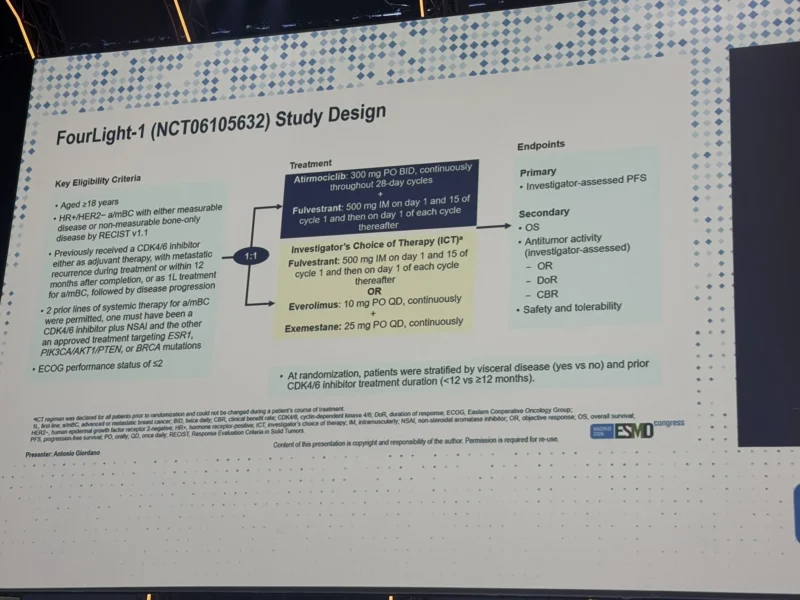
FOURLIGHT-1 enrolled 263 patients with HR-positive/HER2-negative advanced or metastatic breast cancer. Patients were randomized 1:1 to receive atirmociclib 300 mg orally twice daily continuously plus fulvestrant or investigator’s choice therapy.
The control treatment consisted of fulvestrant alone or everolimus plus exemestane. Among 137 patients in the control group, 79 received fulvestrant and 58 received everolimus plus exemestane. Previous CDK4/6 inhibitor exposure was required.
Most participants had received a CDK4/6 inhibitor as first-line treatment for advanced disease, while a smaller proportion had received one in the adjuvant setting and subsequently developed metastatic recurrence.
Two previous systemic regimens for advanced breast cancer were permitted, although one had to include a CDK4/6 inhibitor plus a nonsteroidal aromatase inhibitor. Patients could also previously have received an approved targeted therapy for ESR1, PIK3CA, AKT1, PTEN, or BRCA alterations.
The primary endpoint was investigator-assessed PFS, with overall survival, response rate, duration of response, clinical benefit rate, and safety included as secondary endpoints.
Most Patients Had Recently Progressed on a CDK4/6 Inhibitor
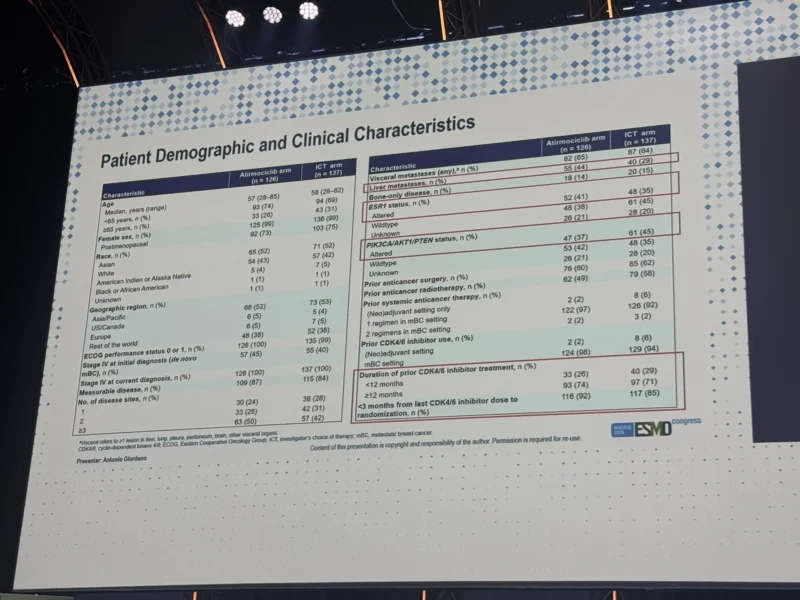
The timing of prior CDK4/6 exposure is particularly important. Approximately 94% of participants had received a CDK4/6 inhibitor as their immediately preceding first-line treatment for metastatic disease. Most patients entered FOURLIGHT-1 shortly after stopping that therapy, rather than after a prolonged interval during which tumor biology could substantially change.
The majority had also remained on their previous CDK4/6 inhibitor for at least 12 months. This makes the result more interesting biologically. Atirmociclib was not simply reintroducing cell-cycle inhibition years after prior exposure. It was being used in tumors that had recently demonstrated clinical resistance to CDK4/6-based therapy.
The PFS improvement therefore suggests that progression on a conventional dual CDK4/6 inhibitor does not necessarily mean complete loss of dependence on CDK4 signaling.
PFS Improved From 6.6 to 9.4 Months
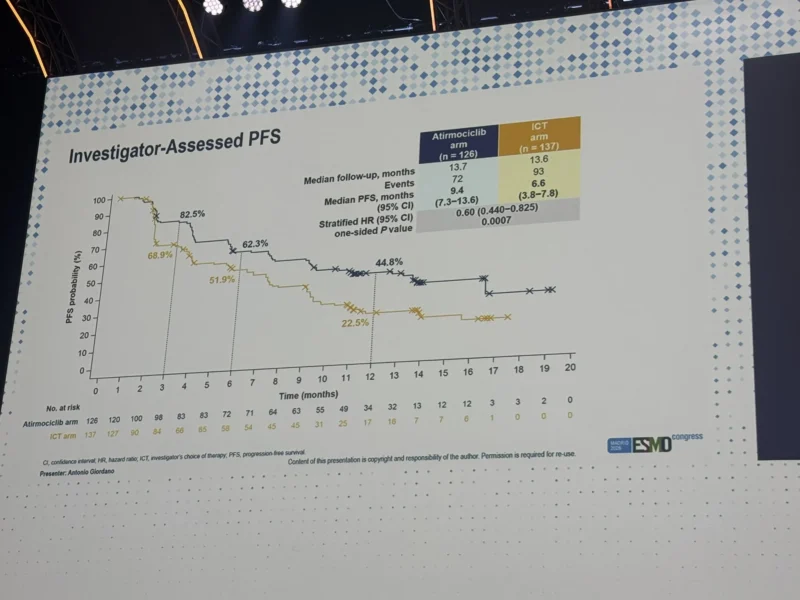
At the January 12, 2026 data cutoff, median follow-up was approximately 13.7 months in the atirmociclib group and 13.6 months in the control group. Median PFS was 9.4 months with atirmociclib plus fulvestrant compared with 6.6 months with investigator’s choice therapy.
The HR of 0.60 met the study’s primary endpoint. The separation was also visible in landmark PFS rates. At approximately three months, PFS was 82.5% with atirmociclib versus 68.9% with investigator’s choice therapy.
At six months, the corresponding rates were approximately 62.3% versus 51.9%. By 12 months, approximately 44.8% of patients receiving atirmociclib remained progression free compared with 22.5% in the control group.
The widening difference at 12 months suggests that the benefit was not restricted to a short delay in progression immediately after randomization.
Benefit Was Seen Across Most Prespecified Subgroups
Investigators reported that the PFS advantage was generally consistent across most prespecified patient subgroups. The study population included patients with visceral disease, liver metastases, bone-only disease, ESR1 alterations, and alterations affecting the PIK3CA/AKT1/PTEN pathway.
The presence of these molecularly and clinically heterogeneous groups is relevant because post-CDK4/6 HR-positive breast cancer does not represent a single resistance state.
Atirmociclib therefore appears to retain activity across more than one biological subgroup, although FOURLIGHT-1 was not designed or powered to establish definitive efficacy within individual molecular categories.
Future biomarker analyses will be particularly important in determining whether there is a population with especially persistent CDK4 dependence after conventional CDK4/6 inhibition.
Response Rate and Clinical Benefit Also Favored Atirmociclib
The PFS advantage was supported by additional measures of antitumor activity. Among patients with measurable disease, confirmed objective response rate was 19.3% with atirmociclib plus fulvestrant compared with 11.3% with investigator’s choice therapy.
The odds ratio was approximately 1.91. Median duration of response was also longer, reaching 14.8 months with atirmociclib compared with 9.3 months in the control arm.
Clinical benefit rate, which incorporated complete response, partial response, or prolonged stable disease, was: 61.9% with atirmociclib versus 46.0% with investigator’s choice therapy.
The corresponding odds ratio was 1.97, with a one-sided P value of 0.0041. These results are particularly relevant in a setting where objective tumor shrinkage is often difficult to achieve after previous endocrine and CDK4/6 therapy.
Atirmociclib appears to have improved not only the duration of disease control but also the probability and durability of measurable response.
Overall Survival Is Not Yet Mature
Overall survival remains immature. FOURLIGHT-1 therefore cannot establish whether the PFS improvement will translate into longer survival. This is an important limitation, particularly because the post-CDK4/6 treatment landscape now contains multiple therapeutic options and patients may receive several subsequent treatments.
The randomized PFS result establishes clinically meaningful activity, but mature survival follow-up and subsequent-treatment analyses will be needed to define the long-term magnitude of benefit.
Selective CDK4 Inhibition Does Not Eliminate Hematologic Toxicity
The selective mechanism of atirmociclib does not mean that hematologic toxicity disappears.
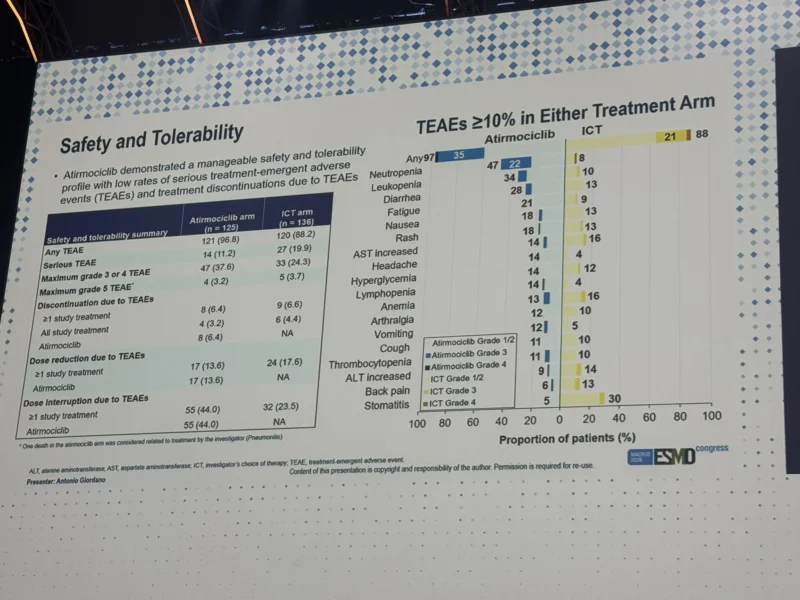
The most common treatment-related adverse event with atirmociclib was neutropenia, occurring in 46.4% of patients, followed by leukopenia in approximately 32.8%. Treatment-emergent adverse events of any cause occurred in nearly all patients receiving atirmociclib.
Grade 3 or 4 treatment-emergent adverse events occurred in approximately 37.6% of patients receiving atirmociclib compared with 24.3% in the investigator’s choice arm.
However, serious treatment-emergent adverse events were reported in approximately 11.2% with atirmociclib compared with 19.9% with investigator’s choice therapy. Treatment-related adverse events led to discontinuation of atirmociclib in approximately 4% of patients. The safety profile therefore needs a nuanced interpretation.
Atirmociclib retains clinically meaningful hematologic toxicity, particularly neutropenia and leukopenia, but permanent discontinuation because of treatment-related toxicity remained relatively uncommon.
Dose Modification Was Part of Treatment Management
Dose interruptions were relatively frequent with atirmociclib, reflecting the need for active toxicity management. Dose reductions were also required in a proportion of patients. This pattern is important when assessing the practical implications of selective CDK4 inhibition.
The potential value of a more selective inhibitor should not be measured by whether it eliminates all treatment-related toxicity. A more relevant question is whether selectivity allows adequate drug exposure and prolonged treatment while maintaining an acceptable rate of serious toxicity and permanent discontinuation.
FOURLIGHT-1 provides an encouraging signal in that direction, but larger phase III experience will be necessary to define the true tolerability advantage.
The Control Arm Is an Important Limitation
FOURLIGHT-1 was randomized, but the comparator was not a single standardized therapy. The investigator’s choice group included both fulvestrant monotherapy and everolimus plus exemestane, treatments with different mechanisms, efficacy expectations, and toxicity profiles. This makes interpretation of the precise magnitude of benefit more complicated.
Contemporary post-CDK4/6 treatment is also increasingly biomarker driven, with therapeutic decisions influenced by alterations such as ESR1, PIK3CA, AKT1, PTEN, and BRCA, as well as endocrine sensitivity, disease burden, prior treatment, and availability of antibody-drug conjugates.
FOURLIGHT-1 therefore should not be interpreted as demonstrating superiority over every modern second-line treatment option.
Instead, it demonstrates that selective CDK4 inhibition can outperform a prespecified standard-treatment control strategy in a randomized post-CDK4/6 population.
Does Progression on CDK4/6 Mean the Cell Cycle Should Still Be Targeted?
This is the central biological question raised by FOURLIGHT-1. Historically, progression on a CDK4/6 inhibitor often prompted clinicians to move toward a different therapeutic pathway rather than continue intensive cell-cycle targeting.
Atirmociclib challenges that assumption. Resistance to dual CDK4/6 inhibition may not always represent complete independence from CDK4.
Some tumors may retain substantial CDK4 dependency while escaping through mechanisms that make conventional inhibitors less effective. More potent or more continuous selective CDK4 suppression could therefore remain active.
Other tumors may shift toward CDK2, CDK6, or alternative proliferative pathways and become less sensitive. The future of this strategy may consequently depend on identifying which resistance states remain CDK4 dependent.
Phase III Development Will Determine Whether Atirmociclib Can Move Earlier
FOURLIGHT-1 is a phase II study and should be viewed as proof of concept rather than definitive practice-changing evidence. The development program is already moving into earlier disease settings.
A phase III study is evaluating atirmociclib in the first-line metastatic setting against established CDK4/6 inhibitor-based therapy combined with letrozole. Pfizer has also described broader development of the agent in early breast cancer.
That strategy sets a substantially higher bar. In the post-CDK4/6 setting, the question is whether atirmociclib retains activity after resistance. In first-line disease, it will need to demonstrate that selective CDK4 inhibition can compete directly with a class of drugs that has already produced major progression-free and overall survival improvements.
The value proposition may ultimately depend on a combination of efficacy, tolerability, treatment continuity, and compatibility with other targeted therapies.
OncoDaily Takeaway
FOURLIGHT-1 provides the first randomized evidence that a next-generation selective CDK inhibitor can significantly improve progression-free survival after prior CDK4/6 inhibitor therapy in HR-positive/HER2-negative advanced breast cancer.
Atirmociclib plus fulvestrant extended median PFS from 6.6 to 9.4 months, reducing the hazard of progression or death by approximately 40%.
Objective response rate increased from 11.3% to 19.3%, while clinical benefit rate improved from 46.0% to 61.9%. Median duration of response reached 14.8 months compared with 9.3 months in the control arm.
The finding is particularly important because most patients had recently progressed on first-line CDK4/6 inhibitor treatment.
That suggests conventional CDK4/6 resistance does not necessarily mean that the tumor has completely escaped dependence on the cell-cycle pathway.
At the same time, FOURLIGHT-1 remains a randomized phase II study. Overall survival is immature, the control arm included two different treatment strategies, and the trial does not establish superiority over the full range of modern biomarker-selected post-CDK4/6 therapies.
The most important implication may therefore be biological rather than immediately practice changing. Selective CDK4 inhibition can remain clinically active after progression on dual CDK4/6 inhibition.
The next challenge is determining which tumors retain that dependency—and whether atirmociclib can ultimately compete with established CDK4/6 inhibitors when moved into earlier treatment lines.
Source
- Giordano A, et al. Efficacy and safety of atirmociclib plus fulvestrant in patients with HR-positive/HER2-negative advanced or metastatic breast cancer who progressed on prior CDK4/6 inhibitor in the randomized phase II FOURLIGHT-1 study. Presented at ESMO Congress 2026, October 24, 2026. Clinical trial identifier NCT06105632.