
Exercise is already an established component of cancer survivorship, with benefits extending across cardiovascular health, physical function, fatigue, and quality of life. A new study now suggests that its effects may reach deeper into the biology of aging itself.
A secondary analysis of the randomized I Can! trial, published in the Journal of the National Cancer Institute, found that a 12-month remotely delivered exercise intervention was associated with slower epigenetic aging in breast cancer survivors compared with an attention-matched health and wellness programme. The analysis also linked faster epigenetic aging with worse attention and self-reported cognition and identified exercise-associated DNA methylation changes involving pathways related to brain-derived neurotrophic factor, or BDNF (Carlin et al., 2026).
The findings do not mean that exercise literally makes survivors younger. Instead, they suggest that physical activity may influence biological processes captured by DNA methylation-based “epigenetic clocks”, and that those changes may be relevant to cognitive health after breast cancer treatment.
Cancer Survivorship and Accelerated Biological Aging
Breast cancer survivorship increasingly extends for decades, making the long-term consequences of cancer and its treatment a major component of oncology care. Chemotherapy, radiation, endocrine therapy, psychological stress, and physical deconditioning can all contribute to physiological changes that resemble or accelerate aspects of aging. These may manifest as declining physical function, fatigue, frailty, cardiovascular risk, and cognitive impairment.
Carlin and colleagues focused on epigenetic aging, a biological concept derived from DNA methylation patterns at specific genomic sites. These patterns change with age and can be combined into mathematical models, often called epigenetic clocks, to estimate aspects of biological rather than chronological aging.
Accelerated epigenetic aging has previously been associated with adverse health outcomes and cognitive decline. Whether these biological trajectories can be modified after cancer treatment, however, remains less clear (Carlin et al., 2026). Exercise represents an attractive intervention because, unlike many treatment-related exposures, physical activity is potentially modifiable.
The I Can! Trial
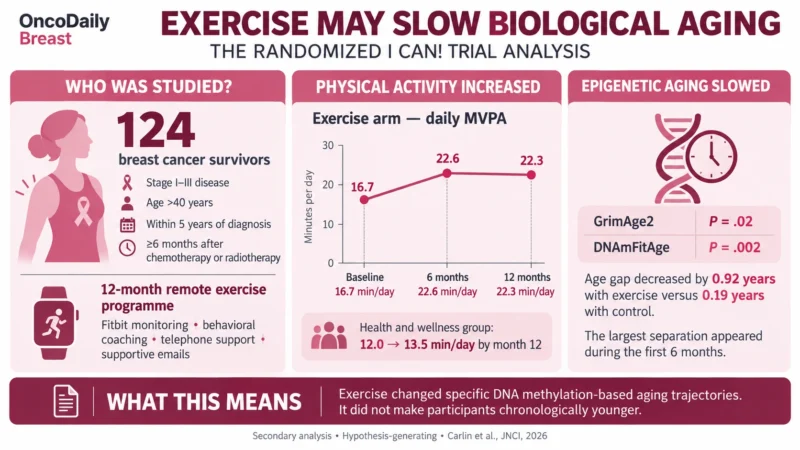
The current study was a secondary analysis of the previously completed Improving Cognition After Cancer, or I Can!, randomized controlled trial. Eligible participants were inactive breast cancer survivors older than 40 years with stage I–III disease, within five years of diagnosis and at least six months beyond active treatment such as chemotherapy or radiotherapy. For the methylation analysis, investigators studied 124 participants with blood samples available across the relevant time points (Carlin et al., 2026).
Participants were assigned to either a remotely delivered exercise programme or a contact-matched health and wellness control. The exercise intervention incorporated Fitbit monitoring, behavioral coaching, regular telephone support, and supportive emails. Participants in the control group received contact on a similar schedule but discussed subjects such as nutrition, stress management, sleep, and general wellness rather than being given the structured physical activity intervention.
The cohort had a mean age of approximately 58.8 years and was, on average, about three years from breast cancer diagnosis. Most participants had previously been diagnosed with stage I or II disease.
The Intervention Actually Increased Physical Activity
An important feature of the analysis is that the behavioral intervention produced a measurable change in activity. Accelerometer-measured moderate-to-vigorous physical activity increased more substantially in the exercise group at follow-up.
Average daily MVPA in the exercise arm increased from approximately:
- 16.7 minutes/day at baseline
to
- 22.6 minutes/day at 6 months
and
- 22.3 minutes/day at 12 months.
In the health and wellness group, activity remained much closer to baseline, increasing from approximately 12.0 minutes/day to 13.5 minutes/day by month 12 (Carlin et al., 2026). This is important because the biological findings were observed in the context of a demonstrated behavioral difference between the randomized groups.
Exercise Was Associated With Slower Epigenetic Aging
The investigators evaluated several epigenetic clocks, with GrimAge2 designated as the primary clock and DNAmFitAge as another major prespecified measure because of its relationship with fitness-related physiology. At baseline, participants in both study groups showed evidence of accelerated epigenetic aging relative to chronological age.
Over the 12-month study period, however, the exercise arm demonstrated a significantly slower epigenetic aging trajectory according to both major clocks:
- GrimAge2: P = .02
- DNAmFitAge: P = .002
The difference was particularly notable during the first six months. While the health and wellness group showed epigenetic aging at approximately twice the rate of chronological time during that period, epigenetic aging was essentially halted in the exercise group. At 12 months, the gap between chronological and epigenetic age had decreased by 0.92 years in the exercise group versus 0.19 years in the control group. That result should be interpreted carefully.
It does not mean participants became 0.92 chronological years younger. Epigenetic age is a biomarker derived from DNA methylation models rather than a direct measure of lifespan or physical age. The more appropriate interpretation is that the exercise intervention shifted the trajectory of specific biological aging signals captured by these clocks.
Not Every Epigenetic Clock Changed
The results were also not universal across all aging measures. The investigators examined several additional models, including the Horvath, Hannum, PhenoAge, Zhang, intrinsic and extrinsic epigenetic age clocks, as well as an epigenetic estimate of telomere length. No significant intervention-associated differences were detected with those measures. This is an important nuance.
Different epigenetic clocks are trained to capture different aspects of aging biology. The fact that GrimAge2 and DNAmFitAge changed while several older models did not suggests the intervention may be influencing specific aging-related biological processes rather than producing a universal change across every methylation-based age estimate.
The authors interpret this pattern as consistent with GrimAge2 and DNAmFitAge being particularly sensitive to health- and fitness-related physiology.
Biological Aging Was Linked With Cognitive Change
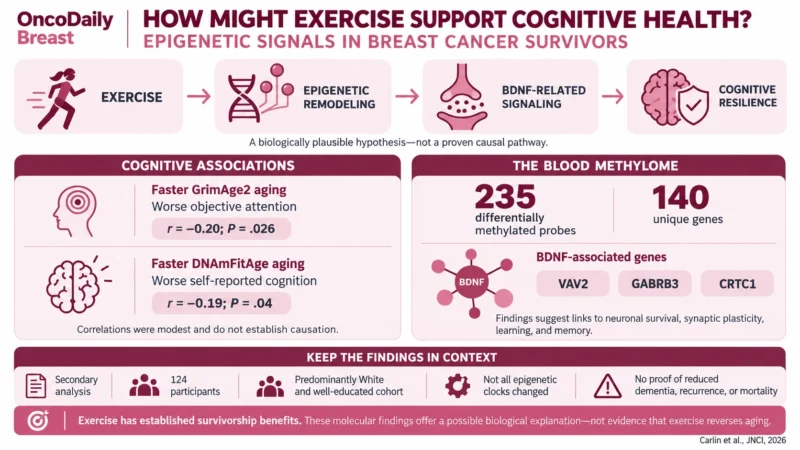
The investigators also explored whether epigenetic aging was related to cognitive outcomes. Faster aging according to GrimAge2 correlated with worsening performance in an objective attention domain:
- r = –0.20; P = .026.
Similarly, greater epigenetic aging according to DNAmFitAge was associated with worsening self-reported cognitive ability:
- r = –0.19; P = .04
These are modest correlations and should not be interpreted as evidence that epigenetic aging directly causes cognitive decline. However, they add a potentially important biological dimension to one of the most persistent concerns reported by breast cancer survivors: changes in memory, attention, concentration, and perceived mental sharpness after treatment.
Interestingly, the relationship between faster epigenetic aging and worse cognitive performance was stronger in the health and wellness group than in the exercise group, which the authors suggest may be consistent with a possible buffering effect of physical activity. Larger studies will be necessary to determine whether that relationship is causal.
Exercise Also Changed the Blood Methylome
The investigators went beyond epigenetic clocks and performed a genome-wide analysis of DNA methylation. They identified 235 significantly differentially methylated probes, mapping to 140 unique genes, as well as 140 differentially methylated regions under their specified analysis. Functional analysis revealed enrichment involving several physiological processes, including physical activity, body fat percentage, blood pressure, and notably BDNF signaling.
Three BDNF-associated genes stood out:
- VAV2
- GABRB3
- CRTC1
Each showed differential methylation within the exercise group.
Why BDNF Is Interesting
BDNF is involved in neuronal survival, synaptic plasticity, learning, and memory. The finding therefore offers a potential biological bridge between physical activity and cognitive health.
The authors describe several possible links. CRTC1 participates in processes related to BDNF-induced dendritic growth; VAV2 is involved in BDNF/TrkB-mediated dendritic spine plasticity; and GABRB3 interacts with BDNF-related mechanisms influencing synaptic development and inhibitory signaling (Carlin et al., 2026).
The study does not establish that these methylation changes caused improved cognition. Instead, they provide a mechanistically plausible hypothesis:
exercise → epigenetic remodeling → altered neuroplasticity-related signaling → greater cognitive resilience.
That pathway now warrants prospective validation.
The Findings Are Relevant to Modern Breast Cancer Survivorship
The number of people living for years or decades after breast cancer treatment continues to increase. As survival improves, survivorship care must address more than recurrence surveillance. Long-term cardiovascular health, bone health, metabolic dysfunction, cognitive impairment, treatment-related menopause, fatigue, sexual health, and physical function increasingly form part of comprehensive breast oncology.
Exercise is particularly attractive because a single intervention may influence several of these domains simultaneously. This study extends that concept by suggesting that physical activity may also influence molecular markers associated with aging. The implication is not that exercise should be thought of as an anti-aging drug. Rather, it suggests that some aspects of the biological aging associated with cancer and cancer therapy may be more modifiable than previously assumed.
Important Limitations
The study remains hypothesis-generating. This was a secondary analysis of a subset of participants from a larger randomized trial rather than a trial originally designed with epigenetic aging as the primary endpoint. The methylation sample included only 124 participants, limiting power for smaller effects and interactions. The study population was also predominantly White and well educated, which limits generalizability to the broader global population of breast cancer survivors.
In addition, the epigenetic aging estimates were calculated relative to the study sample, meaning they may not be directly comparable with values derived from the external populations used to originally develop the different clocks (Carlin et al., 2026).
There was also an initial difference in absolute epigenetic age between the groups, although the difference between epigenetic and chronological age at baseline was not statistically different. And most importantly, the study cannot establish that slowing epigenetic aging itself leads to clinically meaningful reductions in dementia, cardiovascular disease, cancer recurrence, or mortality. Those outcomes would require considerably larger studies with longer follow-up.
Exercise Should Not Be Reduced to an Epigenetic Clock
Another important clinical point is that the value of exercise in survivorship does not depend on proving that it reverses an aging biomarker. Physical activity already has established benefits across multiple areas of general and cancer-related health.
The epigenetic findings add a possible biological explanation rather than providing the sole rationale for exercise. This distinction is important because describing these results simply as “exercise reverses aging” would substantially overstate the evidence. The study instead supports a more precise conclusion:
a structured 12-month physical activity intervention altered specific DNA methylation-based aging trajectories in breast cancer survivors, and those trajectories were associated with measures of cognitive health.
The Bottom Line
The I Can! secondary analysis provides randomized evidence suggesting that physical activity may influence the biology of aging after breast cancer. Among 124 breast cancer survivors:
- GrimAge2 aging was slower with exercise – P = .02
- DNAmFitAge aging was slower – P = .002
The gap between chronological and epigenetic age decreased by 0.92 years in the exercise arm versus 0.19 years in the health and wellness group, while faster epigenetic aging correlated with worse attention and self-reported cognition. Genome-wide methylation analysis also identified changes involving BDNF-related pathways, offering one possible mechanistic link between physical activity and cognitive resilience.
The authors appropriately conclude that these findings provide preliminary evidence supporting physical activity as a potentially useful strategy for addressing cancer-related accelerated aging and cognitive decline, while emphasizing the need for larger confirmatory studies (Carlin et al., 2026).
In breast cancer survivorship, exercise may therefore be doing more than improving fitness. It may also be influencing some of the biological pathways through which cancer and its treatment leave a lasting imprint on aging.
Reference
- Carlin, D., Ott, O., Sears, D. D., Ahles, T., Desplats, P., & Hartman, S. J. (2026). Exercise slows biological aging in breast cancer survivors: Secondary analysis of a randomized trial. JNCI: Journal of the National Cancer Institute. https://doi.org/10.1093/jnci/djag296.