
The 2026 European Society for Medical Oncology Clinical Practice Guideline for early breast cancer marks a significant evolution in risk-adapted treatment. Published in Annals of Oncology on November 25, the updated recommendations incorporate trastuzumab deruxtecan in neoadjuvant and post-neoadjuvant HER2-positive disease, adjuvant giredestrant for selected ER-positive/HER2-negative patients, longer-term immunotherapy evidence in triple-negative breast cancer, and broader opportunities for de-escalation of surgery and radiotherapy. Together, these changes reflect a growing emphasis on matching treatment intensity to recurrence risk, tumor biology, and treatment response.
The management of early breast cancer has undergone a profound transformation over the past decade. Advances in molecular profiling, neoadjuvant systemic therapy, antibody–drug conjugates, endocrine treatment, and locoregional management have expanded the opportunities to cure more patients while reducing unnecessary treatment.
However, increasing therapeutic complexity has also introduced new clinical challenges. Which patients need intensified systemic treatment? Who can safely avoid chemotherapy, axillary surgery, or additional radiotherapy? How should pathological response guide postoperative treatment? And how can clinicians balance improved disease control against long-term toxicity?
The updated ESMO Clinical Practice Guideline, Early Breast Cancer: ESMO Clinical Practice Guideline for Diagnosis, Treatment and Follow-Up, provides a comprehensive framework for these decisions. Developed by an international expert group led by D. Trapani, A. M. Brunt, S. Dawood, R. Dent, and M. Gnant, together with S.-B. Kim, E. A. Mittendorf, M. Oliveira, B. Pistilli, R. Salgado, I. Vaz-Luis, H. Wildiers, R. C. Zellars, G. Curigliano, and S. M. Tolaney, the guideline supersedes the 2024 edition.
The recommendations were last updated in October 2026 and cover the entire pathway of early breast cancer care, from diagnosis and molecular assessment to surgery, systemic treatment, radiotherapy, follow-up, and survivorship.
The central principle is risk-informed treatment optimization: intensifying therapy where recurrence risk justifies additional treatment while reducing interventions in appropriately selected lower-risk populations.
HER2-Positive Breast Cancer: Antibody–Drug Conjugates Enter Curative-Intent Treatment
One of the most important developments is the integration of trastuzumab deruxtecan (T-DXd) into the treatment of HER2-positive early breast cancer. For many years, chemotherapy combined with trastuzumab, with or without pertuzumab, has formed the foundation of curative-intent systemic treatment.
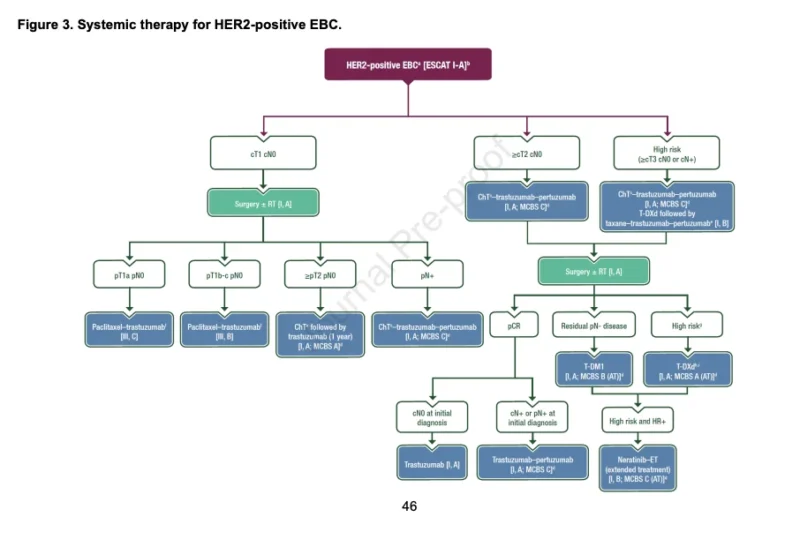
The new guideline maintains 12 months of HER2-directed therapy as a central standard, generally alongside 12–24 weeks of chemotherapy [I, A]. However, the treatment pathway is becoming more individualized. For stage II–III HER2-positive breast cancer, neoadjuvant treatment remains preferred because it permits assessment of pathological response and subsequent adjustment of postoperative therapy.
In selected high-risk patients, ESMO now allows consideration of neoadjuvant T-DXd followed by a taxane, trastuzumab, and pertuzumab [I, B], particularly when an anthracycline-containing approach is unsuitable. The recommendation is informed by DESTINY-Breast11.
In that trial, T-DXd followed by taxane–trastuzumab–pertuzumab achieved a pathological complete response rate of 67.3%, compared with 56.3% for dose-dense doxorubicin–cyclophosphamide followed by taxane–trastuzumab–pertuzumab.
The result supports the potential of an ADC-based neoadjuvant strategy to replace part of conventional cytotoxic treatment in selected patients. Nevertheless, long-term survival data remain immature. A higher pathological complete response rate is clinically relevant but should not automatically be equated with an established overall survival advantage.
DESTINY-Breast05 Changes Post-Neoadjuvant Treatment
The most consequential HER2-directed recommendation concerns patients with high-risk residual invasive disease following neoadjuvant treatment. Previously, trastuzumab emtansine (T-DM1) became the principal post-neoadjuvant intensification strategy following the KATHERINE trial.
Longer-term results confirmed meaningful improvements in both invasive disease–free survival and overall survival compared with trastuzumab. However, DESTINY-Breast05 has now demonstrated superior invasive disease–free survival with T-DXd compared with T-DM1 in a high-risk residual-disease population.
At three years, invasive disease–free survival was 92.4% with T-DXd versus 83.7% with T-DM1. The new ESMO guideline recommends post-neoadjuvant T-DXd for patients meeting its defined high-risk criteria, provided T-DXd has not already been administered [I, A].
Those criteria include selected patients with residual node-positive disease and patients who initially presented with inoperable, locally advanced disease, according to the detailed clinical-stage and pathological-response definitions in the guideline.
Patients with residual node-negative disease remain candidates for T-DM1 [I, A]. This distinction is essential. The recommendations do not imply that every patient with residual HER2-positive disease should automatically receive T-DXd instead of T-DM1.
The choice depends on baseline stage, surgical operability, residual nodal status, prior neoadjuvant treatment, and the risk of recurrence. Safety also becomes increasingly important. T-DXd is associated with interstitial lung disease and pneumonitis, requiring proactive symptom assessment and appropriate pulmonary monitoring.
The guideline specifically emphasizes scheduled chest imaging in the post-neoadjuvant T-DXd setting. The broader implication is that pathological response is now a major determinant of subsequent HER2-directed treatment intensity.
De-Escalation Remains Important for Lower-Risk HER2-Positive Disease
While high-risk disease increasingly supports treatment intensification, the guideline also maintains opportunities to reduce treatment burden in lower-risk populations. For patients with small node-negative tumors, adjuvant paclitaxel plus trastuzumab remains an appropriate option.
Long-term data cited by ESMO report a 10-year invasive disease–free survival of approximately 91.3% with this approach. The guideline also recognizes that anthracycline-free neoadjuvant regimens can provide effective treatment with improved cardiac safety.
For appropriately selected patients, treatment planning should therefore distinguish those who need intensive multiagent treatment from those likely to achieve excellent outcomes with a less toxic regimen. This risk-adapted approach extends beyond chemotherapy selection to the postoperative use of trastuzumab, pertuzumab, T-DM1, and T-DXd.
Triple-Negative Breast Cancer: Seven-Year KEYNOTE-522 Results Strengthen Immunotherapy
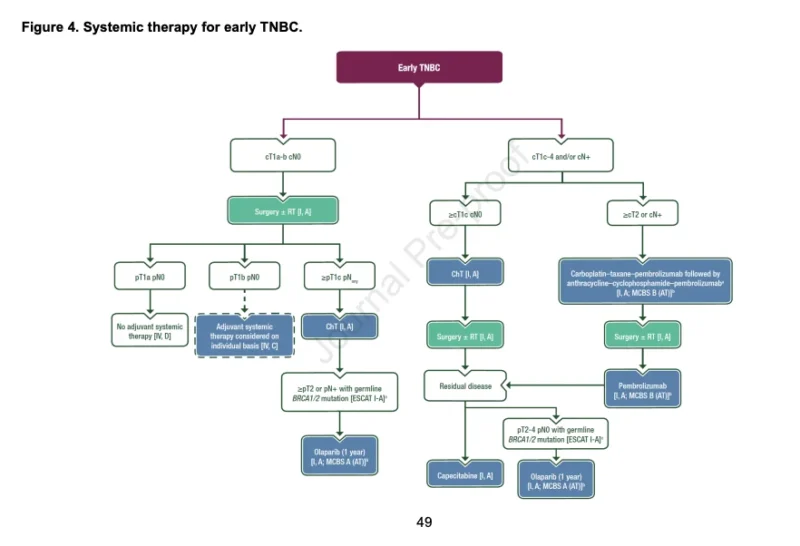
In early triple-negative breast cancer (TNBC), the 2026 guideline reinforces the role of pembrolizumab-containing perioperative therapy. For stage II–III TNBC, ESMO recommends neoadjuvant carboplatin–taxane–pembrolizumab followed by anthracycline–cyclophosphamide–pembrolizumab, unless contraindicated [I, A].
Pembrolizumab is continued after surgery in patients who received it preoperatively, regardless of whether they achieve pathological complete response [I, A]. The recommendation is strengthened by seven-year outcomes from KEYNOTE-522.
Seven-year event-free survival was 78.3% with the pembrolizumab-containing regimen compared with 69.8% with chemotherapy alone. The hazard ratio was 0.68. Overall survival at seven years was 85.1% versus 77.2%, corresponding to a hazard ratio of 0.64.
These mature findings reinforce the importance of immunotherapy in selected patients with early high-risk TNBC. The guideline also explicitly states that PD-L1 expression should not be used to guide treatment decisions in early TNBC [I, E].
This differs from some metastatic TNBC settings, where PD-L1 status may determine eligibility for specific immunotherapy regimens. For patients unable to receive anthracyclines, non-anthracycline regimens may be considered, although the supporting evidence is less mature.
Residual TNBC: Capecitabine, Olaparib and Pembrolizumab Require Careful Sequencing
Response to neoadjuvant treatment also informs postoperative TNBC management. For patients with residual disease after neoadjuvant chemotherapy, ESMO recommends adjuvant capecitabine [I, A].
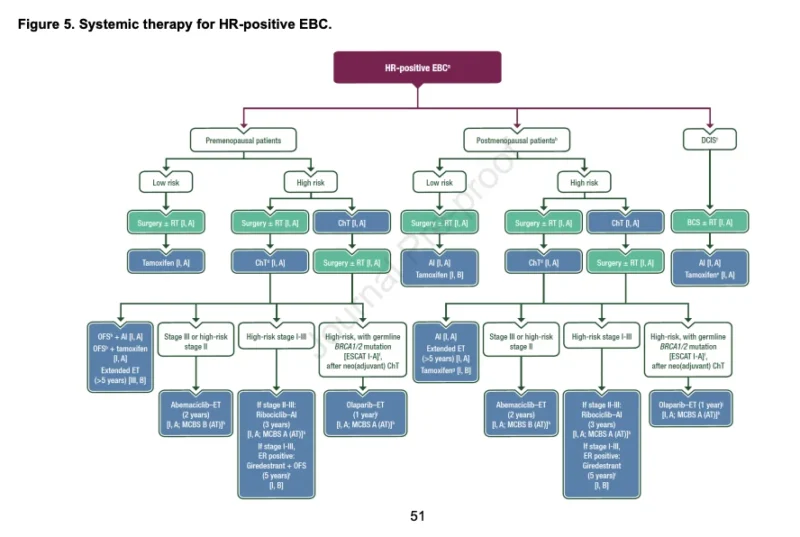
For eligible patients with germline BRCA1/2 mutations and high-risk disease, one year of adjuvant olaparib is recommended [I, A]. Pembrolizumab remains recommended postoperatively when it formed part of the neoadjuvant regimen.
However, the optimal way to combine or sequence pembrolizumab, capecitabine, and olaparib remains incompletely defined. The guideline acknowledges that combining or sequencing olaparib with pembrolizumab may be reasonable despite limited direct evidence.
Importantly, evidence supporting each treatment individually should not be interpreted as proof that every combination improves outcomes. Clinical decisions must consider germline BRCA status, residual disease burden, prior systemic treatment, toxicity, and the patient’s overall recurrence risk.
HR-Positive/HER2-Negative Disease: Giredestrant Enters the Adjuvant Algorithm
Another major development concerns the incorporation of giredestrant into the treatment framework for ER-positive/HER2-negative early breast cancer. Conventional endocrine therapy with tamoxifen or an aromatase inhibitor has remained the foundation of treatment for decades.
However, the phase III lidERA Breast Cancer trial demonstrated that an oral estrogen receptor antagonist with receptor-degrading activity could improve invasive disease–free survival compared with established endocrine therapy.
In lidERA, five years of adjuvant giredestrant reduced the hazard of invasive recurrence or death by 30%, with a hazard ratio of 0.70. Three-year invasive disease–free survival was 92.4% with giredestrant versus 89.6% with standard endocrine therapy.
ESMO states that adjuvant giredestrant for five years, combined with ovarian function suppression in premenopausal patients, could be recommended in selected high-risk stage I–III ER-positive/HER2-negative early breast cancer [I, B].
This is an important recognition of a new endocrine treatment strategy. However, lidERA did not allow concurrent adjuvant CDK4/6 inhibitors.
Therefore, it does not establish whether giredestrant improves outcomes when combined with abemaciclib or ribociclib, or whether it should replace CDK4/6-containing treatment approaches in higher-risk patients.
An important regulatory development also occurred after the manuscript was finalized: the FDA approved adjuvant giredestrant monotherapy on November 23, 2026, for eligible adults with intermediate- to high-risk ER-positive/HER2-negative stage I–III breast cancer.
This approval does not require an ESR1 mutation and is distinct from the separate FDA approval of giredestrant plus everolimus for ESR1-mutated advanced disease.
CDK4/6 Inhibitors Remain Central to High-Risk Adjuvant Treatment
The guideline preserves a major role for adjuvant CDK4/6 inhibitors. For patients with stage III or high-risk stage II HR-positive/HER2-negative breast cancer, two years of abemaciclib combined with endocrine therapy is recommended [I, A]. For eligible patients with high-risk stage II–III disease, three years of ribociclib combined with an aromatase inhibitor is recommended [I, A].
The recommendations reflect increasingly mature results from monarchE and NATALEE. The guideline reports a seven-year absolute recurrence reduction of 6.5 percentage points with adjuvant abemaciclib, accompanied by a 1.8-percentage-point absolute overall survival improvement.
For ribociclib, the cited five-year absolute recurrence reduction is 4.5 percentage points. However, these agents also introduce important tolerability challenges. Premature treatment discontinuation related to adverse events occurred in more than 18% of patients in the referenced adjuvant trials.
These findings emphasize that additional treatment is most likely to provide favorable net benefit when selected according to baseline recurrence risk. The availability of giredestrant creates another treatment-sequencing question but does not diminish the randomized evidence supporting established CDK4/6-based strategies.
Genomic Testing and OPTIMA: Reducing Unnecessary Chemotherapy
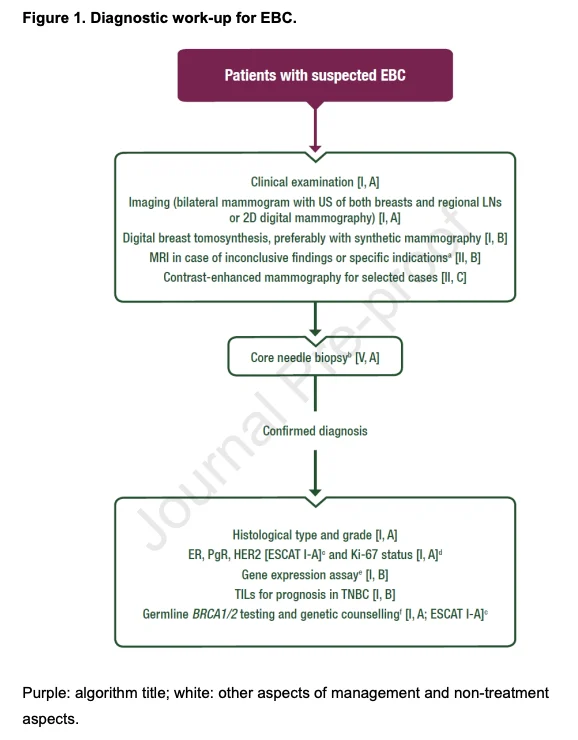
ESMO also strengthens the role of molecular risk stratification when deciding whether chemotherapy is necessary in HR-positive/HER2-negative early breast cancer. Validated prognostic genomic assays are recommended for individualizing chemotherapy decisions in appropriate postmenopausal patients [I, A].
Their use may also be considered in premenopausal node-negative disease, with individualized discussion for patients with limited nodal involvement [I, B]. The guideline highlights the OPTIMA study, which investigated test-directed chemotherapy omission in patients with clinically higher-risk ER-positive/HER2-negative disease.
OPTIMA supported a strategy of genomic test-directed chemotherapy omission in the studied population. However, the guideline cautions against broad extrapolation to premenopausal patients or patients with more extensive nodal disease because these subgroups were relatively limited.
This distinction is central to appropriate implementation. Genomic assays should complement clinical staging, tumor biology, menopausal status, and patient preferences, not replace them. For selected patients, a molecularly informed decision to omit chemotherapy may reduce toxicity without compromising outcomes. For others, chemotherapy remains an important component of curative-intent treatment.
Axillary Surgery: Further Steps Toward Less Invasive Management
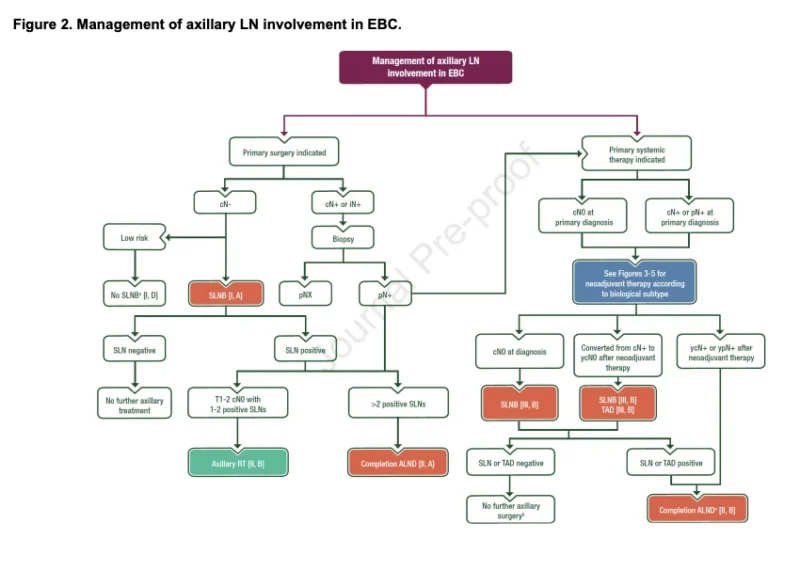
The 2026 guideline reflects the continued evolution of axillary management. Sentinel lymph-node biopsy remains the recommended staging procedure in clinically node-negative disease [I, A]. However, ESMO states that sentinel-node biopsy is not routinely recommended in selected low-risk patients undergoing breast-conserving surgery with whole-breast radiotherapy [I, D].
The examples provided include postmenopausal patients with HR-positive/HER2-negative tumors smaller than 2 cm, low or intermediate histological grade, no lymphovascular invasion, and negative axillary ultrasound.
For patients with one or two positive sentinel nodes and appropriate clinical features, axillary radiotherapy may be used instead of completion axillary lymph-node dissection [II, B].
Following neoadjuvant treatment, sentinel-node biopsy or targeted axillary dissection can be recommended in patients who convert from clinically node-positive to clinically node-negative disease [III, B].
Patients with residual macrometastatic disease generally remain candidates for completion axillary dissection. These recommendations reflect a broader shift away from routine extensive axillary surgery when additional intervention is unlikely to provide meaningful benefit.
However, de-escalation depends on the precise clinical setting, planned radiotherapy, initial and post-treatment nodal status, and surgical feasibility.
Radiation Oncology: Shorter Treatment and Selective Omission
Radiotherapy recommendations also reflect a greater emphasis on treatment optimization. Hypofractionation is now an established standard. Both moderate hypofractionation, such as 40 Gy in 15 fractions, and ultra-hypofractionation, such as 26 Gy in five fractions, are supported.
The guideline identifies ultra-hypofractionation as standard for appropriate breast and chest-wall irradiation without reconstruction. Moderate hypofractionation remains suitable for regional nodal irradiation and post-reconstruction settings.
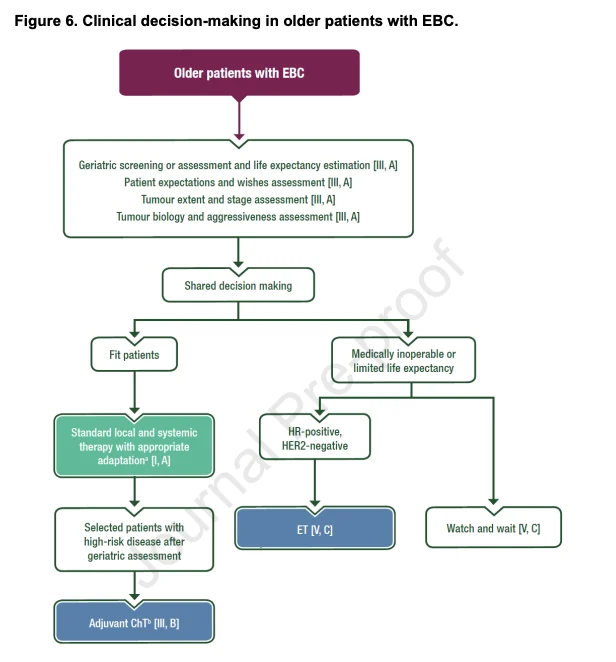
For selected older patients with low-risk HR-positive disease receiving endocrine treatment, omission of radiotherapy may be appropriate. However, omitting radiotherapy increases local recurrence risk even when overall survival is not adversely affected in the studied populations.
This difference must be discussed during shared decision-making. The guideline also addresses patients initially presenting with cT1–3 cN1 disease who achieve ypN0 after neoadjuvant chemotherapy. For this population, regional nodal irradiation is not recommended in the stated guideline algorithm [II, E].
This is a clinically consequential recommendation that requires careful application to the exact population studied. Patients with persistent nodal involvement or a different initial disease burden should not automatically be managed according to the same omission strategy.
Follow-Up: ctDNA Is Promising but Not Yet Routine Surveillance
The guideline extends beyond active treatment to survivorship and long-term monitoring. Clinical review is recommended every six months for five years, followed by annual assessment [I, A]. Annual mammography remains recommended, with additional ultrasound or MRI when clinically indicated.
ESMO explicitly advises against routine use of circulating tumor DNA testing for molecular residual disease or recurrence monitoring outside clinical trials [V, D]. Although ctDNA-based technologies may identify molecular evidence of residual disease before radiological recurrence, there is not yet sufficient evidence that routine testing followed by treatment intervention improves patient outcomes.
This distinction is important as commercial molecular monitoring tests become increasingly accessible. The availability of a test does not necessarily establish that its routine use improves survival or quality of life.
The guideline also emphasizes fertility counselling, cardiovascular and bone health, management of menopausal symptoms, psychological support, and interventions to improve adherence to long-term endocrine therapy.
What Changes in Clinical Practice?
Taken together, the 2026 recommendations illustrate a treatment landscape moving in two directions simultaneously. For patients with high-risk disease, increasingly effective treatments are being integrated into curative-intent care.
T-DXd introduces a major therapeutic advance for selected HER2-positive patients with residual invasive disease. Giredestrant provides a new endocrine treatment option for ER-positive/HER2-negative disease.
Longer-term KEYNOTE-522 findings reinforce perioperative pembrolizumab for higher-risk TNBC. CDK4/6 inhibitors and olaparib remain important options for eligible molecularly and clinically defined populations.
At the same time, the guideline encourages more individualized de-escalation. Genomic testing may reduce unnecessary chemotherapy, selected patients may avoid extensive axillary surgery, and shorter radiation schedules can reduce treatment burden.
The central challenge is ensuring that treatment is neither insufficient for high-risk disease nor unnecessarily intensive for lower-risk patients. An additional practical challenge concerns the difference between guideline publication and regulatory authorization.
The manuscript reports approval status at the time of writing, meaning some statements require updating against current FDA and European Commission decisions before publication or clinical implementation. For example, adjuvant giredestrant was subsequently approved by the FDA on November 23, 2026.
Similarly, the European Commission approved adjuvant T-DXd for an eligible HER2-positive residual-disease population on October 27, 2026, although the guideline manuscript still refers to the earlier positive regulatory opinion.
These timing differences do not alter the guideline’s evidence grades but matter for accurate reporting of medicine availability.
OncoDaily Takeaway
The 2026 ESMO Early Breast Cancer Clinical Practice Guideline represents a major step toward more individualized treatment across the entire disease continuum. In HER2-positive disease, T-DXd is incorporated into neoadjuvant and high-risk post-neoadjuvant strategies, supported by DESTINY-Breast11 and DESTINY-Breast05.
In TNBC, mature KEYNOTE-522 data strengthen the role of perioperative pembrolizumab, while capecitabine and olaparib remain important options in selected residual-disease settings. In HR-positive/HER2-negative early breast cancer, giredestrant enters the adjuvant treatment framework, alongside established endocrine treatment, CDK4/6 inhibitors, genomic risk assessment, and germline BRCA-directed therapy.
Across surgery and radiation oncology, the guideline supports less invasive or shorter treatment approaches when the available evidence identifies populations in whom de-escalation is appropriate.
At the same time, the recommendations preserve important boundaries: investigational ctDNA monitoring is not standard surveillance, clinical trials do not establish every possible treatment combination, and regulatory access varies across jurisdictions.
The defining principle of ESMO 2026 is that the future of early breast cancer care lies not in giving every patient more treatment, but in delivering the right intensity of treatment at the right moment, guided by tumor biology, recurrence risk, pathological response, and patient priorities.
Sources
- Trapani D, Brunt AM, Dawood S, Dent R, Gnant M, et al., on behalf of the ESMO Guidelines Committee. Early Breast Cancer: ESMO Clinical Practice Guideline for Diagnosis, Treatment and Follow-Up. Annals of Oncology. Published online November 25, 2026. DOI: 10.1016/j.annonc.2026.11.003
- DESTINY-Breast11 — Neoadjuvant trastuzumab deruxtecan followed by taxane–trastuzumab–pertuzumab in high-risk HER2-positive early breast cancer.
- DESTINY-Breast05 — Trastuzumab deruxtecan versus T-DM1 in high-risk HER2-positive residual disease.
- KEYNOTE-522 — Perioperative pembrolizumab in stage II–III triple-negative breast cancer.
- lidERA Breast Cancer — Adjuvant giredestrant versus standard endocrine therapy in ER-positive/HER2-negative early breast cancer.
- monarchE and NATALEE — Adjuvant CDK4/6 inhibition in HR-positive/HER2-negative early breast cancer.
- US Food and Drug Administration. FDA Approves Giredestrant for Adjuvant Treatment of ER-Positive, HER2-Negative Early Breast Cancer. November 23, 2026.
- US Food and Drug Administration. FDA Approves Two Separate Indications for Trastuzumab Deruxtecan in HER2-Positive Early-Stage Breast Cancer. May 15, 2026.