
Premenopausal women with hormone receptor-positive, HER2-negative early breast cancer occupy a uniquely difficult space in contemporary breast oncology.
Endocrine therapy is highly effective, genomic assays increasingly guide chemotherapy decisions, and adjuvant CDK4/6 inhibitors have expanded treatment options for higher-risk disease. Yet many of the questions clinicians face every day remain incompletely answered: Who truly needs ovarian function suppression? Can chemotherapy sometimes be replaced by optimal endocrine therapy? How should genomic assays be interpreted in young women? What should happen after five years of endocrine treatment? And how should efficacy be balanced against fertility, long-term toxicity and treatment adherence?
A 2026 review by Licata and colleagues in Annals of Oncology argues that premenopausal HR+/HER2− breast cancer should be viewed as a clinically distinct setting rather than simply applying evidence generated primarily in postmenopausal populations. The authors identify four interconnected areas of uncertainty: chemotherapy tailoring with genomic assays, selection and duration of endocrine therapy, endocrine-treatment adherence and safety, and fertility and reproductive considerations.
Premenopausal HR-Positive Breast Cancer Is Not Simply a Younger Version of Postmenopausal Disease
Young women with breast cancer are more likely to present with adverse clinical and biological features, and younger age has been associated with poorer prognosis particularly within HR-positive disease. The review highlights differences including higher histologic grade, greater prevalence of luminal B biology and enrichment of genomic alterations associated with more aggressive disease.
These biological differences matter because many treatment recommendations for younger patients are still extrapolated from studies in which postmenopausal women predominate. That creates a fundamental tension in clinical decision-making: younger women may have decades of recurrence risk ahead of them, yet they also have decades during which treatment toxicity, premature menopause, infertility and impaired quality of life can exert consequences.
The authors therefore frame treatment not simply around maximal relative risk reduction but around absolute benefit, treatment burden and individual patient priorities.
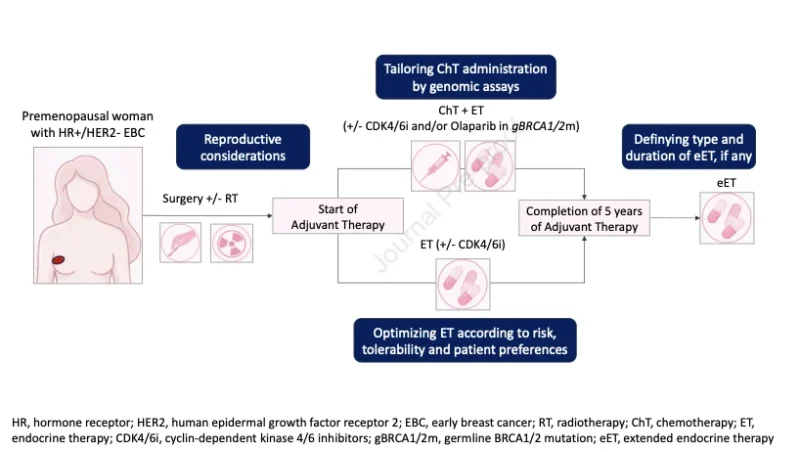
Ovarian Function Suppression: Effective, but Not for Everyone
Ovarian function suppression remains one of the most important, and most nuanced, decisions in adjuvant treatment.
Five years of tamoxifen has long been a standard option for premenopausal HR-positive early breast cancer, but long-term SOFT and TEXT results established that intensifying endocrine therapy with OFS can further reduce recurrence risk. In SOFT, adding OFS to tamoxifen reduced breast cancer events compared with tamoxifen alone, with a hazard ratio of 0.82 at 15 years.
Exemestane plus OFS produced still greater disease-control benefit. In the combined SOFT/TEXT analysis, 15-year DFS was:
- 74.9% with exemestane + OFS
versus
- 71.3% with tamoxifen + OFS
with HR 0.82.
However, overall survival was very similar — 87.8% versus 87.0%.
That distinction is important. The incremental reduction in recurrence must be weighed against years of medically induced menopause, particularly when the expected absolute benefit is small.
Risk, Not Menopausal Status Alone, Should Determine Escalation
SOFT and TEXT showed the greatest absolute benefit from endocrine escalation in women with higher-risk disease, including very young patients and those who had required chemotherapy. By contrast, many women with low-to-intermediate recurrence risk gained little absolute distant-recurrence benefit from aggressive ovarian suppression.
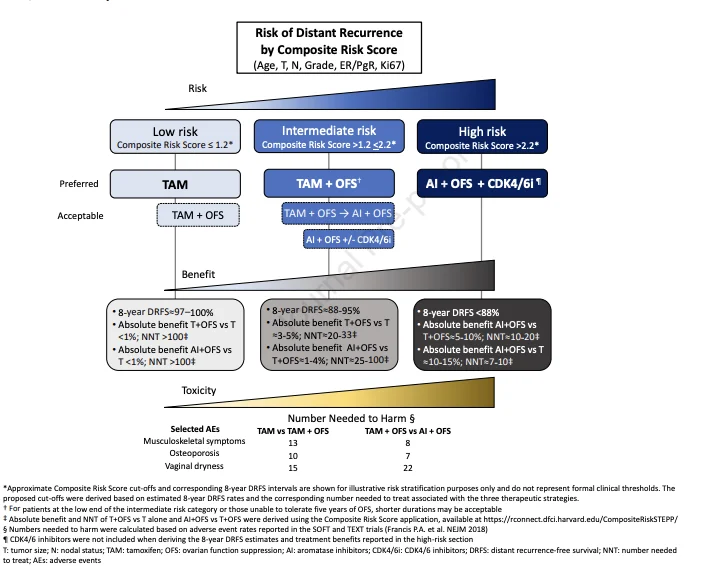
The review therefore argues against a universal approach. A practical framework emerges:
- Low risk: tamoxifen alone may be appropriate
- Intermediate risk: tamoxifen + OFS is a reasonable strategy, particularly when AI toxicity is a concern.
- Highest risk: an aromatase inhibitor + OFS is generally preferred
For appropriately selected higher-risk patients, adjuvant CDK4/6 inhibition should also be considered, since subgroup analyses from pivotal trials have demonstrated benefit in premenopausal patients comparable to the overall populations.
Does OFS Always Need to Last Five Years?
Not necessarily. ASTRRA explored a shorter strategy in women who recovered ovarian function after chemotherapy. Adding two years of OFS to tamoxifen improved 10-year DFS:
- 83.7% versus 75.9%
- HR 0.68
The finding suggests that shorter-duration OFS can still produce meaningful risk reduction in selected patients, particularly when five years of ovarian suppression would impose substantial toxicity or threaten adherence.
The broader message is important: duration should not automatically be separated from expected absolute benefit and tolerability.
Is Ovarian Suppression Actually Adequate?
Another less visible problem is incomplete ovarian suppression. When an aromatase inhibitor is used, persistent ovarian estrogen production could theoretically compromise efficacy. The review notes that three-monthly LHRH agonist formulations appear to provide ovarian suppression comparable with monthly dosing, but there is still no standardized approach to hormonal monitoring.
Routine estradiol measurement is not universally mandated, testing methods vary, and therapeutic thresholds remain poorly defined. Unexpected menopausal symptoms or unexpectedly elevated estradiol should prompt reassessment of treatment adherence, injection timing and dosing schedule.
This seemingly technical issue becomes clinically important because an AI without adequate suppression is biologically different from an AI in a truly postmenopausal hormonal environment.
Genomic Assays: Prognostic, but Chemotherapy Prediction Remains Complicated
Perhaps the most controversial part of treatment selection concerns genomic assays. Tests such as Oncotype DX have transformed chemotherapy decision-making in HR+/HER2− early breast cancer. Their prognostic value in premenopausal women is well established.
The problem is whether they can reliably predict who benefits from chemotherapy in this population. TAILORx and RxPONDER both suggested chemotherapy benefit among certain premenopausal patients with genomically lower-risk disease.
But the authors emphasize a major confounder: relatively few women in the endocrine-only arms received optimal OFS, while chemotherapy itself frequently suppresses ovarian function.
That means some apparent “chemotherapy benefit” may not arise solely from direct cytotoxic activity. It may partially represent a chemo-endocrine effect, chemotherapy causing ovarian suppression and thereby intensifying endocrine treatment.
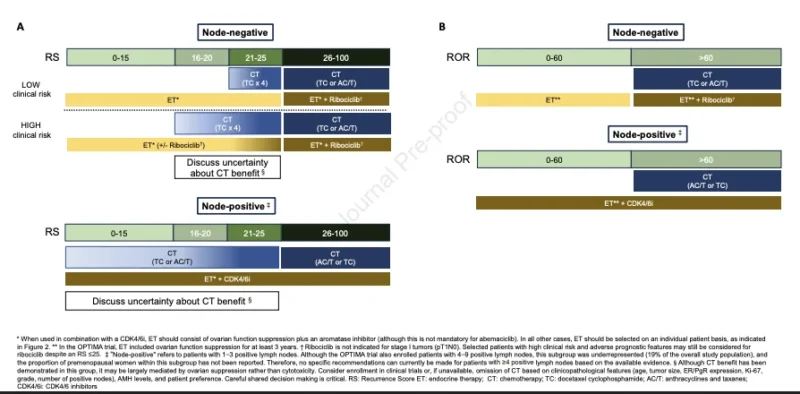
The Chemo-Endocrine Hypothesis
Several observations support this concept. In TAILORx, chemotherapy benefit among women aged ≤50 with recurrence scores of 16–25 was concentrated largely in women aged 40–50, the age group most likely to undergo treatment-induced menopause.
Benefit was not apparent in women younger than 40 to the same degree. In RxPONDER, premenopausal women older than 50 did not appear to gain chemotherapy benefit. A post-hoc RxPONDER analysis adds another biologically interesting observation.
Women with intermediate-to-high anti-Müllerian hormone levels, indicating greater ovarian reserve, appeared to gain substantial benefit from chemotherapy:
- HR 0.48, with an absolute 5-year benefit of 7.8%
Women with low AMH did not show the same benefit. The interpretation proposed by the review is that women with strong ovarian reserve may gain more from chemotherapy-induced ovarian suppression than those already approaching natural menopause.
This remains a hypothesis, not definitive proof that chemotherapy can routinely be replaced by OFS. But it challenges the simplistic assumption that chemotherapy benefit in every young woman necessarily reflects cytotoxic sensitivity.
OPTIMA Adds an Important Piece to the Puzzle
The 2026 OPTIMA findings provide new prospective evidence. OPTIMA randomized 4,429 patients aged over 40 to standard chemotherapy followed by endocrine therapy or a Prosigna-guided approach. Patients with low genomic risk in the test-directed group received endocrine therapy alone.
Five-year invasive breast cancer-free survival among low-ROR patients was:
- 94.8% with standard chemoendocrine therapy
versus
- 93.6% with test-directed endocrine therapy alone.
The strategy met the predefined noninferiority criterion. Importantly, OFS for at least three years was mandatory in premenopausal women receiving endocrine therapy alone. That design helps address one of the major weaknesses of earlier trials: the endocrine-alone arm actually received optimized ovarian suppression.
However, the authors caution that OPTIMA excluded women younger than 40, included relatively few patients with heavier nodal burden and was not powered specifically to establish noninferiority within the premenopausal subgroup.
So the findings are highly informative, but not the final answer.
OFSET and OPTIMA-YOUNG May Finally Address the Question
Two ongoing studies may provide the prospective evidence clinicians have been waiting for. OFSET (NCT05879926) and OPTIMA-YOUNG (NCT07106632) are designed to help determine whether optimized endocrine therapy with OFS can safely replace chemotherapy in selected premenopausal patients with genomically lower-risk disease.
Until those data mature, the review argues for avoiding two extremes automatically giving chemotherapy to all node-positive young women, or assuming that chemotherapy offers no direct cytotoxic benefit simply because ovarian suppression contributes to its effect.
The practical approach remains integration of clinical risk, genomic risk, endocrine strategy and patient preference.
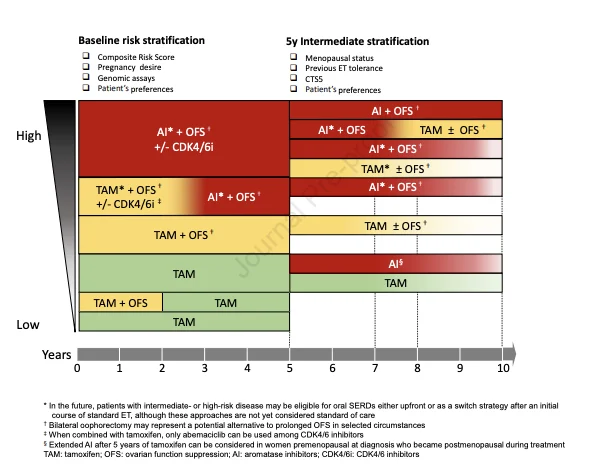
What Happens After Five Years of Endocrine Therapy?
HR-positive breast cancer carries a prolonged recurrence risk. More than half of distant recurrences can occur between years 5 and 20, creating a strong biological rationale for extended endocrine treatment. But this is another area where evidence in premenopausal women is strikingly limited.
ATLAS demonstrated that continuing tamoxifen to 10 years reduced recurrence and breast cancer mortality compared with stopping at five years. The recurrence risk ratio was 0.84, while breast cancer mortality beyond year 10 was reduced with RR 0.71.
aTTom similarly supported longer tamoxifen treatment. Yet most evidence for extended AI therapy comes from postmenopausal populations. For a woman who remains premenopausal after five years of OFS-based treatment, there is still no randomized trial defining the optimal next strategy.
Observational data suggest benefit from extended treatment in some very young women, but they cannot establish the ideal duration or regimen. New trials may eventually change that. EMBER-4, CAMBRIA-1 and ELEGANT are evaluating oral SERD-based extended endocrine approaches, including OFS in premenopausal patients.
Another challenge is determining whether a patient is truly postmenopausal after stopping prolonged OFS. Estradiol measurements can be affected by therapy and assay methodology, and even the appropriate washout period remains uncertain.
The review therefore frames extended endocrine therapy as another decision that must combine late recurrence risk, menopausal status, prior tolerability and patient preference, rather than following a fixed algorithm.
Adherence Is Not a Side Issue, It Is Part of Treatment Efficacy
A highly effective endocrine regimen has little value if a patient cannot remain on it. This is especially relevant in younger women, who can experience abrupt and profound menopausal symptoms after OFS. Hot flashes, sleep disturbance, joint pain, vaginal dryness, sexual dysfunction, fatigue, weight changes and psychological distress can accumulate over years.
In SOFT/TEXT, premature discontinuation was highest among women younger than 35, with approximately 20% stopping assigned therapy early. Real-world evidence consistently links early discontinuation to poorer outcomes.
One Danish registry analysis found recurrence risk approximately 1.7 times higher among premenopausal women who discontinued endocrine therapy than among those who completed treatment. The implication is that adherence should not be treated as a behavioral problem. It is a clinical outcome requiring active toxicity management.
Supportive Care Should Begin With the Treatment Plan
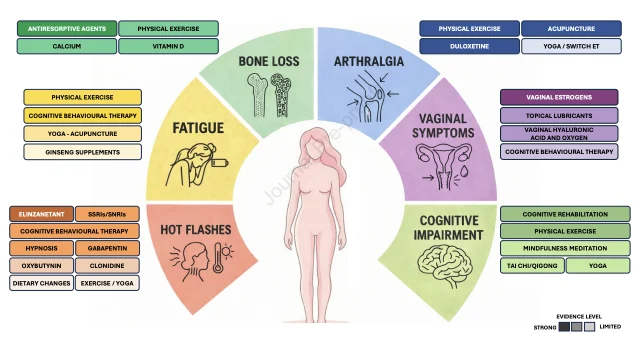
The review provides a practical overview of symptom management. For aromatase inhibitor-related musculoskeletal symptoms, structured aerobic and resistance exercise has supportive randomized evidence. Acupuncture may reduce arthralgia, while duloxetine is among the best-supported pharmacological options.
For vasomotor symptoms, the phase III evidence for elinzanetant, an NK1/3 receptor antagonist, is particularly notable, with reductions in hot-flash frequency and severity and improvements in sleep and menopause-related quality of life. Venlafaxine, desvenlafaxine, escitalopram and gabapentin remain useful alternatives.
Paroxetine requires caution with tamoxifen because of CYP2D6 inhibition. Bone health, cognitive symptoms, fatigue and sexual health also need proactive management rather than waiting until symptoms become treatment-limiting.
For genitourinary symptoms, moisturizers and lubricants remain first-line options. Vaginal estrogen can be highly effective, but its use remains nuanced, especially in patients receiving aromatase inhibitors — and should be considered selectively through shared decision-making when nonhormonal approaches are insufficient.
Digital symptom-monitoring tools may also help identify toxicity earlier and improve patient-clinician communication, although the authors note that implementation must avoid widening disparities or assuming equal digital access.
Fertility Cannot Be Separated From Adjuvant Treatment Planning
For many young women, five to ten years of endocrine therapy overlap directly with reproductive years. That makes fertility counseling part of treatment, not an optional survivorship discussion. The reassuring message is that pregnancy after HR-positive breast cancer has not been shown to worsen prognosis.
A meta-analysis including 3,805 patients found no significant DFS disadvantage among women who subsequently became pregnant. The POSITIVE trial then addressed an even more challenging question: can endocrine treatment be temporarily interrupted to pursue pregnancy?
The study enrolled 516 women aged ≤42 years who had completed 18–30 months of endocrine therapy. Treatment could be interrupted for up to two years to attempt conception, complete pregnancy and breastfeed, after which patients were advised to resume therapy.
At five years, breast cancer events occurred in 12.3%, comparable with an external SOFT/TEXT control population meeting similar eligibility criteria. Among women with reproductive follow-up:
- 76% achieved pregnancy
and
- 69% had a live birth.
No difference in breast cancer outcomes was observed according to breastfeeding status. These data are reassuring but should not be generalized indiscriminately. Most POSITIVE participants had relatively favorable disease characteristics, and longer follow-up remains essential because HR-positive disease carries prolonged recurrence risk.
For that reason, fertility preservation should be discussed before treatment begins, with timely referral for oocyte, embryo or ovarian-tissue cryopreservation when appropriate. GnRH agonists during chemotherapy can also reduce the risk of premature ovarian insufficiency.
The Next Frontier May Be OFS-Sparing Endocrine Therapy
One particularly intriguing question is whether future endocrine agents could eventually reduce the need for prolonged ovarian suppression. The authors highlight emerging interest in oral SERDs without OFS. Such strategies could theoretically preserve ovarian function and reduce the physical and psychosocial consequences of medically induced menopause.
However, the evidence is preliminary, and recent data cited in the review suggest that oral SERD monotherapy may have weaker antiproliferative activity than oral SERD treatment combined with OFS. For now, OFS remains fundamental for patients requiring intensive endocrine treatment. But an effective OFS-sparing strategy would represent a major advance specifically for young patients.
The Central Problem Is Not Lack of Treatment, It Is Lack of Precision
The modern adjuvant landscape offers more therapeutic options than ever before. The problem is knowing how much treatment each young woman actually needs. The authors repeatedly emphasize that risk and treatment sensitivity are not the same concept.
A patient may have a low absolute recurrence risk yet still have a biologically endocrine-sensitive cancer. Conversely, a high-risk patient may require substantial treatment escalation. Small absolute benefits from increasingly intensive therapy can mean that many women experience treatment toxicity for the benefit of relatively few.
At the individual level, however, undertreatment also carries profound consequences when recurrence becomes metastatic. That asymmetry is why the authors place shared decision-making at the center of their framework. The objective is neither reflexive escalation nor de-escalation.
It is treatment proportional to clinical risk, tumor biology, likely endocrine sensitivity, ovarian reserve, genomic risk, toxicity burden, fertility goals and the patient’s own tolerance for risk.
OncoDaily Takeaway
The 2026 Annals of Oncology review makes a compelling case that premenopausal HR+/HER2− early breast cancer remains one of the most evidence-sensitive areas of adjuvant breast oncology. OFS clearly improves outcomes in appropriately selected higher-risk women, but its absolute benefit varies substantially and does not justify universal escalation.
Genomic assays remain strongly prognostic, yet their predictive interpretation is complicated by the possibility that some chemotherapy benefit in young women is actually mediated through ovarian suppression.
The new OPTIMA data strengthen the hypothesis that optimal endocrine therapy may allow chemotherapy omission in selected genomically low-risk premenopausal women, but dedicated prospective trials such as OFSET and OPTIMA-YOUNG are still needed before this becomes a broadly applicable strategy.
Beyond five years, clinicians face another major evidence gap: there is no randomized standard defining the optimal extended endocrine regimen for women who remain premenopausal.
And throughout treatment, fertility, menopausal toxicity and adherence must be considered part of oncologic efficacy rather than secondary quality-of-life issues.
The future of adjuvant treatment for young women with HR+/HER2− breast cancer will therefore depend less on simply adding therapies and more on identifying who truly needs escalation, who can safely receive less, and how treatment can preserve both survival and long-term life goals.
Source
- Licata L, Mariani M, Chiavassa A, et al. Navigating uncertainties and evidence gaps in adjuvant therapy for premenopausal women with HR+/HER2− breast cancer. Annals of Oncology. 2026. DOI: 10.1016/j.annonc.2026.09.005.