
Cyclin-dependent kinase 4/6 inhibition has fundamentally changed the treatment of hormone receptor-positive, HER2-negative breast cancer.
Palbociclib, ribociclib and abemaciclib combined with endocrine therapy have become central treatment strategies across metastatic disease and selected high-risk early breast cancer. But their success has also exposed the limitations of current cell-cycle targeting. Responses remain predominantly cytostatic rather than cytotoxic, hematologic toxicity can restrict dose intensity, and resistance eventually develops in most patients with advanced disease.
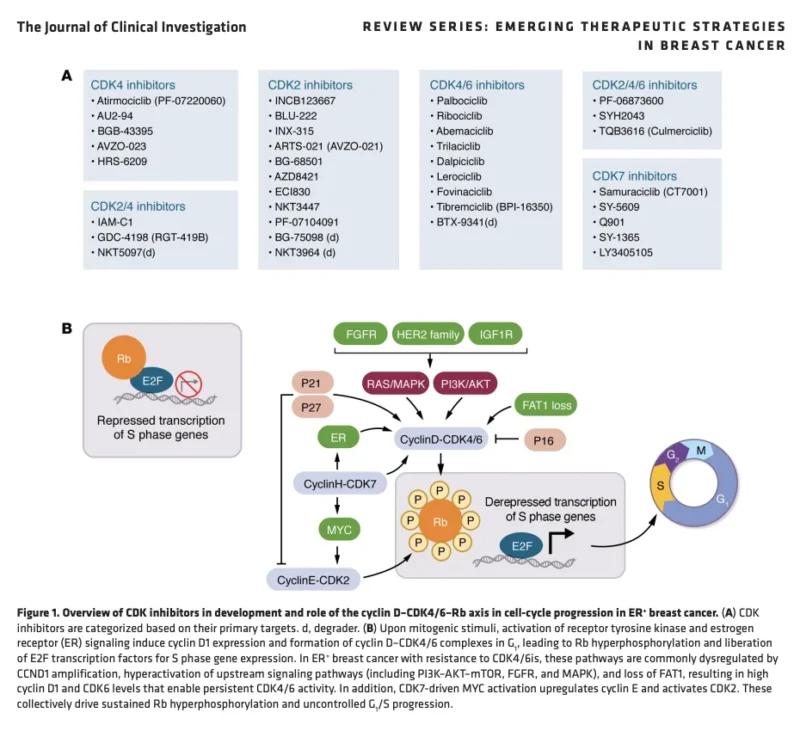
A 2026 review published in The Journal of Clinical Investigation highlights how the next phase of CDK-directed therapy is moving beyond simply producing another CDK4/6 inhibitor. Development is branching into CDK4-selective inhibitors, CDK2 inhibitors, combined CDK2/CDK4 strategies, multi-CDK inhibitors, targeted protein degraders and CDK7 inhibition.
The objective is increasingly ambitious: maintain deeper cell-cycle suppression while reducing toxicity and preventing, or exploiting, the molecular rewiring that follows conventional CDK4/6 inhibition.
Why Current CDK4/6 Inhibition Eventually Fails
The cyclin D–CDK4/6–Rb pathway sits at a critical intersection between estrogen-receptor signaling and cell-cycle progression. Estrogen signaling increases cyclin D1 expression. Cyclin D–CDK4/6 complexes phosphorylate retinoblastoma protein, releasing E2F transcription factors and permitting progression through the G1/S checkpoint.
That biology explains why HR+/HER2− breast cancer is particularly dependent on CDK4/6 activity. But the pathway is not static. Approximately 10%–20% of cancers show intrinsic resistance to CDK4/6 inhibition, while tumors that initially respond can later resume proliferation through alternative mechanisms.
The central problem is cell-cycle plasticity. Tumors may restore Rb phosphorylation through cyclin E–CDK2 activation, increase CDK6 expression, amplify CCNE1 or CCNE2, activate PI3K–AKT–mTOR, FGFR or MAPK signaling, or develop other mechanisms that allow cells to bypass their original dependence on CDK4/6.
Current CDK4/6 inhibitors also generally induce reversible cell-cycle arrest rather than tumor-cell death. Once selective pressure changes or compensatory pathways emerge, proliferation can resume. This biology is driving a new therapeutic strategy: rather than treating cell-cycle resistance as a single mechanism, next-generation agents aim to target the specific kinase dependency that emerges under treatment pressure.
CDK4-Selective Inhibition: Can We Separate Efficacy From Neutropenia?
One major approach is to target CDK4 more selectively while sparing CDK6. CDK4 appears to be the dominant proliferative driver in many HR+/HER2− breast cancers. CDK6, meanwhile, plays an important role in hematopoietic stem and progenitor cells. Its inhibition contributes to the neutropenia associated with conventional dual CDK4/6 inhibitors.
Selective CDK4 inhibition could therefore allow more continuous drug exposure and deeper tumor-cell inhibition with less marrow toxicity. The most advanced agents in this class include atirmociclib and BGB-43395, both of which have moved into phase III development.
Atirmociclib Is Leading the Selective CDK4 Strategy
Atirmociclib, previously PF-07220060, was designed to preferentially inhibit CDK4. Its selectivity for CDK4 over CDK6 is more than 20-fold greater than that of palbociclib and approximately three- to five-fold greater than that of abemaciclib or ribociclib.
Preclinically, this translated into stronger suppression of Rb phosphorylation with reduced hematologic toxicity in CDK4-dependent models. Early clinical results have now provided a first test of that hypothesis. Among 34 previously untreated patients receiving atirmociclib 300 mg twice daily plus letrozole, confirmed objective response rate was:
- 69.7%
while clinical benefit rate reached:
- 93.9%
Median PFS had not been reached after median follow-up of 24.8 months.
Estimated event-free probabilities were:
- 90.9% at 12 months
- 78.4% at 18 months
- 67.2% at 24 months
These are early-phase data and cannot be directly compared with established CDK4/6 inhibitors, but they were sufficiently encouraging to support randomized development.
The Safety Profile May Be Just as Important as Response
Neutropenia remained common with atirmociclib, occurring in approximately 62% of patients in the first-line cohort, but grade 3 neutropenia occurred in about 27%. Leukopenia occurred in approximately 41%, with no grade 3 events reported in that cohort.
Notably, no diarrhea was reported. Dose intensity was largely maintained.
That point matters because the purpose of CDK4-selective development is not necessarily to eliminate every hematologic adverse event. It is to determine whether sparing CDK6 can produce a more favorable balance between continuous target suppression and treatment tolerability.
FOURLIGHT-3 Will Test Whether CDK4 Selectivity Can Challenge Established CDK4/6 Inhibitors
The pivotal FOURLIGHT-3 trial, NCT06760637, takes the important next step.
Rather than comparing atirmociclib with endocrine therapy alone, the phase III study directly compares:
- atirmociclib + letrozole
with
- palbociclib, ribociclib or abemaciclib + letrozole
in previously untreated HR+/HER2− advanced or metastatic breast cancer.
This makes FOURLIGHT-3 particularly important. If selective CDK4 inhibition is to replace or compete with existing CDK4/6 inhibitors, it must demonstrate more than activity. It must show that greater selectivity translates into a meaningful clinical advantage in efficacy, tolerability, treatment continuity, or some combination of these outcomes.
Atirmociclib Also Shows Activity After Prior CDK4/6 Inhibition
Perhaps the more unexpected finding is that selective CDK4 inhibition may retain activity even after progression on a conventional CDK4/6 inhibitor. Among patients with measurable disease previously treated with CDK4/6 inhibition plus endocrine therapy, atirmociclib combined with letrozole or fulvestrant produced 32% confirmed ORR with one complete response and seven partial responses among 25 evaluable patients.
Clinical benefit rate was 60.6%, and median PFS was 8.1 months. Responses occurred irrespective of ESR1 or PI3K pathway mutation status.
This activity is biologically intriguing because CDK4/6 resistance is not generally characterized by increased CDK4 dependence.
One possible explanation is tumor heterogeneity: while one subpopulation evolves alternative resistance mechanisms, other tumor cells may remain substantially CDK4 dependent and therefore susceptible to more potent, continuous CDK4 inhibition.
FOURLIGHT-1 Provides the First Randomized Signal
The randomized phase II FOURLIGHT-1 study evaluates atirmociclib plus fulvestrant after previous CDK4/6 inhibitor therapy.
According to preliminary company-reported results cited in the review, the trial met its primary endpoint, with investigator-assessed PFS favoring atirmociclib:
- HR 0.60
- 95% CI 0.44–0.83
- P=0.0007
These findings remain preliminary and require confirmation from complete mature datasets.
CDK4 Inhibition Is Becoming a Combination Platform
Another reason atirmociclib has attracted attention is its potential use as a partner for newer endocrine and molecularly targeted therapies. The TACTIVE-K programme combines atirmociclib with the ER-targeting PROTAC vepdegestrant after CDK4/6 inhibitor exposure.
Preliminary phase Ib/II results showed ORRs of approximately 16%–24% and median PFS of 9.3–11.5 months across dose cohorts, including activity in ESR1-mutated disease. Atirmociclib is also being combined with the next-generation oral SERD camizestrant.
Another strategy combines atirmociclib with zovegalisib, a mutant-selective PI3Kα inhibitor, plus fulvestrant in PIK3CA-mutated HR+/HER2− disease.
Preliminary company-reported data described an ORR of 44% in a heavily pretreated cohort, although this result remains early and unpublished. The strategic idea is important. If selective CDK4 inhibition reduces toxicity, it may allow combinations that would be difficult to sustain with less selective agents.
BGB-43395 Is Another CDK4-Selective Challenger
Atirmociclib is not alone. BGB-43395 is another orally administered selective CDK4 inhibitor. In early first-line combination cohorts with letrozole, toxicity was manageable at 240 mg and 400 mg twice daily.
Most adverse events were grade 1–2 gastrointestinal events, hematologic toxicity was low, and no treatment-related adverse event led to discontinuation at the recommended phase III dose of 400 mg twice daily.
Confirmed ORRs ranged from:
- 55.0% to 68.4%
across evaluated dose levels.
A phase III first-line study, NCT07492641, has now been launched. Other CDK4-selective compounds including HRS-6209 and AVZO-023 remain in earlier clinical development. Selective CDK4 inhibition has therefore moved from a mechanistic concept into multiple randomized development programmes.
But Selective CDK4 Inhibition Will Have Its Own Resistance
Sparing CDK6 may improve safety, but CDK6 may also become a route of escape. Preclinical models identified baseline CDK6 expression as a potential mediator of intrinsic resistance to atirmociclib. Alterations involving FAT1, PTEN and ARID1A may converge on increased CDK6 activity and therefore reduce dependence on CDK4.
Cyclin E1–CDK2 and FGFR1 signaling have also been associated with acquired resistance. Selective CDK4 inhibition therefore does not eliminate cell-cycle adaptation. It may simply change the evolutionary pressure and shift the tumor toward a new dependency. That brings CDK2 into focus.
CDK2: The Major Escape Route After CDK4/6 Inhibition
One of the most important emerging targets is CDK2. Multiple mechanisms of CDK4/6 inhibitor resistance converge on increased CDK2 activity.
These include:
- cyclin E1 overexpression
- CCNE1 or CCNE2 amplification
- noncanonical cyclin D1–CDK2 signaling
- activation of PI3K–AKT–mTOR, FGFR or MAPK pathways
Once CDK2 becomes sufficiently active, the tumor can restore Rb phosphorylation and continue through the cell cycle despite CDK4/6 blockade. That makes CDK2 an attractive therapeutic target after conventional CDK4/6 inhibition.
But the biology is more complicated than simply saying “CDK2 high = give a CDK2 inhibitor.”
Biomarkers May Be Essential for CDK2 Therapy
Response to selective CDK2 inhibition may depend heavily on the molecular context. In RB1-intact tumors with high cyclin E and preserved p16INK4A, CDK2 may become the dominant driver of Rb phosphorylation.
In this setting, selective CDK2 inhibition can produce G1 arrest. High cyclin E and high p16INK4A may therefore represent promising biomarkers. By contrast, many HR+/HER2− tumors have reduced p16INK4A activity and remain substantially dependent on CDK4/6.
In those cancers, CDK2 inhibition alone may produce incomplete cell-cycle control. That distinction provides a rationale for dual CDK2 + CDK4/6 or CDK2 + CDK4 inhibition, particularly after acquired resistance.
Tegtociclib Provides Early Proof That CDK2 Is Clinically Druggable
Tegtociclib, previously PF-07104091, is one of the first selective CDK2 inhibitors to enter clinical testing. In a heavily pretreated HR+/HER2− metastatic breast cancer cohort, all patients had previously received CDK4/6 inhibition.
Among 16 response-evaluable patients:
- 3 achieved confirmed partial responses – 18.8%
- and six had stable disease
The reported disease-control rate was approximately:
- 61.5%.
- Some responses lasted beyond six months
Subsequent translational work suggested that tegtociclib may influence cell-cycle progression differently from CDK4/6 inhibition, including suppression of mitotic entry and induction of DNA damage.
Clinical benefit in one dataset occurred only among patients whose tumors were TP53 wild-type, although this remains exploratory.
Other CDK2 Inhibitors Are Rapidly Entering the Clinic
The pipeline is broad. INCB123667 has shown preliminary activity particularly in CCNE1-selected tumors, including an ORR of approximately 33% in a CCNE1-selected ovarian cancer cohort. INX-315 has demonstrated early responses in heavily pretreated patients, including HR+/HER2− breast cancer.
BG-68501 is a highly selective CDK2 inhibitor with more than 100-fold selectivity for CDK2. Early clinical experience suggests gastrointestinal toxicity rather than marked myelosuppression may dominate its safety profile.
Among 24 efficacy-evaluable patients in early testing, one heavily pretreated HR+/HER2− breast cancer patient achieved a confirmed response and ten achieved stable disease. Additional agents include AVZO-021, AZD8421, ECI830 and NKT3447.
Most remain in phase I or phase I/II development, largely in patients who have already progressed on CDK4/6 inhibitors. CDK2 therapy therefore remains experimental.
Combining CDK2 and CDK4 May Be More Important Than Either Alone
If resistance reflects redundancy within the cell-cycle network, simultaneous blockade may be more effective than sequential monotherapy. CDK4/6 inhibition continues to restrain cells that remain dependent on the conventional G1 checkpoint, while CDK2 inhibition targets cells that have escaped through cyclin E/CDK2-mediated signaling.
A particularly interesting early clinical example combines atirmociclib with tegtociclib. In heavily pretreated, CDK4/6 inhibitor-exposed metastatic breast cancer, the combination produced a partial-response rate of 27.8% with another 27.8% achieving stable disease among 18 patients with measurable, disease.
Across the broader cohort:
- Disease-control rate: 69.2%
- Median PFS: 8.3 months
The dataset is very small and early, but it provides clinical support for the concept of simultaneously suppressing multiple cell-cycle escape routes.
Multi-CDK Inhibitors Try to Achieve the Same Goal in One Molecule
An alternative is to design one molecule capable of inhibiting more than one relevant CDK. Early multi-CDK compounds often failed because broad kinase inhibition produced unacceptable toxicity. The current generation is more selective.
PF-06873600, targeting CDK2/4/6, produced an ORR of approximately 23% and median PFS of 11.1 months in CDK4/6 inhibitor-naïve patients, but its narrow therapeutic index led to discontinuation in favor of more selective strategies.
GDC-4198, previously RGT-419B, targets CDK4 and CDK2 while largely sparing CDK6. This architecture attempts to combine two goals: block the major proliferative CDKs, while reducing CDK6-associated hematologic toxicity.
In heavily pretreated HR+/HER2− metastatic breast cancer, the drug was generally tolerable. Grade ≥3 treatment-related adverse events occurred in approximately 16%, with no treatment-related discontinuations reported in the early dataset.
Among 24 patients with measurable disease, four confirmed partial responses were observed. Development is continuing, including combination with the oral SERD giredestrant.
PROTACs Take a Different Approach: Destroy the CDK Instead of Inhibiting It
Targeted protein degradation represents another major frontier. PROTACs recruit an E3 ubiquitin ligase to the protein of interest, causing the target to be ubiquitinated and destroyed by the proteasome.
In theory, degradation may provide broader pathway suppression than conventional catalytic inhibition because the entire protein is removed. That can eliminate both kinase-dependent and non-kinase functions. Several CDK degraders are now entering clinical development.
BTX-9341 Targets CDK4/6 for Degradation
BTX-9341 is an orally bioavailable CDK4/6 degrader. Preclinically, it demonstrated activity in HR-positive and CCNE1-high breast cancer models, including tumors resistant to conventional CDK4/6 inhibitors. It has also been reported to cross the blood-brain barrier.
In first-in-human testing in RB1 wild-type HR+/HER2− metastatic breast cancer, no dose-limiting toxicities were reported in the early dataset. On-target pharmacodynamic activity was documented, and investigators reported one confirmed partial response with a 24-week clinical benefit rate of 66.7%.
These results remain extremely preliminary.
CDK2 Degraders Could Avoid Cyclin E Accumulation
NKT3964 is a first-in-class CDK2 degrader designed to produce prolonged CDK2 pathway suppression without increasing cyclin E. It has entered phase I development in tumors with aberrant CDK2/cyclin E signaling, including HR+/HER2− breast cancer after CDK4/6 inhibitor progression.
NKT5097, meanwhile, is designed to degrade both CDK2 and CDK4 and has entered separate phase I testing. The broader clinical feasibility of targeted degradation has received support from the development of ER-directed PROTACs such as vepdegestrant, but peer-reviewed clinical evidence for CDK-directed PROTACs remains very limited.
Important challenges include oral bioavailability, tissue exposure, dependence on E3 ligase expression and the possibility of resistance through E3-ligase downregulation or target alteration.
CDK7 Adds Another Layer: Cell Cycle Plus Transcription
CDK7 represents a somewhat different strategy. Rather than targeting one of the canonical G1/S kinases directly, CDK7 regulates both CDK activation and transcription. As part of the CDK-activating kinase complex, it can influence CDK4 and CDK2 activity.
CDK7 also phosphorylates the estrogen receptor and regulates MYC-dependent transcription. This creates a rationale for targeting CDK7 after CDK4/6 resistance while continuing endocrine therapy. The leading agent in this strategy is samuraciclib.
In a phase I study, samuraciclib plus fulvestrant produced a 36% clinical benefit rate in 25 patients with post-CDK4/6 inhibitor HR+/HER2− breast cancer. Samuraciclib monotherapy also showed activity in TNBC, with a clinical benefit rate of approximately 20%.
Phase II programmes combining samuraciclib with fulvestrant, elacestrant and vepdegestrant are ongoing.
The Pipeline Is Becoming More Complex Than the Original CDK4/6 Class
The next-generation CDK pipeline now includes agents targeting:
- CDK4 alone
- CDK2 alone
- CDK2 + CDK4
- CDK2/4/6
- CDK4/6 degradation
- CDK2 degradation
- CDK2/4 degradation
- CDK7
This creates an increasingly important problem for clinical development.The question cannot simply be whether a drug inhibits cell-cycle progression. It must establish which molecular state actually depends on that target.
That means biomarker development may become as important as drug development.
What Might Biomarker-Directed CDK Therapy Look Like?
Several potential molecular clues are emerging. CCNE1/CCNE2 amplification or cyclin E overexpression may indicate increasing CDK2 dependence. p16INK4A expression could help distinguish CDK2-dominant from CDK4/6-dominant states.
RB1 status remains central because the entire CDK4/6–Rb pathway ultimately depends on functional Rb signaling.CDK6 expression may influence response to selective CDK4 inhibition. FAT1, PTEN and ARID1A alterations may promote CDK6-dependent escape.
PIK3CA alterations provide rationale for combinations with PI3Kα inhibitors. And changes in ctDNA during treatment could potentially provide an early dynamic readout of molecular response and resistance. No single biomarker is currently validated for routine selection of these next-generation agents.
But the direction of the field is clear: future CDK therapy may be selected according to which part of the cell-cycle network a tumor has become dependent upon after therapeutic pressure.
Could Next-Generation CDK Inhibitors Move Into First-Line Therapy?
For selective CDK4 inhibitors, the answer is already being tested. Both atirmociclib and BGB-43395 have entered phase III first-line trials. That creates a fundamental challenge for these agents.
Current CDK4/6 inhibitors are highly effective standards, and ribociclib and abemaciclib have demonstrated substantial survival benefits in modern breast cancer treatment. A new drug therefore cannot simply demonstrate activity. It needs to establish meaningful differentiation.
Potential advantages could include:
- greater dose intensity
- less neutropenia
- simpler continuous dosing
- better tolerability
- greater compatibility with triplet therapy
- superior efficacy
Until randomized phase III results are available, these possibilities remain hypotheses.
Early-Stage Breast Cancer Remains a Major Evidence Gap
The enthusiasm surrounding next-generation CDK therapy is currently driven predominantly by metastatic-disease data. The role of CDK2 inhibitors in first-line and early-stage breast cancer remains undefined. This is important because current CDK4/6 inhibitors have already moved into adjuvant treatment.
Whether next-generation CDK4-selective agents, CDK2 inhibitors or degraders could eventually improve adjuvant efficacy, reduce long-term toxicity or rescue biologically high-risk tumors remains unknown.
Moving these drugs into curative-intent therapy would require a much higher evidentiary standard because patients may receive treatment for years despite already being cured by surgery and standard systemic therapy.
The Major Limitation: Much of the Evidence Is Still Early
Many clinical claims surrounding next-generation CDK therapy currently originate from:
- early phase I/II studies
- small patient cohorts
- conference abstracts
- company communications
Several efficacy estimates therefore remain preliminary and have not yet undergone the scrutiny of mature randomized peer-reviewed reporting. Cross-trial comparisons are particularly inappropriate.
An ORR of 60% or 70% with a novel CDK4 inhibitor cannot be interpreted as superiority over ribociclib, abemaciclib or palbociclib because patient populations, follow-up, endocrine partners and trial design differ. Similarly, early signals after CDK4/6 progression do not yet define the optimal sequencing strategy.
The Real Question May Be How to Sequence the Cell Cycle
The next major question may not be which CDK should be inhibited. It may be when should each CDK be targeted, in which tumor, and in what combination?
A future HR+/HER2− treatment sequence could conceivably evolve from broad CDK4/6 inhibition toward molecularly selected strategies. Tumors remaining predominantly CDK4 dependent could receive a more selective CDK4 inhibitor.
Cyclin E-high, CDK2-dependent tumors could move toward CDK2 targeting. Mixed populations may require combined CDK4 + CDK2 inhibition. PIK3CA-mutated disease could integrate PI3Kα inhibition.
ESR1-mutated or endocrine-resistant disease may combine next-generation CDK inhibition with oral SERDs or ER-directed degraders. And tumors with highly adaptive cell-cycle signaling might eventually be treated with protein degradation rather than conventional kinase inhibition.
This is still a developmental framework rather than a clinical algorithm. But it represents a major change in thinking.
OncoDaily Takeaway
The success of palbociclib, ribociclib and abemaciclib established cell-cycle targeting as one of the defining therapeutic strategies in HR+/HER2− breast cancer. The next generation is attempting to solve the problems created by that success.
Selective CDK4 inhibitors such as atirmociclib and BGB-43395 aim to maintain potent tumor-cell suppression while reducing CDK6-associated hematologic toxicity. Both have now reached phase III first-line development.
CDK2 inhibitors address a different problem: the shift toward cyclin E–CDK2 signaling that frequently accompanies CDK4/6 resistance. Early data with agents such as tegtociclib suggest that CDK2 is clinically druggable, but biomarker selection may be essential.
The early signal from combined atirmociclib + tegtociclib illustrates a broader concept, suppressing both the original cell-cycle dependency and the pathway that emerges to bypass it. Meanwhile, multi-CDK compounds, PROTAC degraders and CDK7 inhibitors are expanding cell-cycle targeting beyond conventional ATP-competitive inhibition.
But the evidence remains immature. Many results come from small early-phase cohorts, conference reports or company disclosures. Mature randomized studies are needed before any of these strategies can challenge current standards.
The most important change may therefore be conceptual rather than pharmacological HR+/HER2− breast cancer may eventually move from giving every patient broadly similar CDK4/6 inhibition toward dynamically targeting the specific cell-cycle dependency that remains, or emerges, during treatment.
If that approach succeeds, the future of CDK therapy will not simply be about developing stronger inhibitors. It will be about selectivity, biomarkers, combinations and sequencing the cell cycle itself.
Source
- Seriak D, Kim JY, Shapiro GI, Giordano A. Next-generation CDK inhibitors in HR+/HER2− breast cancer. Journal of Clinical Investigation. 2026;136(20):e207631. DOI: 10.1172/JCI207631.