
The 2026 European Society for Medical Oncology (ESMO) guidelines for metastatic breast cancer mark a significant evolution in treatment selection across hormone receptor-positive, HER2-positive, and triple-negative disease. New antibody-drug conjugate strategies, oral endocrine therapies, molecularly targeted combinations, and expanded maintenance options are creating a more personalized treatment landscape. However, translating these advances into clinical practice introduces new challenges involving biomarker testing, treatment sequencing, toxicity management, and equitable access to innovative therapies.
A perspective article published in Clinical Breast Cancer on October 7, 2026, examines these developments through the insights of four European breast oncology experts: Giuseppe Curigliano, Luís Castelo-Branco, Volkmar Müller, and Nadia Harbeck.
The article, titled 2026 Key European Guideline Changes for Metastatic Breast Cancer and Their Impact on Practice, compares the updated recommendations with the previous ESMO Living Guidelines version 1.2 and discusses their clinical implications.
The most consequential changes involve the expansion of antibody-drug conjugates (ADCs) into first-line treatment, particularly trastuzumab deruxtecan (T-DXd) plus pertuzumab for HER2-positive metastatic breast cancer and TROP2-directed ADCs for triple-negative breast cancer (TNBC).
For hormone receptor-positive/HER2-negative disease, the guidelines further refine molecularly guided treatment selection through ESR1, PIK3CA, AKT1, and PTEN alterations, while incorporating newer endocrine and targeted treatment options.
These advances reflect a broader shift away from rigid, chemotherapy-centered treatment sequences toward individualized strategies guided by tumor biology, prior treatment exposure, disease behavior, and patient characteristics.
However, the experts emphasize that the growing number of therapeutic options does not automatically translate into better outcomes unless patients can access the appropriate diagnostic tests, treatments, and specialist support.
HR-Positive/HER2-Negative Disease: Endocrine Sensitivity Defines the First Decision
One of the most important developments in contemporary metastatic breast cancer management is the increasingly explicit separation of endocrine-sensitive and endocrine-resistant disease. Although this distinction was already recognized in the 2025 Living Guidelines, the 2026 recommendations provide more detailed treatment pathways.
For endocrine-sensitive HR-positive/HER2-negative metastatic breast cancer, aromatase inhibitors combined with CDK4/6 inhibitors remain a foundational first-line approach. Clinical evidence from MONALEESA-2, MONARCH-3, and PALOMA-2 established substantial improvements in progression-free survival with CDK4/6 inhibitor-based combinations.
Among these agents, ribociclib has demonstrated a statistically significant overall survival benefit in the first-line setting, reinforcing its position as an important treatment option. However, treatment becomes more complex in patients who relapse while receiving adjuvant endocrine therapy or within 12 months after its completion.
In this population, endocrine resistance changes the therapeutic approach and increases the relevance of molecular profiling. The INAVO120 trial established the clinical value of combining inavolisib, palbociclib, and fulvestrant in patients with PIK3CA-mutated, endocrine-resistant advanced breast cancer.
The combination significantly improved PFS (HR 0.43; p<0.001) and OS (HR 0.67; p=0.02). These findings support the use of molecularly selected treatment earlier in the metastatic setting.
Importantly, PIK3CA testing and the inavolisib-containing treatment strategy were already incorporated into the 2025 recommendations. Their prominence in the 2026 framework reflects refinement and implementation rather than an entirely new treatment concept.
The practical message is that endocrine resistance should prompt timely molecular assessment rather than an automatic transition to conventional chemotherapy.
ESR1 Mutations: Imlunestrant Expands Endocrine Treatment Options
A notable addition to the 2026 recommendations is imlunestrant, an oral selective estrogen receptor degrader (SERD), for appropriately selected ESR1-mutated metastatic breast cancer. ESR1 mutations frequently emerge under the selective pressure of prior endocrine treatment, particularly aromatase inhibitors.
These alterations can produce ligand-independent estrogen receptor signaling and contribute to resistance. The importance of ESR1 testing was established through the development of oral SERDs, including elacestrant, which had already entered earlier guideline versions following the EMERALD trial.
The phase III EMBER-3 study subsequently demonstrated the efficacy of imlunestrant in ESR1-mutated, endocrine-resistant disease. In the ESR1-mutated population, imlunestrant improved PFS compared with standard endocrine monotherapy, with a statistically significant benefit in restricted mean survival time.
The updated recommendations therefore expand the available endocrine treatment options for patients whose tumors develop acquired ESR1 mutations. However, these agents should not be regarded as interchangeable without considering their respective trial populations, prior treatment requirements, clinical benefits, and safety characteristics.
The broader implication is that reassessment of molecular alterations at progression is becoming increasingly central to treatment selection. Liquid biopsy offers a practical method for detecting ESR1 mutations and other actionable alterations, potentially reducing the need for repeated tissue sampling in selected circumstances.
Nevertheless, the availability, sensitivity, and turnaround time of molecular testing remain important implementation considerations.
PI3K/AKT Pathway Alterations Guide Additional Treatment Choices
The expanding use of molecularly targeted therapy extends beyond ESR1 mutations. Alterations involving PIK3CA, AKT1, and PTEN can activate the PI3K/AKT signaling pathway, contributing to endocrine resistance and tumor progression.
For appropriately selected patients with alterations in this pathway, capivasertib plus fulvestrant represents an established targeted option. The phase III CAPItello-291 trial demonstrated a significant PFS benefit in the AKT pathway-altered population, with an HR of approximately 0.50.
The 2026 ESMO recommendations emphasize comprehensive molecular assessment following progression on endocrine therapy and CDK4/6 inhibition to identify suitable treatment options. However, molecularly targeted therapies introduce toxicities requiring specific monitoring.
Capivasertib is associated with diarrhea, rash, and hyperglycemia, while PI3K inhibitors may produce clinically significant metabolic adverse effects. Therefore, treatment selection requires consideration of both molecular eligibility and the patient’s comorbidities, particularly diabetes, gastrointestinal disorders, and dermatological conditions.
The increasing availability of targeted agents also makes the optimal sequencing of endocrine-based combinations more complex. Prospective comparisons remain limited, and treatment choices must integrate prior therapies, resistance mechanisms, clinical disease tempo, and patient preferences.
HER2-Low and HER2-Ultralow Disease: ADC Treatment Expands Beyond Traditional HER2 Positivity
The development of T-DXd has transformed the clinical significance of low-level HER2 expression. Traditionally, breast cancer was classified as HER2-positive or HER2-negative, primarily to determine eligibility for HER2-directed monoclonal antibodies.
However, the activity of modern HER2-directed ADCs has established therapeutic relevance for tumors expressing HER2 below the conventional positivity threshold. HER2-low disease includes tumors classified as IHC 1+ or IHC 2+ with negative in situ hybridization. HER2-ultralow describes tumors within the IHC 0 category demonstrating faint, incomplete membrane staining.
The phase III DESTINY-Breast06 trial demonstrated improved PFS with T-DXd compared with physician’s choice chemotherapy in patients with HR-positive, HER2-low advanced breast cancer who had progressed after endocrine therapy but had not received chemotherapy for metastatic disease.
The reported PFS HR was 0.62 (p<0.001), with encouraging findings also observed in HER2-ultralow disease. These results supported the incorporation of T-DXd into treatment pathways before conventional metastatic chemotherapy in eligible patients.
However, this recommendation was already reflected in the 2025 Living Guidelines rather than being introduced for the first time in 2026. The continuing clinical challenge lies in implementing accurate HER2 assessment.
Distinguishing HER2-low, ultralow, and truly HER2-zero tumors requires careful pathological evaluation because conventional HER2 assays were not originally optimized for very low levels of antigen expression.
Interobserver variability, sample quality, tumor heterogeneity, and changes in expression over time may influence classification.
Consequently, the experts emphasize the need for pathology education, standardized reporting, and access to specialist review when results are uncertain.
HER2-Positive Disease: DESTINY-Breast09 Introduces a New First-Line Option
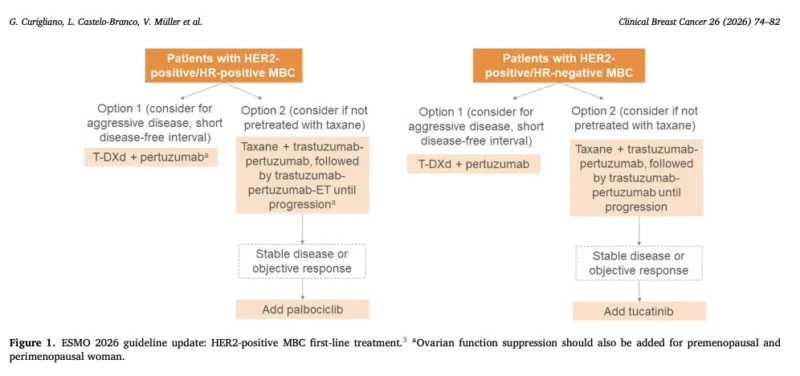
One of the most consequential additions to the 2026 ESMO recommendations is T-DXd plus pertuzumab in the first-line setting for HER2-positive metastatic breast cancer. The phase III DESTINY-Breast09 trial demonstrated that the ADC-based combination significantly improved PFS compared with the established taxane–trastuzumab–pertuzumab (THP) regimen.
Median PFS reached approximately 41 months with T-DXd plus pertuzumab versus 27 months with THP, corresponding to an HR of 0.56 (p<0.00001). The findings establish a substantial improvement in disease control. However, the expert panel emphasizes that this does not make THP obsolete.
THP remains an established treatment strategy supported by the long-term overall survival benefit demonstrated in CLEOPATRA. In that trial, the addition of pertuzumab to trastuzumab and docetaxel improved median OS to approximately 57 months compared with 41 months in the control group.
By contrast, mature OS results from DESTINY-Breast09 were not yet available when the new recommendations were developed.
The experts suggest that T-DXd plus pertuzumab may be particularly attractive for patients with aggressive or symptomatic disease, a short disease-free interval following earlier treatment, or a need for substantial disease control.
THP remains a relevant alternative, particularly when treatment tolerability, previous exposure, lower disease burden, or the established maintenance strategy influence clinical decision-making. These considerations represent expert clinical judgment rather than a prospectively validated algorithm identifying patients who benefit exclusively from one regimen.
The most important implication is that clinicians now have two evidence-based first-line approaches with different toxicity profiles and treatment structures.
Maintenance Treatment: PATINA and HER2CLIMB-05 Introduce New Opportunities
An increasingly important question concerns what should happen after first-line disease control is achieved. For patients receiving THP, the established approach involves discontinuing taxane chemotherapy after induction while continuing HER2-directed maintenance.
For HR-positive/HER2-positive disease, endocrine treatment can be incorporated into the maintenance strategy. The phase III PATINA trial demonstrated that adding palbociclib to HER2-directed therapy and endocrine treatment significantly improved PFS, with an HR of approximately 0.75.
The phase III HER2CLIMB-05 trial also demonstrated improved PFS when tucatinib was added to trastuzumab and pertuzumab maintenance, with an HR of approximately 0.64. These findings have expanded maintenance treatment opportunities, particularly for patients who achieve disease control following taxane-containing induction therapy.
However, a major unanswered question remains following the introduction of first-line T-DXd plus pertuzumab. DESTINY-Breast09 did not evaluate a planned transition from ADC induction to a separate maintenance regimen.
Therefore, the efficacy of switching to trastuzumab–pertuzumab maintenance, with or without palbociclib or tucatinib, after T-DXd-based induction has not been established. Similarly, the optimal duration of T-DXd exposure remains uncertain.
The experts emphasize that prospective trials are needed before strategies validated after THP induction can be routinely transferred to patients previously treated with T-DXd plus pertuzumab. This distinction is particularly relevant as prolonged ADC exposure creates additional concerns regarding interstitial lung disease, treatment-related adverse events, and quality of life.
Sequencing After First-Line T-DXd Remains a Major Challenge
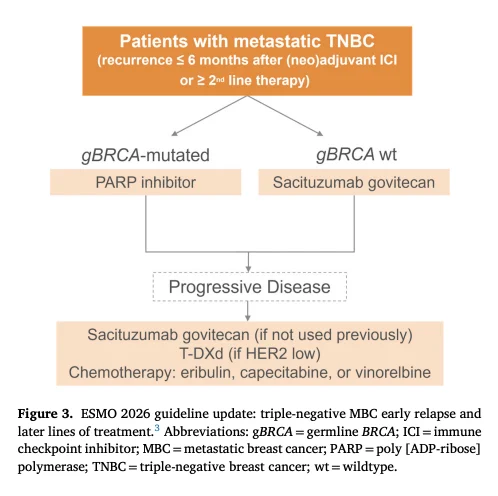
The migration of T-DXd into earlier treatment lines has important consequences for subsequent therapy. Historically, T-DXd was a preferred second-line option based on the DESTINY-Breast03 trial, which demonstrated significant improvements in PFS and OS compared with trastuzumab emtansine.
However, patients who already receive T-DXd in the first-line setting will require alternative strategies after progression. The 2026 recommendations recognize tucatinib–trastuzumab–capecitabine as an important subsequent treatment option, particularly when CNS involvement is clinically relevant.
T-DM1 and other HER2-directed approaches remain available in appropriate later-line settings. Nevertheless, the optimal sequence following first-line T-DXd remains inadequately defined. The extent to which prior ADC exposure influences sensitivity to subsequent HER2-targeted agents is also uncertain.
This creates a need for prospective sequencing trials and translational research addressing HER2 expression changes, payload resistance, receptor internalization, and alternative mechanisms of treatment failure.
The challenge is increasingly to optimize the entire treatment pathway rather than selecting the most active initial regimen in isolation.
Triple-Negative Breast Cancer: ADCs Move Into First-Line Treatment
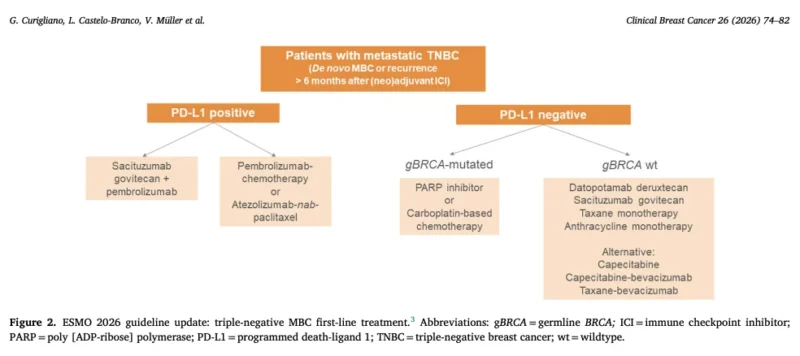
The 2026 guideline changes are particularly important for metastatic TNBC, where rapid disease progression can limit opportunities for subsequent systemic therapy. Traditionally, first-line treatment selection has been strongly influenced by PD-L1 expression and immunotherapy eligibility.
For patients with PD-L1-positive disease, pembrolizumab-based chemoimmunotherapy has represented a major treatment standard. However, the phase III ASCENT-04 trial demonstrated that replacing conventional chemotherapy with sacituzumab govitecan in combination with pembrolizumab significantly improved PFS.
The trial reported a PFS HR of 0.65 (p<0.001) compared with chemotherapy plus pembrolizumab. These findings support the incorporation of ADC-based immunotherapy combinations into first-line treatment for eligible PD-L1-positive metastatic TNBC.
Patient selection remains dependent on the appropriate PD-L1 assay and eligibility criteria, including prior treatment exposure and the interval since earlier therapy. Importantly, PD-L1 positivity is a biomarker for the immunotherapy-containing treatment strategy rather than a validated predictor of TROP2 ADC sensitivity.
The introduction of an ADC–immunotherapy combination therefore represents an important advance, but not the elimination of conventional chemoimmunotherapy from clinical practice.
ASCENT-03 and TROPION-Breast02 Expand Options for Immunotherapy-Ineligible TNBC
The most significant changes in PD-L1-negative or immunotherapy-ineligible metastatic TNBC involve first-line ADC monotherapy. In the phase III ASCENT-03 trial, sacituzumab govitecan significantly improved PFS compared with physician’s choice chemotherapy in patients who were not candidates for checkpoint inhibition.
The reported HR was 0.62 (p<0.001). The phase III TROPION-Breast02 trial evaluated datopotamab deruxtecan (Dato-DXd) in a similar clinical setting and demonstrated improvements in both PFS and OS compared with chemotherapy.
The reported HRs were 0.57 for PFS (p<0.0001) and 0.79 for OS (p=0.0291). Together, these findings support the earlier use of TROP2-directed ADC therapy in patients unable to receive first-line immunotherapy.
However, the two agents were evaluated in separate trials with differences in eligibility criteria, prior treatment exposure, and patient populations. Their results should not be used to establish comparative superiority without a direct randomized trial.
The expert panel highlights treatment-related toxicity as an important factor in selection. Datopotamab deruxtecan is associated with stomatitis and ocular adverse events, while sacituzumab govitecan is particularly associated with neutropenia and diarrhea.
Individual comorbidities, prior therapy, disease progression, and patient preferences therefore remain essential considerations.
ADC Sequencing Becomes the Next Major Unanswered Question
The expanding availability of ADCs creates new challenges across metastatic breast cancer subtypes. In HR-positive/HER2-negative disease, patients with HER2-low expression may become eligible for T-DXd and later receive TROP2-directed treatment.
However, evidence defining the optimal sequence remains limited. It is unclear whether patients benefit more from receiving HER2-directed ADCs before TROP2-directed ADCs or whether the degree of HER2 expression should influence the sequence.
Another concern is potential cross-resistance. Several ADCs use topoisomerase I inhibitor payloads, and resistance may involve mechanisms extending beyond antigen expression alone. Consequently, changing the antigen target may not fully overcome resistance to the cytotoxic payload.
In TNBC, sequencing is particularly challenging because several effective first-line and later-line ADCs target the same antigen, TROP2. The clinical benefit of administering multiple TROP2-directed ADCs sequentially remains uncertain.
The experts also emphasize the potential importance of patient deterioration during the disease course. Because some patients with metastatic TNBC may not remain fit enough to receive multiple subsequent treatment lines, maximizing the benefit of initial systemic therapy is especially important.
Future prospective trials must determine whether ADC sequencing, intervening chemotherapy, or changes in payload class can improve outcomes after progression.
Biomarker Testing Is Now Central to Metastatic Breast Cancer Care
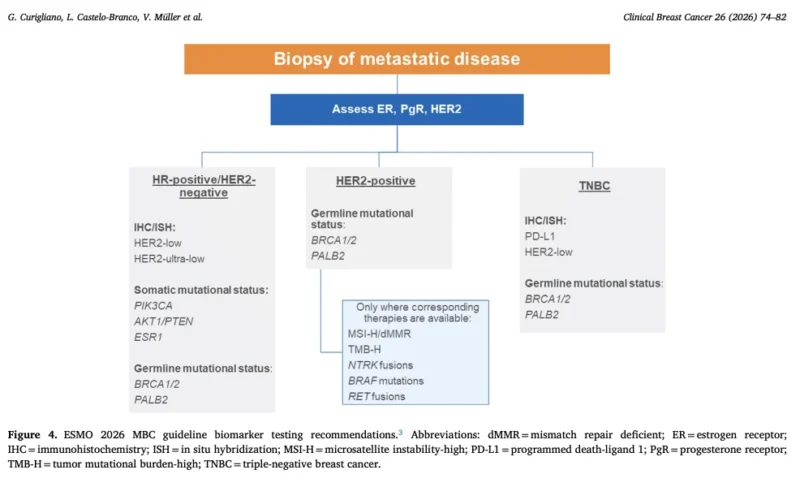
The 2026 guidance reinforces the importance of comprehensive biomarker assessment at metastatic diagnosis and at relevant treatment transitions. Baseline evaluation should include hormone receptor and HER2 status, with PD-L1 testing in appropriate TNBC populations.
Germline BRCA1/2 and PALB2 testing is also important because these alterations may influence eligibility for targeted treatment and hereditary cancer counseling. For HR-positive disease, molecular evaluation increasingly includes PIK3CA, ESR1, AKT1, and PTEN alterations.
Repeat assessment of HER2 expression may be appropriate when earlier samples were reported as HER2-negative, particularly because low-level HER2 expression can vary between primary and metastatic disease.
Liquid biopsy has become an important diagnostic tool for detecting acquired genomic alterations, although availability and analytical performance vary. The experts identify delayed molecular testing as a substantial barrier to treatment implementation.
In some healthcare systems, results may not become available for several weeks or longer, potentially delaying the initiation of effective treatment. Centralized pathology review, regional molecular testing networks, and improved coordination between oncology services may help address these challenges.
Ultimately, a treatment guideline that requires comprehensive biomarker assessment cannot be implemented effectively without corresponding investment in diagnostic infrastructure.
Managing Novel Toxicities Requires Multidisciplinary Expertise
The increasing use of ADCs, oral targeted therapies, and immunotherapy introduces adverse-event profiles that differ from traditional chemotherapy. Interstitial lung disease and pneumonitis remain major concerns with T-DXd and, to a different extent, Dato-DXd.
The panel emphasizes the importance of pulmonary expertise, early symptom recognition, and prompt intervention. Dato-DXd-associated stomatitis and ocular toxicity require preventive strategies and, when appropriate, collaboration with dental and ophthalmology specialists.
Sacituzumab govitecan requires monitoring for myelosuppression and diarrhea. Targeted agents such as capivasertib require additional attention to gastrointestinal toxicity, rash, and metabolic complications, including hyperglycemia.
Immune checkpoint inhibitors may produce endocrinopathies, hepatitis, colitis, pneumonitis, and other immune-mediated complications. The authors advocate multidisciplinary treatment structures that include oncologists, oncology nurses, pharmacists, pathologists, pulmonologists, and additional specialists.
Patient education is equally important. Patients should understand the early warning signs of treatment toxicity, when urgent assessment is required, and how preventive supportive measures can reduce avoidable complications.
The increasing complexity of treatment therefore creates an equally important need for specialized supportive care.
Translating European Guidelines Into Global Clinical Practice
Although the updated ESMO recommendations reflect substantial therapeutic progress, their implementation will vary across healthcare systems. Access to newer ADCs, oral targeted agents, molecular testing, and specialist supportive care remains uneven.
Regulatory approvals and reimbursement decisions also evolve at different speeds, meaning that treatments incorporated into international guidelines may not be immediately accessible in every country.
Importantly, the regulatory status documented in guidelines reflects the time of their preparation and may change through subsequent national or regional authorization decisions.
The expert panel emphasizes education, molecular testing infrastructure, centralized pathology services, multidisciplinary collaboration, and regional adaptation as essential components of guideline implementation.
For resource-limited settings, the challenge is not simply choosing between multiple effective therapies. It is ensuring that patients receive the necessary diagnostic assessment early enough for available treatments to be used appropriately.
The increasing number of biomarker-defined treatment pathways makes equitable access to testing a prerequisite for equitable access to precision oncology.
OncoDaily Takeaway
The 2026 ESMO metastatic breast cancer guidance represents a major transition toward increasingly biomarker-driven treatment and earlier integration of antibody-drug conjugates across all principal breast cancer subtypes.
In HR-positive/HER2-negative disease, molecular profiling has become essential for selecting among endocrine and targeted treatment strategies, with imlunestrant expanding the options for ESR1-mutated disease.
In HER2-positive metastatic breast cancer, DESTINY-Breast09 establishes T-DXd plus pertuzumab as a major first-line option alongside THP, while PATINA and HER2CLIMB-05 provide additional evidence supporting maintenance intensification after conventional HER2-directed induction.
In metastatic TNBC, ASCENT-04, ASCENT-03, and TROPION-Breast02 support a growing role for TROP2-directed ADCs in first-line treatment, including populations eligible for immunotherapy and those who cannot receive checkpoint inhibition.
However, these advances introduce new uncertainties involving ADC sequencing, resistance, maintenance after T-DXd, and long-term management of treatment-related toxicity. The expert perspective by Curigliano and colleagues emphasizes that successful implementation will require more than adding therapies to treatment algorithms.
The next major challenge in metastatic breast cancer is ensuring that molecular testing, treatment selection, supportive care, and access to innovation advance together—allowing increasingly effective therapies to deliver meaningful benefits across diverse clinical settings.
Sources
- Curigliano G, Castelo-Branco L, Müller V, Harbeck N. 2026 Key European Guideline Changes for Metastatic Breast Cancer and Their Impact on Practice, Commentary Based on a Virtual Focus Group.vClinical Breast Cancer. 2026;26:74–82. Published online October 7, 2026. DOI: 10.1016/j.clbc.2026.10.003
- Primary guideline: de Azambuja E, Barrios CH, Bartsch R, et al. Metastatic Breast Cancer: ESMO linical Practice Guideline for Diagnosis, Treatment and Follow-up. Annals of Oncology. 2026;37:1203–1219. DOI: 10.1016/j.annonc.2026.05.707. ESMO Living Guideline: Metastatic Breast Cancer, Version 2.0, August 2026.
- Principal clinical studies: EMBER-3, INAVO120, CAPItello-291, DESTINY-Breast06, DESTINY-Breast09, PATINA, HER2CLIMB-05, ASCENT-04, ASCENT-03, TROPION-Breast02, DESTINY-Breast03, and TROPiCS-02.