
A new study published in JAMA Network Open raises important questions about the long-term biological consequences of chemotherapy in breast cancer survivors. Using a population-level simulation incorporating cellular senescence, investigators projected that anthracycline-based regimens could be associated with substantially greater lifetime losses attributable to biological age acceleration than nonanthracycline treatment. While these results do not represent observed patient survival outcomes, they highlight a potentially important dimension of cancer survivorship: the long-term balance between effective cancer treatment and aging-related health risks.
Breast cancer treatment has undergone a remarkable transformation over recent decades. Earlier diagnosis, more effective systemic therapies, improved local treatment, and advances in supportive care have allowed increasing numbers of women to survive breast cancer and live for many years after completing treatment.
However, long-term survival introduces new clinical challenges. Cancer survivors may experience persistent treatment-related complications, including cardiovascular disease, metabolic disorders, functional decline, and other conditions traditionally associated with aging.
An emerging research field suggests that some of these late effects may reflect a biological process known as accelerated aging. A new study published on November 10, 2026, in JAMA Network Open investigates the potential lifetime consequences of this phenomenon among breast cancer survivors exposed to chemotherapy.
The research, titled Chemotherapy-Induced Biological Age Acceleration and Lifetime Outcomes in Breast Cancer Survivors, was conducted by Swarnavo Sarkar, Mina S. Sedrak, Judith E. Carroll, Clyde Schechter, Hyman B. Muss, and Jeanne S. Mandelblatt.
Using an established breast cancer simulation model integrated with data on cellular senescence, the investigators examined whether chemotherapy-associated biological aging could alter the long-term balance between breast cancer mortality and mortality from other causes.
The findings are striking but require careful interpretation. The model projected a median difference of 7.6 life-years lost through biological age acceleration when comparing more cytotoxic anthracycline-based treatment with less cytotoxic nonanthracycline therapy.
This estimate does not mean that anthracyclines have been clinically demonstrated to shorten life expectancy by 7.6 years compared with other regimens. Rather, it represents a modeled difference in the potential consequences of chemotherapy-associated biological aging under a specific set of assumptions.
Chemotherapy and Biological Aging: Understanding the Mechanism
Biological age is not necessarily identical to chronological age. Chronological age measures the time elapsed since birth, whereas biological age attempts to characterize the functional and molecular changes that accumulate within tissues and organs over time.
Two individuals of the same chronological age may exhibit substantially different biological aging trajectories. One mechanism potentially contributing to accelerated aging is cellular senescence.
Senescent cells have withdrawn from the normal cell cycle but remain metabolically active and resistant to elimination. Their accumulation can contribute to tissue dysfunction, chronic inflammation, and changes in the surrounding cellular environment.
Senescent cells may also develop a senescence-associated secretory phenotype, characterized by the production of inflammatory mediators and other signaling molecules. Chemotherapy can induce cellular damage and senescence in both malignant and nonmalignant tissues.
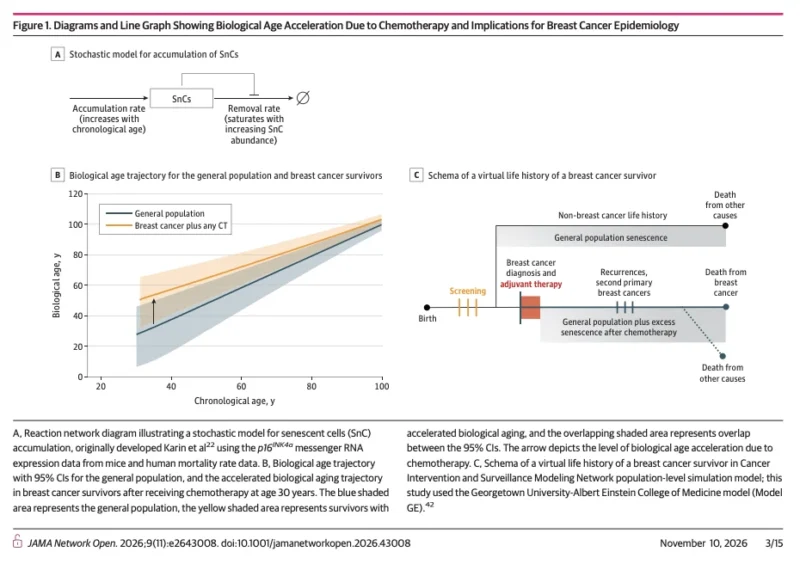
Although this process may contribute to cancer treatment effects, its persistence in normal tissues could potentially influence later health outcomes. The new study focused on a commonly investigated senescence biomarker, p16INK4a, encoded by the CDKN2A gene.
Previous clinical investigations have demonstrated increased p16INK4a expression following cytotoxic chemotherapy in patients with breast cancer. The researchers used these observations to estimate how treatment-related increases in senescence might alter biological age over the remaining lifetime.
Importantly, the study did not establish that p16INK4a alone captures every dimension of human biological aging. Rather, it used this marker as a measurable component of a broader biological process.
A Simulation of 400 Million Women, Not a Clinical Cohort
The investigators employed a population-level Monte Carlo simulation based on the Cancer Intervention and Surveillance Modeling Network (CISNET). Specifically, they adapted the Georgetown University–Albert Einstein College of Medicine breast cancer model.
The simulation included 400 million virtual US women diagnosed with breast cancer between 1990 and 2030, at ages 30–79 years. The model followed these simulated individuals over their projected remaining lifetimes. Two hypothetical treatment scenarios were examined.
In the first, women were assumed to receive anthracycline-based chemotherapy, representing a more cytotoxic treatment approach. In the second, women were assumed to receive nonanthracycline chemotherapy, representing a comparatively less cytotoxic approach.
These categories were chosen because relevant clinical data on chemotherapy-associated p16INK4a changes were available. The model combined breast cancer outcomes with estimates of non–breast cancer mortality derived from biological aging trajectories.
A central assumption was that chemotherapy-induced increases in senescence persisted throughout the remainder of a survivor’s life. Another assumption was that the modeled senescence effect influenced mortality from causes other than breast cancer, without directly increasing breast cancer mortality.
The model did not separately incorporate the potential effects of endocrine therapy, radiotherapy, immunotherapy, or contemporary targeted therapies on biological aging. Therefore, the study should be understood as a simulation of potential lifetime consequences under defined biological assumptions, not a measurement of actual life expectancy in 400 million patients.
The Main Finding: A 7.6-Year Modeled Difference
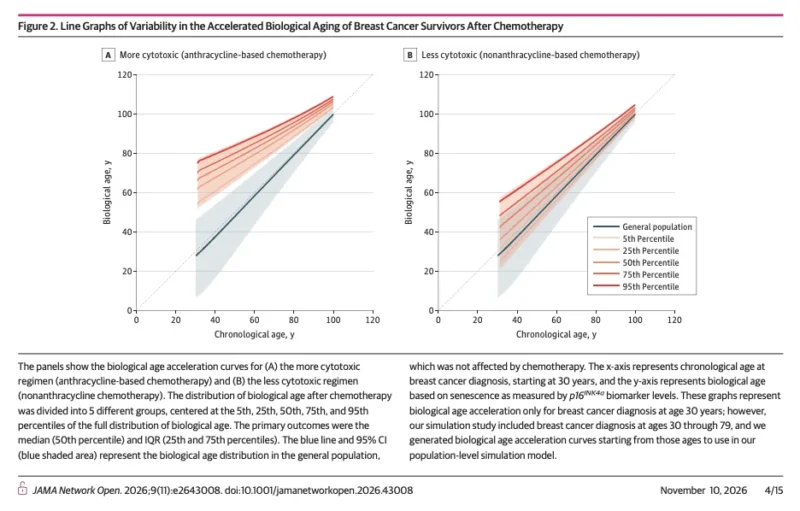
Among simulated breast cancer survivors receiving anthracycline-based treatment, the median life-years lost attributable to biological age acceleration were projected to be 9.4 years, with an interquartile range of 7.6–11.2 years. For the nonanthracycline scenario, the corresponding median was 1.8 years.
The investigators estimated a median difference of 7.6 years between the regimens, with an interquartile range of 7.0–8.0 years. These values represent differences associated with the biological aging component of the model. They are not direct observations of treatment-related mortality in patients receiving anthracyclines.
Nor can the results be used to tell an individual patient that choosing an anthracycline-containing regimen will reduce her life expectancy by a particular number of years. The projected results depend on assumptions about the persistence of senescence, its relationship with mortality, baseline biological age distributions, and the relative cancer-control benefits of chemotherapy regimens.
These assumptions require additional longitudinal clinical validation. Nevertheless, the findings provide a framework for exploring potential late consequences that may not be captured during conventional oncology trial follow-up.
Younger Women May Face the Greatest Lifetime Impact
One of the most notable findings was the variation in projected consequences according to age at breast cancer diagnosis.
Although older survivors are often considered particularly vulnerable to treatment-related complications, younger women may have more remaining years during which accelerated aging could influence long-term health.
In the simulation, women diagnosed at ages 30–39 experienced the greatest potential loss of remaining life-years associated with the more cytotoxic regimen. For this age group, the model estimated 50.4 remaining life-years using chronological-age-based mortality assumptions in the anthracycline scenario.
When biological aging effects were incorporated, estimated remaining life expectancy declined to a median of 38.7 years. This represented an 11.7-year modeled loss attributable to accelerated biological aging.
In the nonanthracycline scenario, the corresponding median loss was 2.1 years. The modeled difference in life-years lost through age acceleration between the two approaches was 9.6 years for women diagnosed at ages 30–39.
These estimates varied substantially across senescence distributions. In older age groups, the potential number of life-years affected was smaller, partly because the remaining lifespan was shorter. The findings therefore suggest that biological aging research should not focus exclusively on older cancer survivors.
Young women treated successfully for breast cancer may face decades of potential treatment-related biological consequences. However, these results do not establish that younger patients should receive less effective chemotherapy to avoid possible accelerated aging. The anticancer benefits of treatment must remain central to clinical decision-making.
When Does Non–Breast Cancer Mortality Become the Dominant Risk?
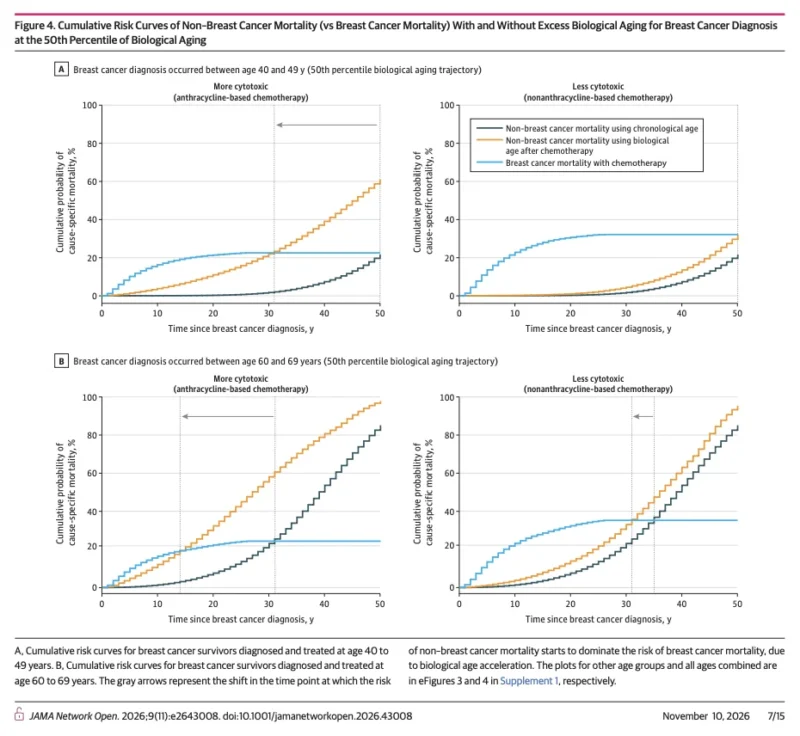
The researchers also examined the changing balance between mortality from breast cancer and mortality from other causes. In the general population, the risk of death from noncancer conditions increases with chronological age.
Among breast cancer survivors, this transition may be influenced by the probability of recurrence, treatment effectiveness, and competing health risks. The simulation estimated that chemotherapy-associated accelerated biological aging could shift the point at which non–breast cancer mortality exceeds breast cancer mortality.
Across all age groups, the transition was projected to occur a median of 16 years earlier than would be expected using chronological age alone in the more cytotoxic treatment scenario. This does not mean that non–breast cancer deaths occurred 16 years after treatment.
Rather, it refers to an earlier crossover in the modeled competing mortality risks. The projected effect varied by age. For women diagnosed at ages 40–49, the transition was estimated to occur approximately 19 years earlier with the more cytotoxic chemotherapy-associated aging trajectory.
These findings suggest that long-term health outcomes may increasingly depend on conditions unrelated to cancer recurrence. Cardiovascular disease, metabolic illness, frailty, and functional decline are therefore relevant components of breast cancer survivorship.
However, the study did not directly quantify the incidence of individual diseases within its primary results. Its principal mortality projections were based on modeled associations between biological age and non–breast cancer mortality.
Anthracyclines Improved Breast Cancer Outcomes in the Model
A critical aspect of the findings is that more intensive chemotherapy also produced better modeled breast cancer outcomes. The study was designed to investigate competing effects: the benefit of more effective cancer treatment and the potential long-term consequences of greater biological aging.
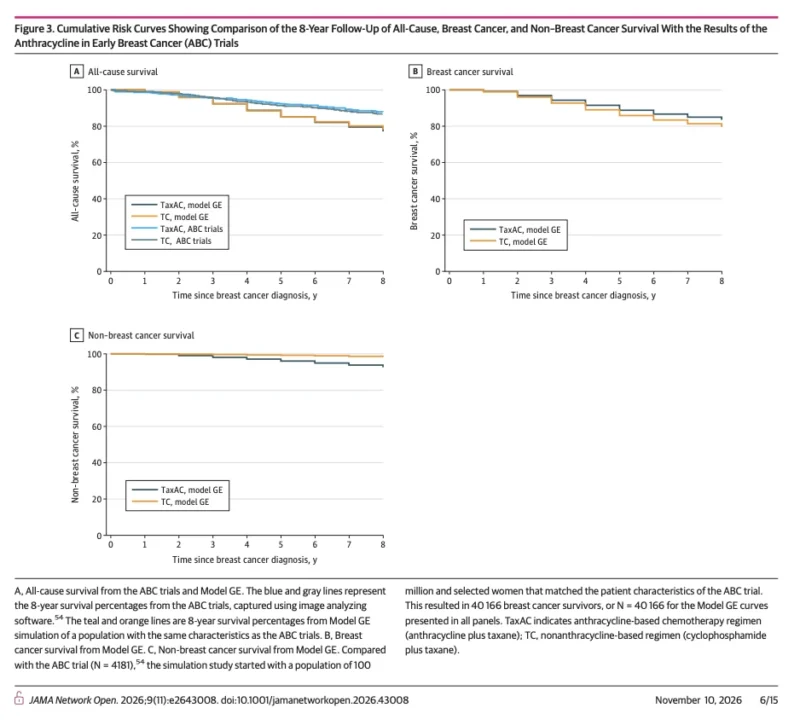
The researchers compared their simulation with the Anthracyclines in Early Breast Cancer (ABC) trials. These randomized trials compared anthracycline–taxane-containing regimens with nonanthracycline docetaxel–cyclophosphamide treatment.
The model reproduced the general pattern observed during eight years of follow-up. Anthracycline-containing regimens were associated with better breast cancer outcomes, while overall survival differences were not clearly separated during the observed period. This distinction is important.
Preventing breast cancer recurrence and death can provide substantial clinical benefit, particularly for patients with higher-risk disease. Even if a treatment has potential late consequences, avoiding it may expose a patient to a greater immediate or long-term risk from cancer itself.
The current model does not replace the randomized evidence supporting chemotherapy selection. Nor does it establish that a nonanthracycline regimen is preferable for every patient. The authors explicitly caution against changing treatment decisions on the basis of the projected aging effects.
The findings instead reinforce the importance of investigating survivorship outcomes alongside traditional oncological endpoints.
Why Eight-Year Validation Cannot Confirm Lifetime Predictions
The investigators assessed their simulation against outcomes from the ABC trials. They generated a trial-like simulated population of 40,166 breast cancer survivors and compared model predictions with approximately eight years of observed outcomes.
The model reproduced the broad relationship between breast cancer control and overall mortality seen in the trials. This provides some support for its representation of short- and medium-term treatment effects.
However, matching outcomes over eight years does not validate predictions extending several decades beyond treatment. A model may accurately reproduce observed early outcomes while generating uncertain long-term estimates when assumptions are extended into the future.
The projected 20-year and lifetime consequences of chemotherapy-induced senescence therefore remain hypotheses requiring prospective verification. The investigators acknowledge that more extensive longitudinal biological aging measurements will be necessary before these findings can be translated into individual clinical decision-making.
The Biological Aging Assumption Is Crucial
One of the study’s most consequential assumptions is that chemotherapy-associated increases in p16INK4a persist for the remainder of a patient’s life. This assumption was informed by published studies documenting persistent senescence-associated changes following chemotherapy.
However, the biological aging process is complex. Cellular senescence may vary across tissues and over time. Different patients may experience distinct trajectories influenced by genetics, lifestyle, comorbidities, environmental exposures, treatment characteristics, and physiological recovery.
The model did not simulate recovery or reversal of chemotherapy-induced senescence. If some treatment-associated biological changes diminish over time, the projected lifetime effects could differ. Conversely, if additional treatments or comorbidities contribute to greater biological damage, the model may not capture the entire burden.
Furthermore, p16INK4a is only one marker among several potential indicators of biological aging. Other approaches include epigenetic clocks, DNA methylation profiles, mitochondrial dysfunction, genomic instability, inflammatory biomarkers, and functional measures such as frailty.
Future studies integrating multiple biological and clinical indicators could improve understanding of treatment-associated aging.
What About Modern Chemotherapy and Targeted Treatments?
The study focused on anthracycline-containing and nonanthracycline chemotherapy scenarios because these had suitable data for modeling senescence. However, breast cancer treatment has evolved substantially. Modern management increasingly incorporates endocrine treatment intensification, CDK4/6 inhibitors, HER2-directed agents, immunotherapy, antibody–drug conjugates, and other targeted strategies.
The biological aging consequences of these approaches remain incompletely understood. The model did not separately evaluate their effects on senescence or their potential interactions with chemotherapy. Consequently, the findings cannot be directly extrapolated to every modern breast cancer regimen.
This is particularly relevant because systemic therapy selection is increasingly driven by molecular subtype, stage, genomic risk, and treatment response. The results should not be interpreted as a universal comparison of all anthracycline-containing regimens with every available nonanthracycline alternative.
Further research is needed to determine whether different chemotherapy schedules, cumulative doses, combinations, or supportive interventions produce distinct biological aging profiles.
Does This Change Clinical Practice?
At present, the study does not justify changing standard adjuvant or neoadjuvant chemotherapy recommendations. The decision to use anthracycline-containing therapy remains dependent on expected cancer-control benefit and treatment-related risks.
Current clinical guidance supports individualized chemotherapy selection according to tumor size, nodal involvement, grade, molecular subtype, patient fitness, comorbidities, and preferences. Anthracycline-containing regimens remain important for selected patients with higher-risk disease.
Nonanthracycline regimens may be appropriate in lower-risk settings or when cardiovascular comorbidities and other toxicity considerations favor anthracycline avoidance. The new study adds a potential dimension to long-term toxicity research, but it does not provide a clinically validated biological aging score for selecting chemotherapy.
Similarly, p16INK4a testing is not an established routine tool for determining whether a patient should receive an anthracycline. Clinicians should therefore avoid applying the model’s numerical estimates directly to individual treatment discussions as if they were measured probabilities.
For now, established tools for estimating recurrence risk and treatment benefit remain the appropriate basis for systemic therapy decisions.
Survivorship Care May Be the Immediate Opportunity
Although the findings do not establish a new treatment-selection strategy, they highlight potential opportunities in survivorship care. Long-term follow-up after breast cancer treatment should extend beyond surveillance for recurrence.
Assessment of cardiovascular health, metabolic risk, physical function, psychological well-being, and other chronic health conditions is increasingly important. Regular physical activity, adequate sleep, and other evidence-based health behaviors can support long-term health and are already relevant to cancer survivorship recommendations.
The researchers also discuss future investigation of interventions targeting senescent cells. Senolytic drugs, designed to selectively eliminate senescent cells, represent one area of emerging geroscience research. However, these agents are investigational in this context.
The current study does not establish their efficacy or safety for preventing chemotherapy-related aging, and it does not support their routine use in breast cancer survivors. The immediate clinical implication is therefore greater awareness of late health outcomes and the need to develop validated strategies for identifying survivors who may require additional support.
Biological Age as a Future Oncology Endpoint
Traditional breast cancer trials prioritize outcomes such as invasive disease-free survival, distant recurrence-free survival, overall survival, and treatment-related adverse events. These endpoints remain essential. However, long-term biological aging may provide additional information about the health consequences of treatment.
The investigators suggest that biological age acceleration could eventually become an exploratory endpoint in clinical trials. For example, future studies could collect serial measurements of senescence-associated biomarkers before treatment, immediately after chemotherapy, and during extended survivorship follow-up.
These data could help clarify whether different regimens produce distinct biological trajectories. They could also determine whether changes in biological aging markers predict clinically meaningful outcomes, including frailty, cardiovascular disease, metabolic dysfunction, functional decline, and mortality.
Such findings would be necessary before biological age could inform treatment selection or risk-adapted survivorship guidelines. Until that evidence becomes available, the relationship between chemotherapy-induced senescence and lifetime outcomes remains a compelling but incompletely validated area of research.
OncoDaily Takeaway
The new JAMA Network Open study highlights an important question for modern breast oncology: how should the long-term biological consequences of cancer treatment be evaluated alongside its ability to prevent recurrence and death?
Using a population-level simulation of 400 million virtual women, Sarkar and colleagues projected that chemotherapy-associated biological age acceleration could substantially influence lifetime mortality from causes other than breast cancer.
The modeled median difference in life-years lost through biological aging was 7.6 years between more cytotoxic anthracycline-based and less cytotoxic nonanthracycline chemotherapy scenarios. The potential lifetime effect was greatest among women diagnosed at younger ages.
However, these figures are simulation-derived projections, not directly observed patient outcomes or established causal estimates of life expectancy lost from anthracyclines. The model relied on important assumptions, particularly that p16INK4a-associated senescence persists throughout life and influences non–breast cancer mortality.
More intensive chemotherapy also provided better breast cancer control within the model, highlighting the competing benefits and risks that must be considered. The findings do not support withholding effective chemotherapy. They underscore the need to understand how cancer treatment affects biological aging, long-term health, and quality of life across decades of survivorship.
Prospective research incorporating biological aging biomarkers, clinical outcomes, and contemporary treatment regimens will be essential to determine whether these insights can eventually improve treatment individualization and survivorship care.
Sources
- Sarkar S, Sedrak MS, Carroll JE, Schechter C, Muss HB, Mandelblatt JS. Chemotherapy-Induced Biological Age Acceleration and Lifetime Outcomes in Breast Cancer Survivors. JAMA Network Open. 2026;9(11). Published November 10, 2026. DOI: 10.1001/jamanetworkopen.2026.43008
- Geyer CE Jr, et al. Long-Term Follow-Up of the Anthracyclines in Early Breast Cancer Trials (USOR 06-090, NSABP B-46-I/USOR 07132, and NSABP B-49). Journal of Clinical Oncology. 2024;42:1344–1349. DOI: 10.1200/JCO.23.01428
- Sanoff HK, et al. Effect of Cytotoxic Chemotherapy on Markers of Molecular Age in Patients With Breast Cancer. Journal of the National Cancer Institute. 2014;106. DOI: 10.1093/jnci/dju057
- Medical Therapy for Hormone Receptor–Positive, HER2-Negative Stage I to III Breast Cancer: ASCO Living Guideline, Version 2026.1.0. Journal of Clinical Oncology. 2026. DOI: 10.1200/JCO-26-02034