
Adjuvant giredestrant, a next-generation oral selective estrogen receptor degrader (SERD), is now under regulatory review: Roche has submitted a new drug application for its use in stage I–III ER-positive/HER2-negative breast cancer. In a new JAMA Oncology commentary, Pusztai and colleagues argue that giredestrant could change adjuvant endocrine therapy as much as aromatase inhibitors did two decades ago. The catch is that this will only happen if it is priced so that it can be widely used.
The lidERA trial
The application is based on the phase 3 lidERA trial (NCT04961996). It randomized 4,170 patients to 5 years of adjuvant giredestrant or standard endocrine therapy with an aromatase inhibitor or tamoxifen. Giredestrant improved 3-year invasive disease-free survival from 89.6% to 92.4% (HR 0.70; 95% CI 0.57–0.87; P = .001). It also reduced the risk of distant recurrence by 31% (102 vs. 145 events; HR 0.69; 95% CI 0.54–0.89). Overall survival data are still immature, at 31% event maturity (HR 0.79; 95% CI 0.56–1.12). Adverse event profiles were similar between arms, and fewer patients stopped giredestrant because of adverse events.
A familiar story
The authors compare these results to the trials that replaced tamoxifen with aromatase inhibitors in the early 2000s. In ER-positive patients in ATAC, 3-year disease-free survival was 91.2% with anastrozole vs. 89.3% with tamoxifen (HR 0.78). In BIG 1-98, it was 90.5% with letrozole vs. 89% with tamoxifen (HR 0.81). Neither trial showed more than a trend toward better overall survival. A later meta-analysis of 31,920 patients confirmed that aromatase inhibitors reduce breast cancer mortality. They were adopted quickly because they were modestly more effective, well tolerated, and cost-effective. At launch, anastrozole cost about $6–7 per day vs. $1–2 for tamoxifen.
Why low-risk disease matters
The authors see the biggest potential for giredestrant in low- to moderate-risk stage I and II disease. lidERA enrolled patients with any node-positive disease, or node-negative tumors larger than 1 cm with high grade, Ki-67 above 20%, or a high-risk genomic score. About 21% of patients were node-negative and 12–13% had stage I disease.
Stage I–II cancers usually have a good prognosis, but they are so common that they cause a large share of breast cancer deaths. In the US in 2017, stage I and stage II hormone receptor–positive cancers accounted for 17% and 28% of breast cancer–specific deaths. Between 2000 and 2017, the share of deaths from stage I disease rose while the share from stage III fell. The authors link this to better therapies for high-risk patients: chemotherapy, ovarian function suppression, extended endocrine therapy, bisphosphonates, and CDK4/6 inhibitors. Each of these added toxicity and cost, so none was adopted in low-risk disease.
Consistent benefit across subgroups
The IDFS benefit was seen in all clinical subsets. The hazard ratios were 0.89 for stage I, 0.58 for stage II, and 0.63 for patients who did not receive adjuvant chemotherapy. The confidence intervals overlap, which suggests no significant heterogeneity by anatomic risk. For high-risk stage II–III disease, CDK4/6 inhibitors plus an aromatase inhibitor remain the standard, and it is unknown whether giredestrant alone can match them. For low-risk patients who are not candidates for CDK4/6 inhibitors, giredestrant offers better efficacy without adding treatment burden.
Adjuvant giredestrant cuts the risk of invasive recurrence by 30% vs. standard endocrine therapy in the lidERA trial. A JAMA Oncology commentary argues it could prevent thousands of recurrences in stage I–II ER+/HER2− breast cancer, but only at an affordable price.
The population-level effect
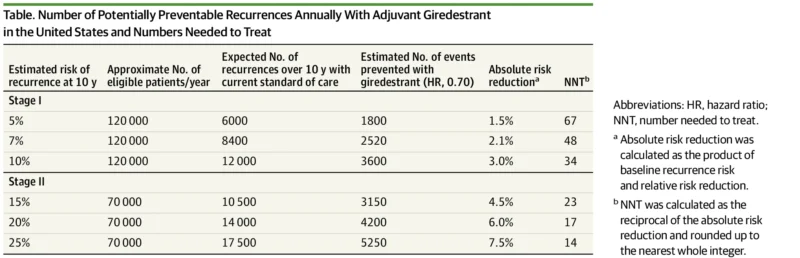
About 120,000 stage I and 70,000 stage II ER-positive/HER2-negative breast cancers could be eligible each year in the US. The authors assumed a constant HR of 0.70 over 10 years. On that basis, they estimate that giredestrant could prevent 1,800–3,600 distant recurrences per year in stage I disease (NNT 67–34) and 3,150–5,250 in stage II disease (NNT 23–14). They acknowledge that lidERA follow-up is short and there are few events in low-risk patients. However, earlier adjuvant endocrine trials showed that hazard ratios stay fairly stable over time.
The price barrier
One year of an aromatase inhibitor costs $5,000–8,000 at average wholesale price. One year of an already approved next-generation SERD, such as elacestrant or imlunestrant, costs $350,000–390,000 in the US. If giredestrant is priced like these drugs, the authors warn that broad adjuvant use will not be feasible.
Bottom line
For an individual patient, the benefit of giredestrant is modest. Across the large number of patients with low-risk disease, it could prevent thousands of metastatic recurrences every year. Whether that happens may depend more on pricing than on the trial data.