Calculators
 OncoCalendar


Roupen Odabashian, Oncologist at Abbotsford Regional Hospital and Cancer Centre, Founder at MeDucation AI, Podcast Host at OncoDaily, shared a post on X:
“I posted yesterday about a clinical decision support tool I built using open weight AI models. It helps me assess whether a patient’s cancer has progressed when a CT scan is available but the radiology report isn’t ready yet.
Some people interpreted that as me saying AI could replace radiologists. That wasn’t my point.
But it raised a much bigger question: Can an LLM replace the clinical decisions physicians make every day?
Let me walk you through a relatively simple example from my oncology clinic.
Imagine a patient diagnosed with cancer at the back of the throat, called the oropharynx. The cancer has spread to nearby lymph nodes in the neck.
We have two potential treatment approaches: surgery or a combination of chemotherapy and radiation.
The surgeon evaluates the patient and decides that chemotherapy and radiation would be the better option.
Sounds straightforward, right? Not quite.
Before starting treatment, we need imaging to make sure the cancer hasn’t spread elsewhere. We order scans of the neck, chest, abdomen, and pelvis.
The CT scan shows something suspicious in the liver. Could it be cancer?
We order a PET scan, which helps us identify areas of increased metabolic activity that might represent cancer.
The liver spot doesn’t show concerning activity. Great.
But now the PET scan reveals suspicious lymph nodes lower in the neck and in the upper chest.
And suddenly, our entire treatment plan might change.
Why?
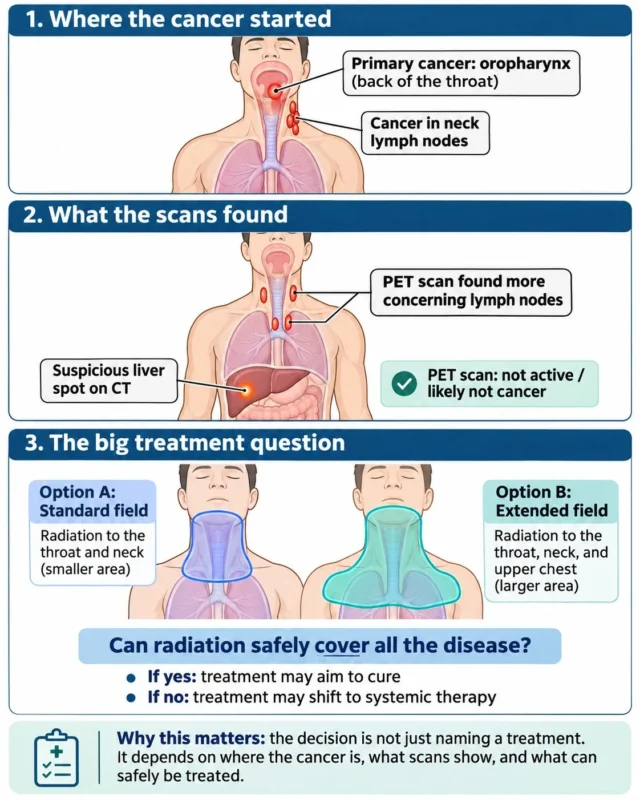
Because if the cancer has spread beyond the areas we can reasonably treat with radiation, we may need to approach it as advanced disease rather than potentially curable localized disease.
But what if we could include those lymph nodes in the radiation field?
This is where I pick up the phone and talk to my radiation oncology colleague.
- Can we safely cover all these areas with radiation?
- What would the risks be?
- Could we still aim to cure this patient?
The location of those lymph nodes matters enormously. Some may still be considered regional disease, while others could represent distant spread.
The answer could determine whether we recommend treatment with the goal of curing the patient or treatment primarily aimed at controlling the disease.
An LLM might suggest a treatment based on the guidelines. But the guidelines don’t tell us everything about what is technically feasible for this particular patient.
Let’s assume we decide to proceed with chemotherapy and radiation.
Now comes another decision.
The standard chemotherapy drug we often use is cisplatin. It helps make radiation more effective.
- But what if the patient has hearing loss?
- Kidney disease?
- Significant nerve damage?
Cisplatin may not be safe.
We now need to consider alternatives, such as carboplatin with 5-FU or other regimens used in certain clinical settings.
And these aren’t interchangeable options.
One treatment might require the patient to come to the infusion center, receive medication, and go home.
Another might require a catheter placed into a vein and a portable pump delivering chemotherapy continuously for several days.
Think about what that means for someone who works, takes care of their family, or simply wants to maintain their independence.
Now I have to consider not just what the guidelines recommend, but what my institution offers, what evidence supports each option, what toxicities the patient can tolerate, and what the patient actually prefers.
And we’re still not done.
What if there’s a clinical trial available?
Should we recommend the established treatment or discuss enrolling in a trial?
The patient might receive an experimental treatment, or they might be assigned to the standard treatment.
Will the experimental option be better? We don’t know. That’s why we’re conducting the trial.
Now imagine explaining all these possibilities to a patient who has just learned they have cancer.
- Explaining the evidence, the uncertainty, the side effects, the practical burden of treatment, and the tradeoffs
- Listening to what matters most to them.
Sometimes these conversations take more than one appointment and several hours. They also involve discussions with surgeons, radiation oncologists, radiologists, clinical trial teams, and other specialists.
And remember, this is a relatively straightforward example compared with many of the cases we manage in oncology.
So can an LLM answer what treatment we should give?
Often, yes. It can identify standard treatments, summarize guidelines, explain trial results, and suggest reasonable options. And many times better than me because I can’t cite trials as good as LLMs.
That’s valuable, and I use AI because I believe it can make physicians better at what they do.
But identifying a recommended treatment is not the same as making a clinical decision.
An LLM doesn’t automatically know whether my radiation oncology colleague can safely cover a particular area, which treatment protocols my institution uses, or whether my patient is willing to carry an infusion pump for four days.
And even if we give it all that information, someone still has to examine the patient, verify the findings, interpret the uncertainty, coordinate care, and take responsibility for the decision.
This is also why I don’t view clinical decision support tools as replacements for radiologists or oncologists.
I view them as tools that can help us gather information, identify things we might miss, and make better informed decisions.
Medicine is not just about knowing the right answer. It’s about understanding why that answer is right for the person sitting in front of you.
That’s the distinction I think we’re missing in many conversations about AI replacing physicians.
This is an image that I hope it helps in understanding what I’m talking about. In real life, there is more nuance and detail that comes to it.”
You can also read:
Douglas Flora: How Can AI Transform Cancer Care Without Losing the Human Touch?