
Zeynep Birsu Çinçin, Honorary Professor of Medical Biochemistry at Washington University of Health and Science, Ambassador at European Association for Cancer Research (EACR), shared a post on LinkedIn:
“01. Awareness Is No Longer Enough
The global burden remains immense. In 2024, an estimated 2.4 million women were diagnosed with breast cancer, 694,000 died from the disease, and 8.2 million were living with it worldwide. Breast cancer was the most commonly diagnosed cancer among women in 164 of 186 countries.
WHO’s 2026 Breast Cancer Awareness Month theme—’Every story is unique, every journey matters’—also resonates with a biological reality: breast cancer is not a static disease. Tumour cells and their microenvironment can adapt under therapeutic pressure, reshaping signalling networks, cellular states and mechanisms of treatment resistance.
In 2026, awareness must therefore extend beyond diagnosis to molecular awareness: understanding not only what a tumour is, but what it is becoming under treatment—and detecting that change early enough to act.
02. The 2026 Breast Cancer R&D Radar
The pace of regulatory activity in 2026 tells a larger story: breast cancer therapeutics are becoming increasingly biomarker-driven, resistance-aware, modality-diverse and combination-based.
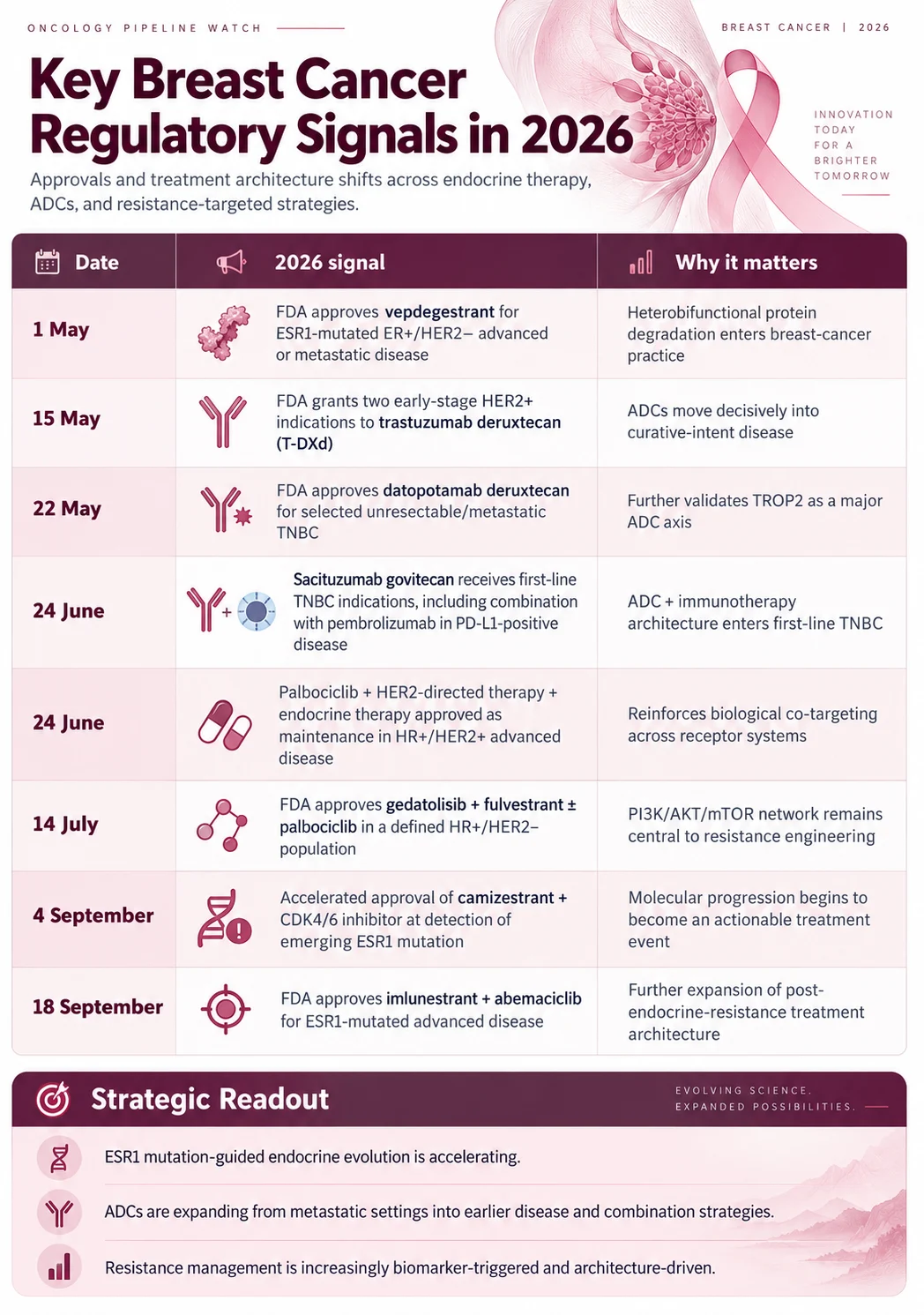
Figure 1. Selected FDA breast cancer approvals and regulatory milestones in 2026. Sources: U.S. Food and Drug Administration.
The individual approvals matter. The pattern matters more.
Competition is shifting from the individual asset toward the therapeutic architecture surrounding it—companion diagnostics, resistance monitoring, combination partners, sequencing strategy and the evidence defining when treatment should enter the patient journey.
In precision oncology, the drug is increasingly only one component of the therapeutic system.
03.The Most Important Change May Be When We Treat
SERENA-6 may ultimately be remembered less for introducing another endocrine agent than for changing the temporal logic of cancer treatment.
In this phase III trial, patients receiving an aromatase inhibitor plus a CDK4/6 inhibitor underwent serial ctDNA monitoring for emerging ESR1 mutations. When a mutation appeared—before radiological progression—endocrine therapy could be switched to camizestrant while CDK4/6 inhibition continued.
With longer follow-up, median progression-free survival was 16.8 months versus 9.2 months, while median second progression-free survival was 25.7 versus 19.1 months, favouring the early-switch strategy.
On 4 September 2026, the FDA granted accelerated approval to camizestrant in this molecularly defined setting and approved Guardant360 CDx as the companion diagnostic. The agency described it as the first FDA approval of a cancer therapy guided by detection of a resistance mutation in ctDNA before imaging showed disease progression.
Traditional oncology: progression → reassessment → treatment change
Adaptive oncology: molecular resistance → detection → intervention before radiological progression
A resistance mutation is shifting from an explanation of treatment failure to a potential trigger for treatment.
For drug developers, this expands the therapeutic strategy beyond the molecule itself. Assay sensitivity, testing intervals, intervention thresholds, companion diagnostics and treatment sequencing increasingly become part of the development programme.
Importantly, the FDA has required confirmatory studies to establish whether intervention at molecular progression translates into durable clinical benefit.
04. Endocrine Therapy Is Becoming Resistance Engineering
ESR1 biology is revealing multiple ways to attack the same resistance landscape.
Approved by the FDA on 1 May 2026, vepdegestrant is a heterobifunctional protein degrader for ESR1-mutated ER+/HER2− advanced or metastatic breast cancer. Its approval, together with Guardant360 CDx as a companion diagnostic, illustrates how target degradation and molecular selection are converging within the same therapeutic strategy.Camizestrant and imlunestrant further expand the emerging repertoire of ER-directed treatment.
But endocrine resistance extends beyond the receptor itself.
In the phase III evERA trial, published in The New England Journal of Medicine in October 2026, giredestrant plus everolimus improved median progression-free survival after prior CDK4/6 inhibitor therapy. Among patients with ESR1-mutated tumours, median PFS was 10.0 versus 5.5 months; in the overall population, it was 8.8 versus 5.5 months.
The therapeutic question is therefore shifting from:
What drives this tumour?
to
What escape route has treatment selected—and can we drug it?
A resistance mechanism becomes most valuable when three elements converge: causal biology, a measurable biomarker and a therapeutically actionable vulnerability.
For AI, the near-term opportunity is not to replace experimental oncology, but to help prioritise resistance pathways and rational combinations for functional and clinical validation.
05. The ADC Race Is Entering a Different Phase
ADCs have already reshaped breast-cancer therapy. The next question is harder: why do they fail, and which biological contexts determine response?
2026 accelerated this transition. T-DXd moved further into early HER2-positive disease, datopotamab deruxtecan entered first-line metastatic TNBC for patients not eligible for checkpoint inhibition, and sacituzumab govitecan expanded into first-line TNBC, including combination with pembrolizumab in PD-L1-positive disease.[4–6] In October, AstraZeneca and Daiichi Sankyo announced plans to evaluate datopotamab deruxtecan with the PD-1/VEGF bispecific ivonescimab, beginning with a phase III first-line TNBC study.
The trajectory is clear:
ADC expansion → earlier-line use → rational combinations → resistance-informed development.
Spatial biology is beginning to explain the last step. A 2026 Cell Reports Medicine study profiled 912,360 cells across 157 tumour regions from 47 HER2-positive/HR-negative breast cancers. Higher tumour-cell H3K27ac was associated with greater ADC sensitivity, whereas collagen-positive fibroblasts contributed to resistance; the investigators subsequently developed a spatial ADC barrier prediction model.[15]
Complementary work in Clinical Cancer Research identified an S100–RAGE pro-survival programme associated with intrinsic T-DXd resistance. Pharmacological RAGE inhibition restored T-DXd sensitivity in preclinical models, linking spatial resistance biology to a potentially actionable vulnerability.
The next ADC race may be won as much by tumour ecology as by antibody affinity or payload chemistry.
For pharma, this shifts biomarker development beyond antigen abundance toward the spatial and molecular architecture that permits—or prevents—ADC response.
06. AI Must Graduate from Accuracy to Decision Value
In breast cancer screening, the relevant AI question is no longer simply whether a model is accurate. It is whether that model improves a clinical decision or workflow without introducing unacceptable trade-offs.
A 2026 Nature Cancer study evaluated an AI mammography system in 115,973 retrospective mammograms, followed by prospective technical deployment across 9,266 cases. Retrospectively, cancer detection increased from 7.54 to 9.33 per 1,000 women; simulated replacement of the second reader reduced reading time by 32% while increasing detection by 17.7%. Yet prospective deployment revealed a distribution shift requiring threshold recalibration.
A separate prospective Nature Medicine trial involving 31,301 women showed the same tension between performance and implementation. A partially autonomous AI workflow reduced radiologist workload by 63.6% and increased cancer detection by 15.2%, but the recall rate was 14.8% higher and did not meet the prespecified non-inferiority criterion.
The lesson is not simply that AI works—or that it does not.
Clinical performance depends on where, how and for whom the system is deployed.
Clinical AI should be judged not by the benchmark it wins, but by the quality of the decision it changes.
For developers and health systems, this makes calibration, distribution-shift monitoring, workflow integration and post-deployment surveillance part of the AI product itself.
07. Digital Pathology Is Moving Toward Treatment-Relevant Biology
Digital pathology is moving beyond cancer detection toward a more consequential goal: extracting treatment-relevant biology from routine tissue morphology.
A 2026 Lancet Oncology multicentre study combined H&E whole-slide images with clinicopathological variables to estimate the Oncotype DX 21-gene recurrence score in HR+/HER2− early breast cancer. In the 2,407-patient TAILORx test set, the model achieved an AUC of 0.898 for identifying recurrence scores ≥26, with external AUCs of 0.858–0.903 across six independent cohorts. Because the model was evaluated within TAILORx, investigators could also examine associations between AI-defined risk and chemotherapy benefit.
A separate Nature Communications study integrated digital pathology with clinical data from 8,161 patients across 15 cohorts. The multimodal model predicted recurrence risk across major breast-cancer subtypes, including TNBC, demonstrating that routine histology can encode prognostic information beyond conventional pathological interpretation.[20]
At a larger scale, PRISM2 was trained on 2.3 million whole-slide images and 14 million question–answer pairs derived from approximately 700,000 pathology reports. The model achieved strong performance across cancer-detection, biomarker and survival tasks, including breast pathology benchmarks, while its authors also highlighted remaining questions around robustness, dataset bias and clinical generalisability.
The emerging opportunity is not simply to recognise cancer in an H&E slide, but to recover clinically meaningful biology that has traditionally required additional testing.
For pharma, digitised histology could become a scalable computational phenotype for biomarker discovery, trial enrichment and retrospective translational analysis. The critical threshold, however, remains prospective validation: prediction becomes valuable only when it can support a reproducible clinical or drug-development decision.
08. Agentic AI Is Moving from Recognition to Hypothesis Generation
A different form of AI entered cancer pathology in 2026: systems designed not only to recognise patterns, but to generate and test biologically framed analytical hypotheses.
In Nature Medicine, SPARK—the System of Pathology Agents for Research and Knowledge—used interacting AI agents to translate biological concepts into computational pathology analyses without task-specific model retraining. It was evaluated across 18 cohorts, five cancer types and more than 5,400 patients, alongside a spatial breast-cancer dataset involving 625 patients.[22]
SPARK generated tissue-derived concepts associated with prognosis, established pathological variables and predictive biomarkers, illustrating a shift from:
What is present in this image?
to:
What biological relationship might this tissue contain—and how can we test it?
That distinction is potentially important for translational research. But the boundary must remain clear:
A machine-generated hypothesis is not a mechanism. Association is not validation, and computational discovery is not biological proof.
The opportunity is therefore not autonomous science replacing investigators, but human–AI experimental science: AI generates and prioritises hypotheses; molecular and functional experiments challenge them; clinical data determine whether they matter.
For pharma, the value could lie in accelerating biomarker discovery, tissue-based hypothesis generation and target prioritisation—provided that computational signals ultimately survive independent, functional and prospective validation.
09. Spatial Biology May Redefine What a Biomarker Is
Traditional biomarkers largely ask what is present and how much. Spatial biology adds another dimension: where it is, what surrounds it and how those cellular neighbourhoods interact.
A 2026 Nature Communications study integrated single-cell RNA sequencing, spatial transcriptomics and genomic profiling across 28 patients with synchronous ductal carcinoma in situ (DCIS) and invasive breast carcinoma (IBC). The transition to invasion was driven predominantly by expansion of pre-existing DCIS subclones, accompanied by transcriptional reprogramming and extensive tumour-microenvironment remodelling, rather than by the simple acquisition of additional driver alterations.
At the invasive front, the investigators identified spatially organised ligand–receptor interactions associated with basement-membrane disruption, angiogenesis and immunosuppression, and resolved four molecular stages of basement-membrane breach associated with progressively poorer survival.
The implication extends beyond breast-cancer invasion:
A biomarker may ultimately be defined not only by what a tumour expresses, but by where that signal occurs, which cells surround it and what biological programme that neighbourhood creates.
For translational R&D, spatial biology could therefore move biomarker development from isolated molecular measurements toward context-dependent cellular ecosystems—particularly in resistance, patient stratification and combination-therapy design.
10. Organoids Are Becoming a Functional Validation Layer
One of oncology’s persistent gaps lies between computational prediction and patient response. Patient-derived organoids offer a functional system in which some of those predictions can be challenged experimentally.
A 2026 Cell Reports Medicine study characterised 40 patient-derived breast-cancer organoids using clinically measurable biomarkers and integrated them with treatment-response data from the I-SPY2 trial. Models derived from patient data were used to predict therapeutic response, including response to veliparib–platinum therapy in TNBC, and those predictions were subsequently tested in organoids.
In treatment-resistant TNBC organoids, functional drug screening identified combinations capable of overcoming cisplatin resistance, including pro-apoptotic strategies. HSP90 inhibitors also emerged as a candidate vulnerability and were linked to improved recurrence-free survival in a biomarker-defined patient subgroup.
The translational opportunity is therefore a closed loop:
clinical data → computational prediction → patient-derived model → perturbation → biomarker refinement → clinical testing
AI can prioritise which hypotheses deserve experiments; functional models can determine which computational hypotheses deserve belief.
For pharma, this pairing could help reduce uncertainty in drug-response prediction, resistance modelling and combination prioritisation. Organoids are not substitutes for clinical trials; their value is as a functional filter between prediction and clinical development.
11. The Real Pharma AI Race Is About Uncertainty
The pharmaceutical AI narrative often centres on molecule generation. But the more consequential opportunity may be elsewhere: reducing uncertainty between biological hypothesis and clinical proof.
A 2026 Molecular Cancer review mapped 202 publications across the oncology AI landscape and found a clear evidence gradient. Selected imaging applications have reached prospective or randomized evaluation, while foundation models, multi-omics and spatial systems increasingly generate testable biological hypotheses. Yet many treatment-selection and drug-discovery applications still lack functional or prospective validation.[25]
For pharma, this shifts the objective. AI is potentially valuable across target prioritisation, biomarker discovery, resistance modelling, combination selection and trial enrichment—but only when computational predictions reduce a real development uncertainty.
The scarce resource in pharmaceutical R&D is not data. It is validated translational judgment.
Industry investment in 2026 reflects the scale of that ambition. Lilly and NVIDIA announced up to $1 billion over five years for an AI co-innovation laboratory designed to connect computational models with experimental drug discovery. Roche added 2,176 NVIDIA Blackwell GPUs, bringing its announced hybrid-cloud AI infrastructure above 3,500 GPUs and extending AI capacity across therapeutics, diagnostics and clinical development.
At the same time, the Astex–Genentech breast-cancer collaboration, worth more than $490 million in potential payments, is built around fragment-based discovery against a cell-cycle-dependent regulator rather than AI.[28] That distinction matters: the future of drug development is unlikely to be AI instead of molecular pharmacology, but AI integrated with mechanism-driven experimental science.
The competitive advantage will therefore belong not to the organisation that generates the most predictions, but to the one that can move most reliably from:
prediction → experiment → mechanism → biomarker → clinical evidence.
12. The New Breast Cancer R&D Stack
The emerging breast-cancer R&D model is no longer a sequence of isolated technologies. It is becoming an integrated learning system in which molecular surveillance, computational inference, functional validation and therapeutic intervention continuously inform one another.
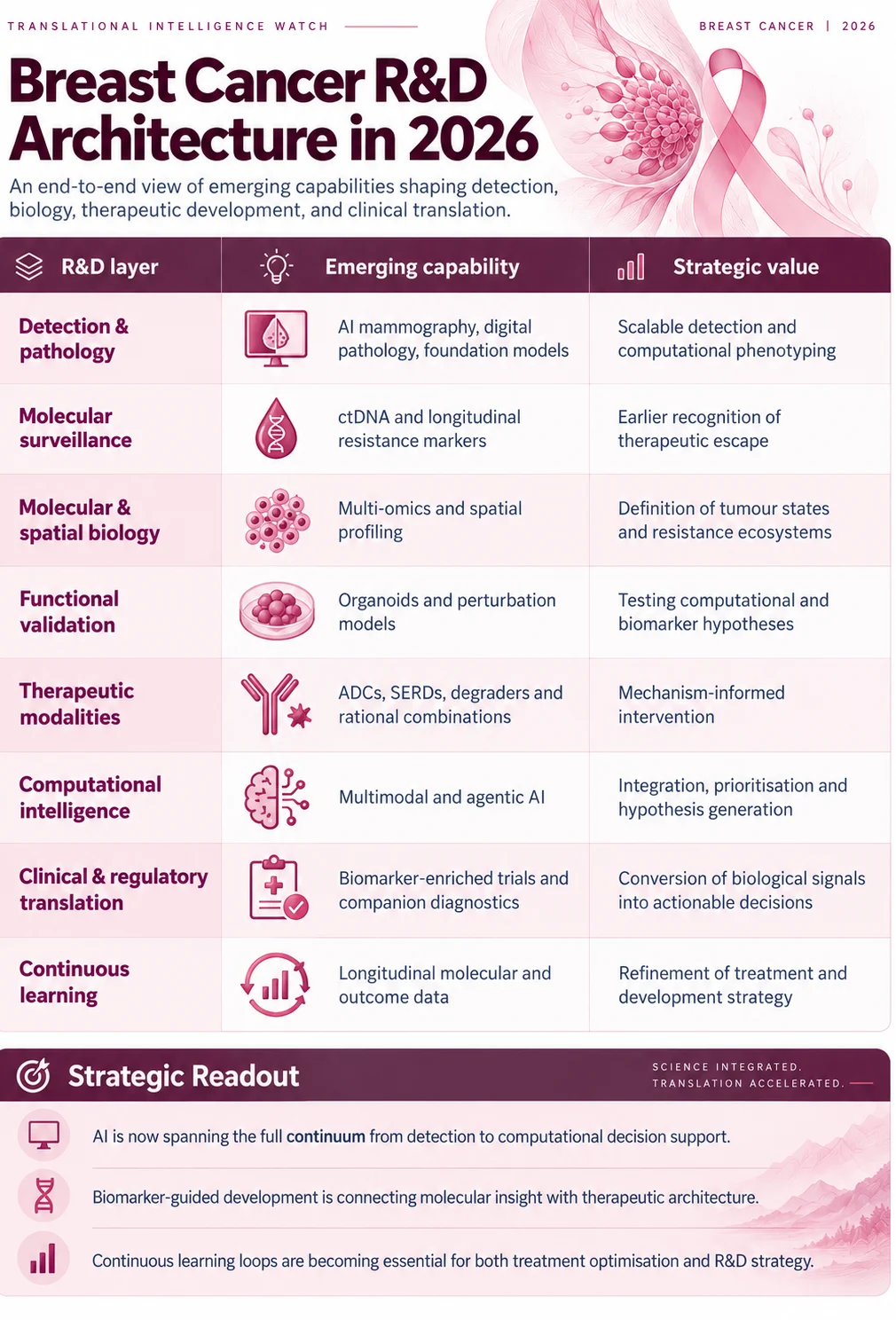
Figure 2. Breast cancer R&D architecture in 2026. Integrated framework of emerging diagnostic, molecular, computational, and therapeutic capabilities
The strategic advantage increasingly lies not in owning any one layer, but in connecting them.
The most valuable oncology platform may not be an AI platform at all, but a learning therapeutic system in which data, biology and intervention continuously update one another.
13. Five Questions That Should Define Breast Cancer R&D in 2027
The most important questions emerging from 2026 are no longer purely technical. They concern when to intervene, what to measure and which signals are sufficiently credible to change development strategy or patient care.
1. Can molecular progression become routinely actionable before imaging progression?
SERENA-6 has provided proof of principle, but the broader question is whether longitudinal ctDNA-guided intervention can deliver durable clinical benefit across additional resistance mechanisms and treatment settings.
2. Can ADC sequencing become biologically rational rather than empirical?
As ADCs move earlier and combinations expand, spatial resistance biology may help determine which patients respond, why resistance emerges and which therapeutic sequence should follow.
3. Can computational pathology move from prognostic association to treatment-decision value?
Digital pathology models can infer recurrence risk and clinically relevant biology from routine H&E, but the decisive threshold remains prospective evidence that these predictions improve a real therapeutic decision.
4. Can patient-derived functional models influence drug-development portfolios at scale?
Organoids offer a compelling bridge between computational prediction and experimental validation, but scalability, reproducibility and clinical integration will determine whether they become routine translational tools.
5. Can multimodal AI integrate tumour evolution without creating false precision?
The next generation of oncology AI will need to combine imaging, pathology, molecular profiling, spatial context and longitudinal treatment data while preserving biological interpretability, calibration and clinical validity.
The central challenge of 2027 will not be generating more biological information. It will be deciding which information is trustworthy enough to change an experiment, a trial—or a treatment.
These questions cannot be answered by computer science alone. They require oncology, molecular biology, pathology, pharmacology, diagnostics, bioinformatics, medicinal chemistry and regulatory science to converge around the same translational problem.
EDITOR’S NOTE
Breast cancer in 2026 illustrates a broader transformation in oncology. The field is moving from static classification toward continuous molecular interpretation—from defining what a tumour is to understanding what it is becoming under therapeutic pressure.
Across this special report, the same principle appears repeatedly: ctDNA can reveal emerging resistance before radiological progression; ADC response depends on more than antigen expression; spatial biology exposes tumour ecosystems that conventional biomarkers cannot capture; computational pathology extracts previously inaccessible information from routine tissue; and patient-derived models provide a functional test for increasingly sophisticated computational predictions.
AI is therefore only part of the story.
Its real value will not be determined by how many predictions, biomarkers or molecules it can generate, but by whether it helps move oncology more reliably from observation to mechanism, from mechanism to validation, and from validation to a better therapeutic decision.
The future of breast cancer medicine will depend less on generating more information than on recognising which biological change matters—and acting while it can still alter the course of disease.”

You can also read: ESMO 2026 Metastatic Breast Cancer Guideline: Biomarker-Driven Therapy Reshapes Treatment Across Subtypes