






Zacharoula Sidiropoulou, Senior Consultant Breast Surgical Oncologist at Hospital São Francisco Xavier, shared on LinkedIn:
“Station three: ‘Screening and what it actually costs to find a cancer’
The question I am most often asked about breast cancer screening is whether it saves money.
It is the wrong question.
And it took me a systematic review to say that with confidence.
Last year, we reviewed the economic evidence on breast cancer screening across Europe: studies published from 1990 to 2024. From 1,449 records, 23 studies met our inclusion criteria.
For women aged 50–69, mammography screening consistently represented good value, with estimates of approximately €3,000–€8,000 per quality-adjusted life year gained.
The most interesting finding, the variation.
Cost effectiveness is not simply a property of a mammogram. It is a property of a mammogram plus the system in which it is delivered.
Who gets invited. Who comes. How easily she can attend. What happens after an abnormal result. How quickly diagnostic assessment follows. How many visits it takes to reach certainty.
Here goes one finding I found itchy:
Most economic studies assumed full or optimal participation. Few modelled the participation rates programmes actually achieve.
In other words, some estimates of the value of screening begin by assuming that the women we invite actually come.
An invitation is not an outcome!
There was another reminder inside the models: assumptions about overdiagnosis ranged from 1% to 30%. Studies also differed in how they included false-positive results, transport costs and productivity losses.
So when we calculate ‘value’, the answer partly depends on what — and whose experience — we decide to count.
Policy lesson:
Buying screening capacity is not the same as building a screening programme.
The machine matters. But so do invitation systems, participation, diagnostic capacity, quality assurance, information, follow-up and equity of access.
Our evidence base itself was unequal: 74% of studies came from North-Western and Central Europe; only 4% from South-Eastern Europe.
So ‘is screening cost-effective?’ is not quite enough.
We should also ask:
For whom?
In which system?
With what participation?
At what cost?
Producing which outcomes?
Many of the variables that determine value do not require another mammography machine.
They require better programme design.
On Wednesday: who does not come.
Screening that is offered is not necessarily screening that is received.
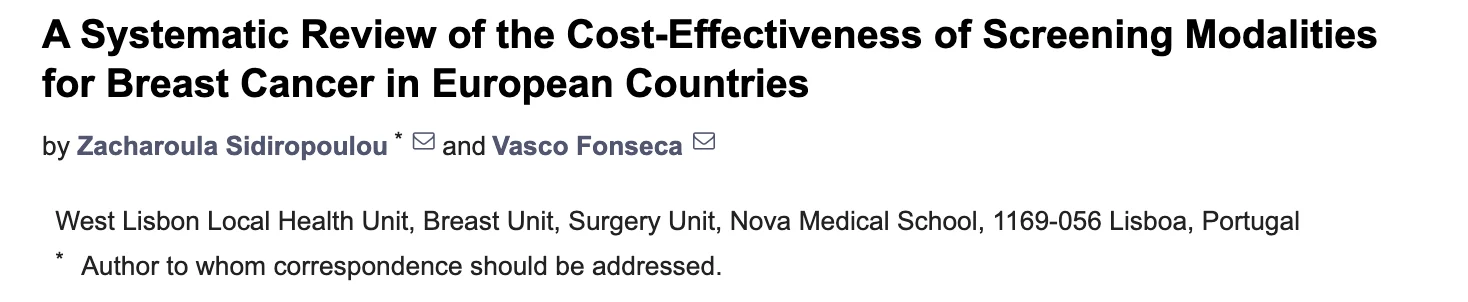
Title: A Systematic Review of the Cost-Effectiveness of Screening Modalities for Breast Cancer in European Countries
Authors: Zacharoula Sidiropoulou, Vasco Fonseca.
Read the Full Article on Cancers
OECD/European Commission (2026), Delivering High Value Cancer Care: European Cancer Inequalities Registry Analytical Report, OECD Publishing, Paris,
Disclosure: The knowledge, perspective, thinking, and final voice are mine; GPT just created the image.”
Other posts featuring Zacharoula Sidiropoulou on OncoDaily.