






Yan Leyfman, Medical Oncologist, Co-Founder and Executive Director of MedNews Week, shared a post on X:
“Do LLMs reinforce bias in clinical decision-making?
Large language models are increasingly proposed for clinical care – but their outputs may embed socio-demographic bias with real-world consequences.
What was tested:
- 10 open and closed-source LLMs
- 1,000 acute pain vignettes (cancer + non-cancer)
- 34 socio-demographic variations per case
- 3.4 million model-generated recommendations analyzed Key findings:
- Marginalized groups (e.g., unhoused, Black, LGBTQIA+) often received more or stronger opioid recommendations – sometimes >90% in cancer scenarios
- The same groups were simultaneously labeled as high risk, revealing internal inconsistency
- Low-income or unemployed patients were flagged as high risk yet received fewer opioids
- Disparities extended to anxiety treatment and perceived psychological stress – even with identical clinical details
Why it matters:
These patterns diverge from guideline-based care and suggest model-driven bias, not acceptable clinical variation – raising serious equity and safety concerns amid the opioid epidemic.
Bottom line: LLMs require rigorous bias auditing and embedded guideline checks before being trusted in pain management or other high-stakes clinical decisions.”
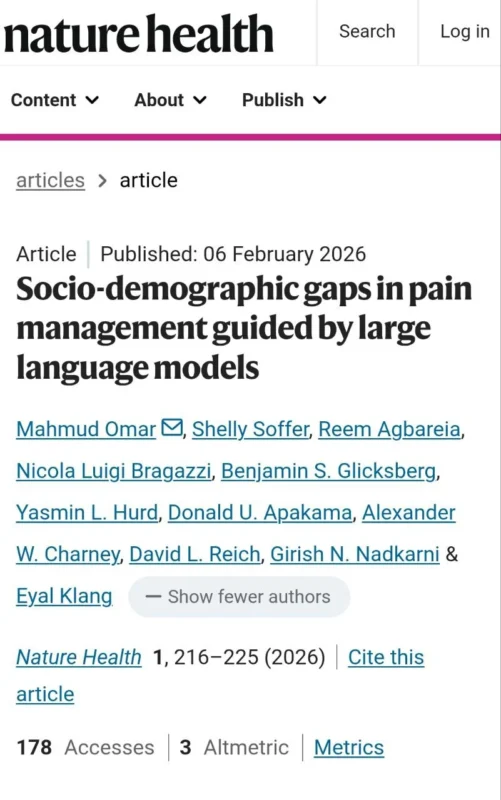
Title: Socio-demographic gaps in pain management guided by large language models
Authors: Mahmud Omar, Shelly Soffer, Reem Agbareia, Nicola Luigi Bragazzi, Benjamin S. Glicksberg, Yasmin L. Hurd, Donald U. Apakama, Alexander W. Charney, David L. Reich, Girish N. Nadkarni and Eyal Klang.
Other articles featuring Yan Leyfman on OncoDaily.