






Yan Leyfman, Medical Oncologist, Co-Founder and Executive Director of MedNews Week, shared a post on LinkedIn about a recent article by Nadav Ahituv et al, adding:
“What if we could starve tumors—by design?
Tumors are metabolically greedy. We engineered adipocytes to outcompete cancer cells for nutrients, creating a novel therapeutic strategy termed Adipose Manipulation Transplantation (AMT).
Key insights:
- Engineered adipocytes with increased UCP1 consume more glucose and fatty acids → tumor suppression
- Co-implantation with cancer cells/xenografts significantly reduced tumor growth
- In pancreatic and breast cancer mouse models: decreased tumor growth, angiogenesis, and hypoxia
- Patient-derived breast cancer organoids showed decreased proliferation when co-cultured with engineered adipocytes
- AMT is tunable: inducing nutrient competition (e.g., tetracycline control, scaffold delivery) further impaired tumor growth
- Customization potential: targeting uridine metabolism (increased UPP1) suppressed uridine-dependent pancreatic cancer
Takeaway: Reprogramming adipose tissue to metabolically outcompete tumors offers a new, adaptable anti-cancer platform—turning nutrient competition into therapy.”
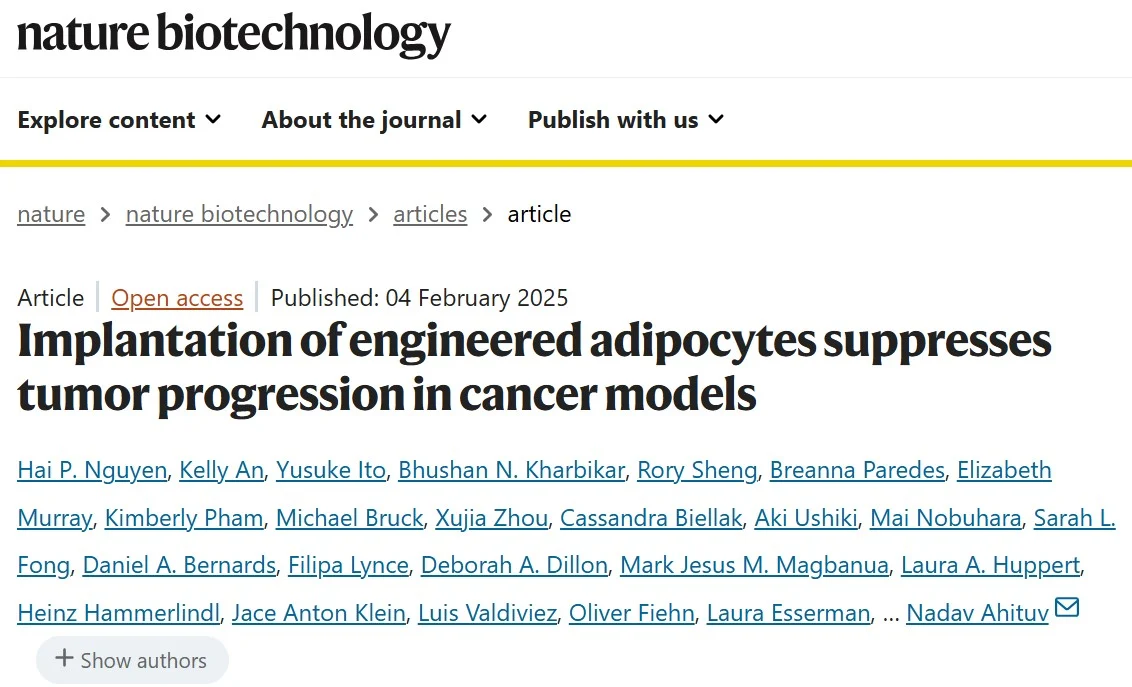
Title: Implantation of engineered adipocytes suppresses tumor progression in cancer models
Authors: Hai P. Nguyen, Kelly An, Yusuke Ito, Bhushan N. Kharbikar, Rory Sheng, Breanna Paredes, Elizabeth Murray, Kimberly Pham, Michael Bruck, Xujia Zhou, Cassandra Biellak, Aki Ushiki, Mai Nobuhara, Sarah L. Fong, Daniel A. Bernards, Filipa Lynce, Deborah A. Dillon, Mark Jesus M. Magbanua, Laura A. Huppert, Heinz Hammerlindl, Jace Anton Klein, Luis Valdiviez, Oliver Fiehn, Laura Esserman, Tejal A. Desai, Sook Wah Yee, Jennifer M. Rosenbluth, Nadav Ahituv
You can read the full article in Nature Biotechnology.
More posts about Pancreatic Cancer.