






Yan Leyfman, Medical Oncologist, Co-Founder and Executive Director of MedNews Week, shared a post on LinkedIn about a recent article by Emily Greene et al, adding:
“Pancreatic ductal adenocarcinoma (PDAC) is among the most lethal solid tumors, with most patients presenting with metastatic disease and limited responses to immunotherapy.
Using multiplex IHC, spatial profiling, and single-cell mass cytometry (CyTOF) across 27 primary PDAC tumors and 26 liver metastases, we uncovered striking site-specific immune and stromal differences:
- Liver metastases showed reduced T-cell infiltration , fewer fibroblasts, and decreased collagen deposition
- CD68⁺ myeloid cells—often CCR2⁺—were enriched in metastatic lesions
- Spatial analyses revealed distinct immune–stromal neighborhoods, with CK19⁺ tumor cells clustering differently with α-SMA⁺, CD3⁺, and CD68⁺ cells depending on site
- CD8⁺ T cells were markedly depleted in metastases
- T cells in primary tumors expressed suppressive TFs (FoxP3, RORγt)
- CyTOF showed co-expression of inhibitory checkpoints, notably PD-1 and LAG-3
Bottom line: primary and metastatic PDAC harbor profoundly different immune ecosystems—arguing for site-specific, rationally designed immunotherapy strategies.”
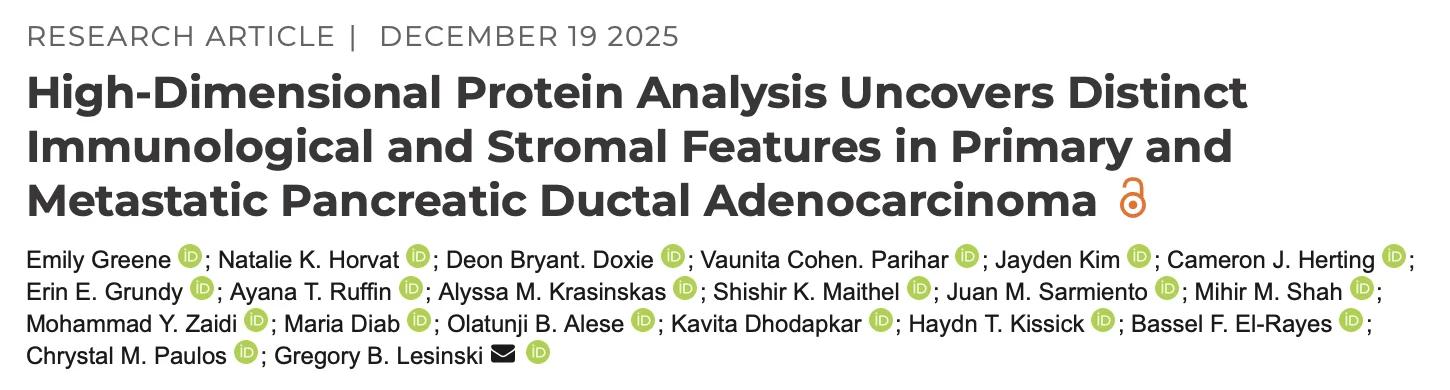
Title: High-Dimensional Protein Analysis Uncovers Distinct Immunological and Stromal Features in Primary and Metastatic Pancreatic Ductal Adenocarcinoma
Authors: Emily Greene, Natalie K. Horvat, Deon Bryant. Doxie, Vaunita Cohen. Parihar, Jayden Kim, Cameron J. Herting, Erin E. Grundy, Ayana T. Ruffin, Alyssa M. Krasinskas, Shishir K. Maithel, Juan M. Sarmiento, Mihir M. Shah, Mohammad Y. Zaidi, Maria Diab, Olatunji B. Alese, Kavita Dhodapkar, Haydn T. Kissick, Bassel F. El-Rayes, Chrystal M. Paulos,Gregory B. Lesinski
Read the Full Article on Cancer Research
More posts featuring Yan Leyfman.