






Yan Leyfman, Medical Oncologist, Co-Founder and Executive Director of MedNews Week, shared a post on LinkedIn about a recent article by Payal Goala et al, adding:
“New insights into CAR-T toxicity mechanisms
CAR T-cell therapy has transformed cancer outcomes, but a subset of patients develop severe toxicities—cytokine release syndrome (CRS) and immune cell–associated hematologic toxicity (ICAHT)—that limit benefit.
Using IL-2Rα knockout models, we show that CRS is tightly linked to acute neutropenia, driven by:
- Elevated IL-6, IFNγ, and TNFα
- Expansion of M1-like macrophages
- Disrupted bone-marrow neutrophil homeostasis (increased apoptosis, decreased proliferation/maturation)
A Th1–Th17 imbalance emerged as the key driver:
Increased IFNγ dominance → Decreased IL-17A and G-CSF → impaired neutrophil production and survival
IFNγ blockade:
- Reduced CRS
- Reversed neutropenia
- Preserved CAR-T antitumor efficacy
Clinical relevance: Patients with high-grade CRS and neutropenia showed an increased IFNγ : IL-17A ratio in peripheral blood.
These findings uncover a biological basis for ICAHT and support targeted IFNγ inhibition as a strategy to mitigate CAR-T toxicity without sacrificing efficacy.”
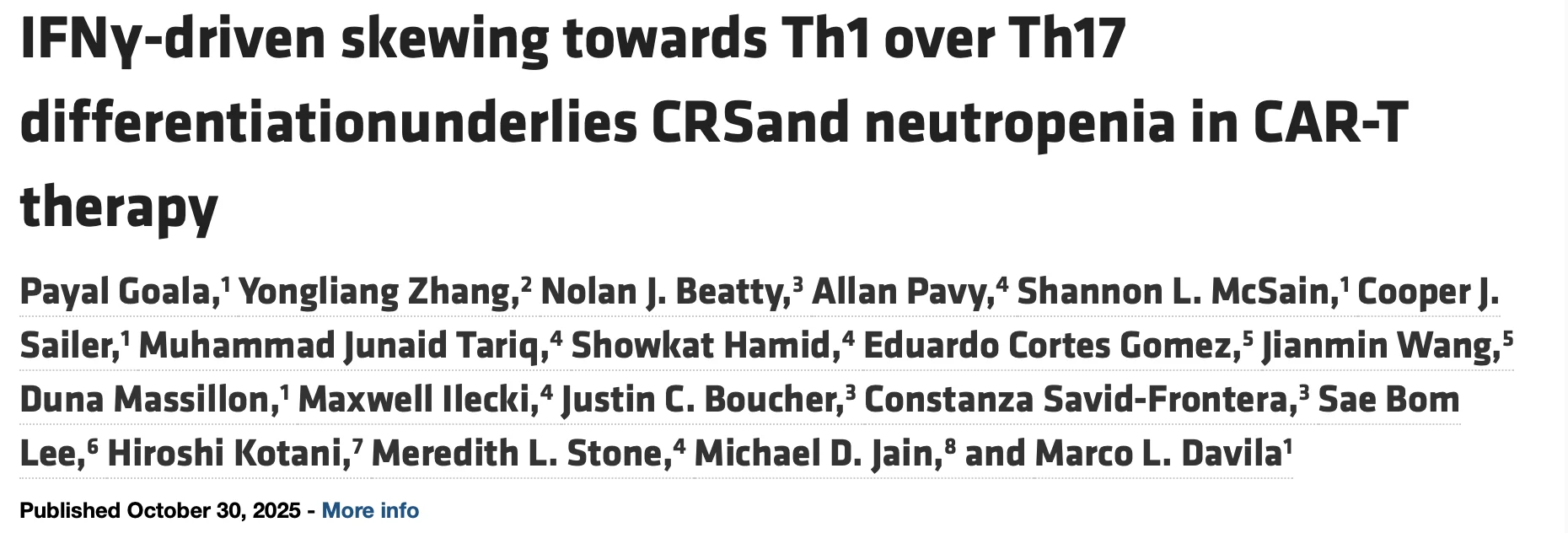
Title: IFNγ-driven skewing towards Th1 over Th17 differentiationunderlies CRSand neutropenia in CAR-T therapy
Authors: Payal Goala, Yongliang Zhang, Nolan J. Beatty, Allan Pavy, Shannon L. McSain, Cooper J. Sailer, Muhammad Junaid Tariq, Showkat Hamid, Eduardo Cortes Gomez, Jianmin Wang, Duna Massillon, Maxwell Ilecki, Justin C. Boucher, Constanza Savid-Frontera, Sae Bom Lee, Hiroshi Kotani, Meredith L. Stone, Michael D. Jain, Marco L. Davila
Read the Full Article on The Journal of Clinical Investigation
More posts featuring Yan Leyfman