





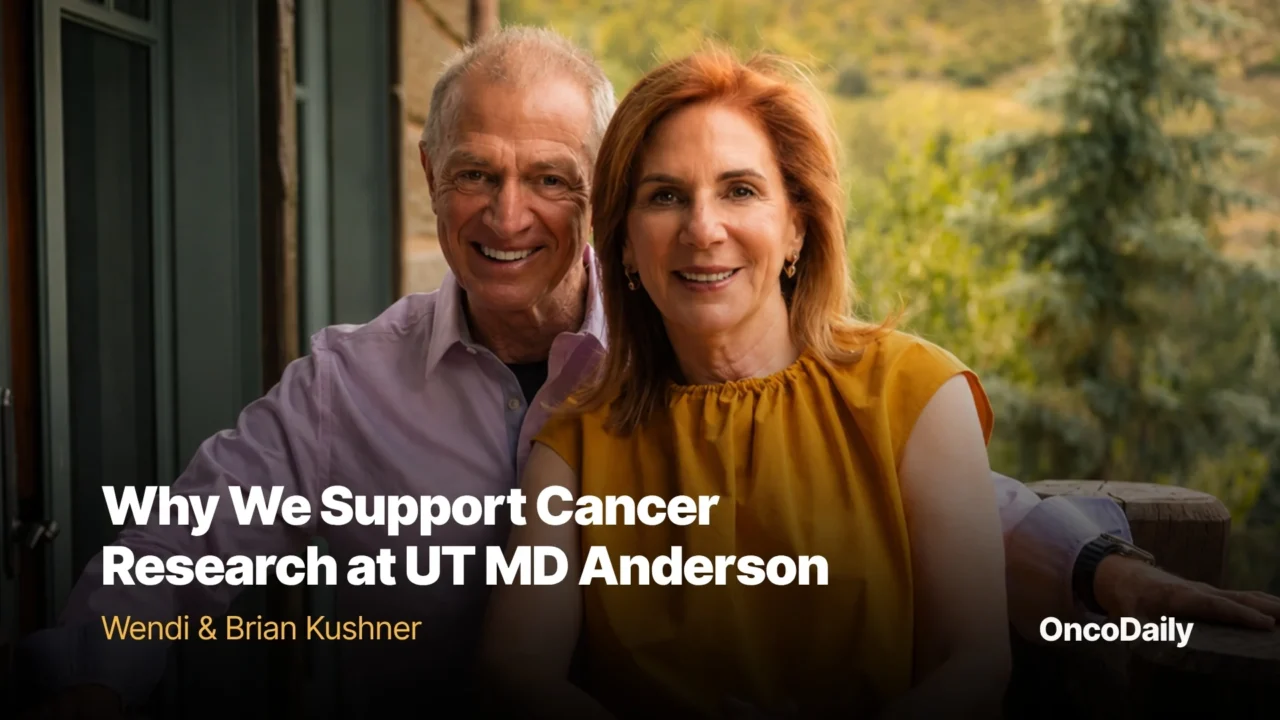
For Wendi and Brian Kushner, supporting cancer research is deeply personal.
Their connection to The University of Texas MD Anderson Cancer Center began after Brian was diagnosed with stage 3 melanoma in October 2018. It grew stronger when Wendi later faced stage 2, high-grade, triple-positive breast cancer and experienced firsthand how participation in a clinical trial could transform a patient’s treatment path.
Today, both are cancer-free. Their experiences have inspired them to support several areas of research at MD Anderson, including immunotherapy research at the James P. Allison Institute.
A Melanoma Diagnosis That Changed Everything
When melanoma was discovered on Brian’s scalp, the tumor was deep and concerning. His physician in Austin was unable to identify a local specialist who could provide the treatment he needed.
Remembering advice from a friend who had survived breast cancer, Wendi and Brian turned to MD Anderson.
Brian underwent surgery, followed by two weeks of radiation therapy and one year of immunotherapy. After completing treatment, he was declared cancer-free and has remained so.
For the couple, the outcome demonstrated how rapidly advances in oncology can change the meaning of a diagnosis. What initially appeared potentially terminal became treatable—and ultimately curable.
That experience gave Wendi and Brian a new sense of purpose: to raise awareness of the institution that had treated Brian and to support research that could create similar opportunities for other patients.
Then Cancer Came for Wendi
Wendi’s own diagnosis began unexpectedly during the final day of a bicycling trip in September. She felt a sudden, sharp pain in her right breast and discovered a lump.
A biopsy confirmed stage 2, high-grade, triple-positive breast cancer.
The diagnosis came as a shock. Wendi underwent annual mammograms, maintained a healthy lifestyle, and had no known risk factors. Her breast medical oncologist, Adaeze Nwosu Iheme, MD, explained that cancer can sometimes develop despite an individual’s best efforts to prevent it.
Additional testing was performed, and Wendi’s multidisciplinary care team developed a treatment strategy. The team included breast surgical oncologist Taiwo Adesoye, MD; breast radiation oncologist Melissa Mitchell, MD, PhD; and breast medical oncologists Adaeze Nwosu Iheme, MD, and Vicente Valero, MD.
Among the options presented was participation in a Phase 2 clinical trial.
A Clinical Trial That Changed the Surgical Plan
The trial evaluated the bispecific antibody zanidatamab in combination with endocrine therapy.
Zanidatamab was already being used in the treatment of HER2-positive metastatic breast cancer, biliary tract cancer, and certain gastric cancers. Preliminary findings from the Phase 2 study were encouraging, and Wendi agreed to participate.
The response became apparent early in treatment.
After her second infusion, imaging showed a marked reduction in the tumor. The lump, which had previously been easy to feel, gradually became barely detectable and eventually could no longer be identified.
Valero, who led the clinical trial, described the result as a “very robust response.”
By the conclusion of the study treatment, no tumor could be detected in Wendi’s breast. The response allowed her to undergo a lumpectomy rather than a mastectomy.
The postoperative pathology report showed a complete pathological response, with no residual cancer identified in either the breast or the lymph nodes.
For Wendi, the result was more than a clinical milestone. It was direct evidence of what carefully designed cancer research can offer an individual patient.
When Research Becomes Personal
Clinical trials are often discussed through response rates, survival outcomes, and statistical measures. Wendi’s experience illustrates the individual meaning behind those figures.
Participation in the trial did not simply reduce the size of her tumor. It changed the extent of surgery she required and led to the absence of detectable residual disease at the time of surgery.
Her experience also reinforced the importance of offering eligible patients access to investigational treatment approaches, particularly within specialist centers where multidisciplinary teams can evaluate emerging evidence and integrate research into clinical care.
For Wendi and Brian, supporting research became a way to help expand those possibilities for others.
Care That Extends Beyond Treatment
Wendi also emphasized the coordination she experienced throughout her care at MD Anderson.
On one occasion, she was scheduled for a blood draw, CT scan, bone scan, and appointments with three physicians within a narrow period. Although the schedule initially appeared impossible, staff members coordinated the sequence of visits so that each examination could be completed efficiently.
Her physicians received the results shortly after the tests were performed.
For patients navigating cancer, such coordination can make a significant difference. Managing multiple appointments, medical records, imaging results, and specialist consultations may create an additional burden during an already difficult period.
Wendi described an environment in which these responsibilities were handled by an integrated team, allowing her and Brian to focus more fully on treatment and recovery.
She also recalled the kindness shown by staff members throughout the institution—from clinical teams who carefully explained each step of treatment to employees who helped them find their way through the center.
Immunotherapy and a Rapidly Changing Field
Brian’s treatment also demonstrated how quickly oncology practice can evolve.
The immunotherapy recommended by his care team had been approved as an adjuvant treatment for melanoma only one year before his diagnosis. Access to specialists familiar with the latest treatment options allowed him to benefit from a relatively recent advance.
For Wendi and Brian, this experience highlighted the importance of research institutions that can rapidly translate scientific progress into patient care.
Their first contribution to MD Anderson, made in 2020, supported research exploring whether intratumoral therapy—delivering immunotherapy directly into a tumor—could improve treatment effectiveness.
Their commitment grew further following the opening of the James P. Allison Institute in 2022.
Supporting the Next Immunotherapy Breakthrough
The James P. Allison Institute was established to advance immunotherapy research and develop new approaches to using the immune system against disease.
Wendi credits James P. Allison, PhD, not only for his scientific vision but also for the persistence that helped establish immune checkpoint therapy as a major pillar of modern cancer treatment.
She believes the future impact of immunotherapy may extend beyond oncology and contribute to the treatment of autoimmune diseases and other chronic conditions.
For Wendi and Brian, supporting this work is both an expression of gratitude and an investment in future patients.
They know from personal experience that research can turn a frightening diagnosis into a treatable condition, offer less extensive surgical options, and create outcomes that may not have been possible only a few years earlier.
From Survivorship to Purpose
Wendi and Brian’s story brings together several dimensions of contemporary cancer care: multidisciplinary treatment, access to clinical trials, advances in immunotherapy, coordinated patient support, and philanthropic investment in research.
Brian’s melanoma treatment introduced the couple to MD Anderson. Wendi’s breast cancer trial deepened their understanding of how research directly shapes treatment decisions and patient outcomes.
Now, as a cancer survivor and caregiver, Wendi uses her experience to advocate for the institution and the research programs that changed both of their lives.
Their message is ultimately one of possibility. Cancer research is not an abstract scientific pursuit. For patients and families, it can mean another treatment option, a less invasive operation, a complete response, or more years together.
Read more stories shaping the future of cancer care on OncoDaily.