






Walid Kamoun, Vice President, Global Head of R&D Oncology at Servier, shared a post on LinkedIn about a recent article by Maorong Cai et al, published in Cell Death Discovery:
“Weekend Tradition – GBM Scientific Light Reading
An excellent and insightful paper just published in Cell Death and Discovery (Nature Portfolio) sheds new light on the complex role of inflammation and lipid metabolism in glioblastoma (GBM).
The authors elegantly show that low‑dose TNF‑α, rather than being cytotoxic, can actually promote GBM progression by rewiring lipid metabolism. Mechanistically, low‑dose TNF‑α activates TNFR signaling and the adaptor protein TRAF2, which in turn stabilizes fatty acid synthase (FASN) through K63‑linked ubiquitination driving lipid accumulation and malignant phenotypes.
Importantly, the study goes beyond mechanism: through virtual screening, the authors identify Jionoside B1, a small molecule that disrupts the TRAF2–FASN axis, suppresses lipid synthesis, and attenuates tumor growth both in vitro and in vivo.
This work highlights the true ‘double‑edged sword’ nature of TNF‑α in the tumor microenvironment and reinforces lipid metabolism as a therapeutically actionable vulnerability in GBM.
Congratulations to the authors for this rigorous and conceptually powerful contribution.”
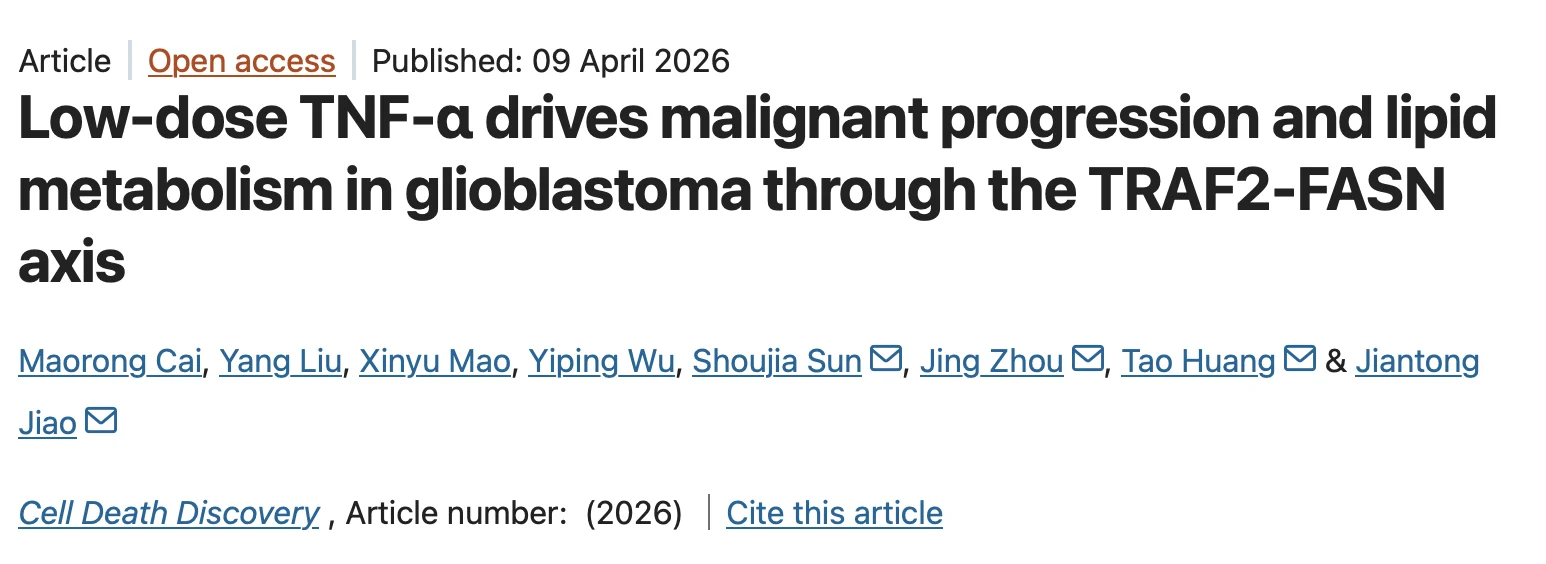
Title: Low-dose TNF-α drives malignant progression and lipid metabolism in glioblastoma through the TRAF2-FASN axis
Authors: Maorong Cai, Yang Liu, Xinyu Mao, Yiping Wu, Shoujia Sun, Jing Zhou, Tao Huang, Jiantong Jiao
Read the Full Article on Cell Death Discovery
More posts featuring Walid Kamoun.