Vincent Rajkumar, Professor of Medicine at the Mayo Clinic in Rochester and Editor‑in‑Chief at Blood Cancer Journal, shared a post on X:
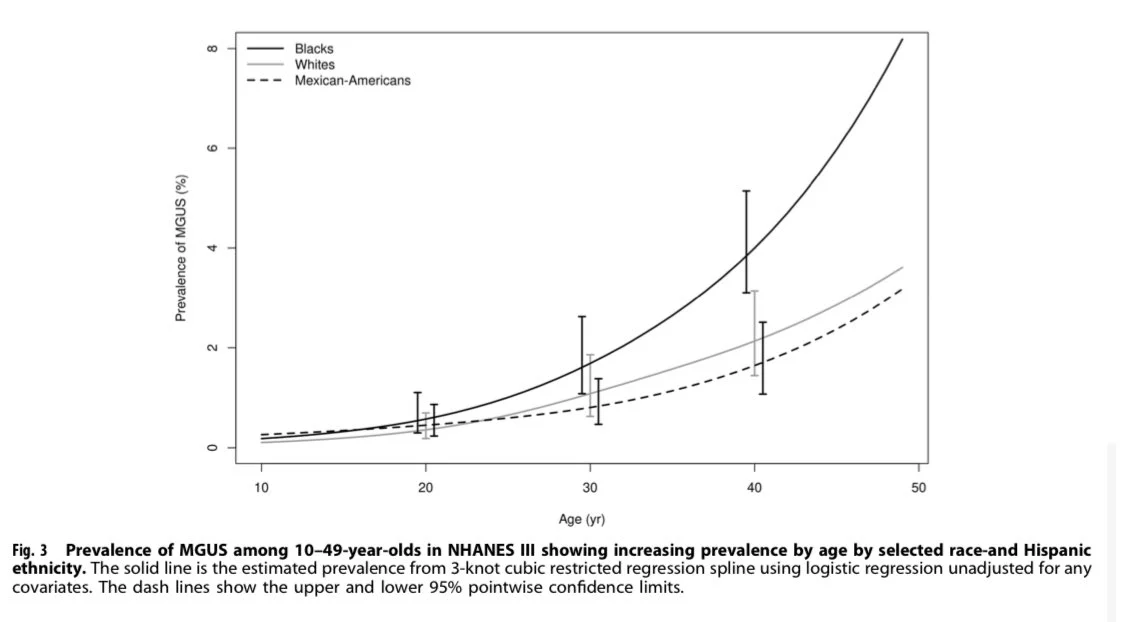
“Just out: Our study using NHANES samples in persons age 10-49 shows that MGUS starts at a younger age in Black people and that there is a markedly higher risk of MGUS in African Americans compared to White people.
The 2-3 fold high risk of MGUS in Black people is the reason why Multiple Myeloma is 2-3 fold more likely to occur in African Americans compared to the White population. Study done in collaboration with C. Ola Landgren, over 15 years. This is the third paper and uses highly sensitive mass spectrometry.
Monoclonal Gammopathy of Undetermined Significance (MGUS) is the premalignant precursor of multiple myeloma. The reason age adjusted prevalence of myeloma in African Americans is mainly because they have a 2-3 fold higher higher risk of MGUS and not felt to be due to a higher risk of progression of MGUS to myeloma. This is an important point. Genetic differences in other words predispose to the ‘polyp’ (MGUS) but not the cancer (myeloma).
We believe there is a genetic predisposition to the origin of MGUS presumably due to an aberrant response to antigen stimulation in Blacks in the US and in Western Africa compared to Whites. We don’t think that the disparity in the occurrence of MGUS is due to environmental exposure differences. For one it’s seen in all socio economic strata. Second the higher prevalence is seen in studies we did in Ghana exactly similar to what we see in African Americans. And third, in a study we did in a Southern US cohort where we looked at African American and White women living in the same region with same socioeconomic status, we found a 2-3 fold higher risk of MGUS in African American women.
So it’s unlikely to be environmental differences. Our study of other modifiable risk factors in NHANES doesn’t explain the disparity. We suspect that the disparity we see in African Americans and in studies Western Africa, may or may not be present in Eastern African countries. Which is why we are studying the Somali population in Minnesota currently. Our NHANES study just published Blood Cancer Journal shows that the disparity in occurrence of MGUS is apparent even at age 30-39 in African Americans compared to White population in America.”
Title: Prevalence of monoclonal gammopathy of undetermined significance (MGUS) using a sensitive mass spectrometry assay in young individuals 10–49 years of age: a population-based study from the National Health and Nutritional Examination Survey
Authors: Shaji Kumar, David Murray, Dirk R. Larson, Ola Landgren, P. Leif Bergsagel, James R. Cerhan, S. Vincent Rajkumar
Other articles featuring Vincent Rajkumar on OncoDaily.