






Vincent Rajkumar, Professor of Medicine at the Mayo Clinic in Rochester, Editor‑in‑Chief at Blood Cancer Journal, and Chairman of the International Myeloma Foundation Board, shared a post on X:
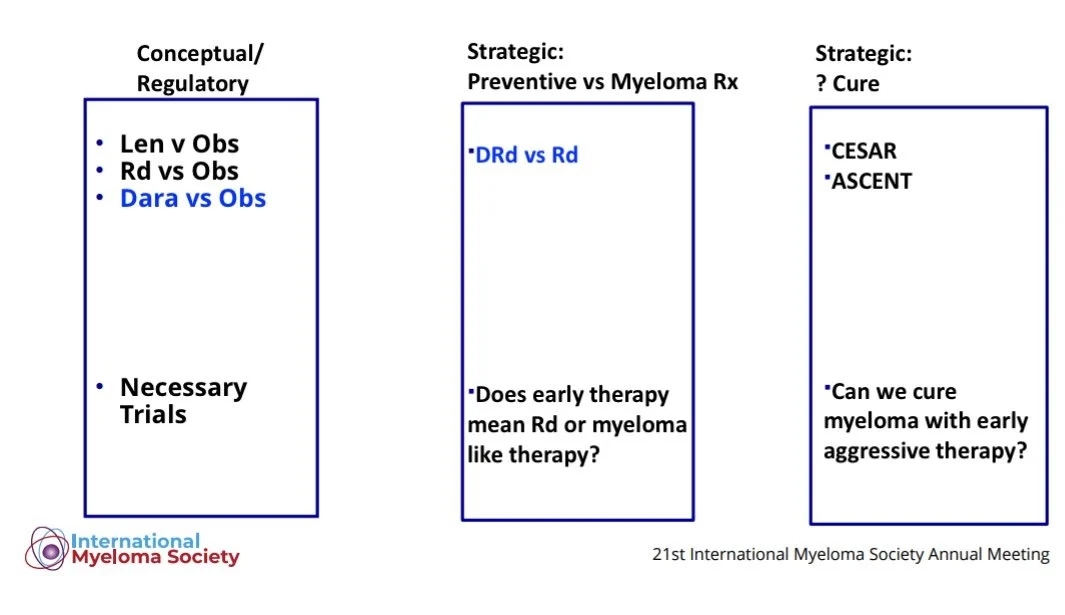
“This slide explains the current strategy for smoldering myeloma trials. I use it as an example. It is useful to study this for anyone interested in a career in strategic clinical trials.
What do we do if we need to test multiple strategies to solve a clinical problem, when each step of each strategy takes more than a decade to accomplish? This is the situation we face in SMM. And here is how we are approaching it.
In SMM we have 3 key strategies to test. Each is an important question to be addressed in our strategy to improve outcomes for patients. We are tackling this problem by testing all of these 3 key strategies in parallel. We will be happy if any one of these succeeds, or whether all 3 are successful.
The 3 strategies tackle 3 problems, all of which are important and time is of the essence.
Question 1) Does early therapy improve outcome in smoldering myeloma, and if it does how do we make it available to patients worldwide?
To address this in a manner that actually helps patients we need to first prove one drug is better than nothing. No regulator will approve early therapy if you test Dara-VRd vs observation. You won’t know which drug is essential and which is not. You have to prove 1 is better than 0, before you get to 2 is better than 1, and do on. As we did with active myeloma. These are necessary trials. Without this step we won’t get regulatory approval for anything. And without regulatory approval even if early therapy is useful, few patients outside the US will have access. These are also incredibly difficult trials because SMM is much less frequently diagnosed than active MM, and because endpoints take much longer.
Question 2) If early therapy is indeed helpful, will patients have better outcomes and live longer with monotherapy or with myeloma-like combination therapy?
Ideally you would like to do this after you find out that monotherapy is helpful, but time is of the essence and many patients want to test early intervention. So shortly after the first monotherapy trial shows promise, we embarked on these trials to test what is the optimal way to approach early therapy. Two phase IIIs have been done: IsaRd vs Rd and DaraRd vs Rd. One has completed accrual and one is almost done with accrual. Results will take time, but far sooner than if we were just starting to design such trials. This is the advantage of anticipating results and designing successor trials. We have done this over and over again in myeloma successfully.
Question 3) Can intervention used early in the SMM stage actually result in a cure?
In other words, instead of just delaying myeloma or improving overall survival, can early intervention deliver an actual cure! We don’t need early intervention to be curative; delaying myeloma, delaying or preventing need for myeloma like therapy, or improving overall survival is sufficient. But cure will be surely great and the question of whether and if so which therapy will be curative is important. Again we have embarked on trials to address this question in parallel. Trials targeting cure as a goal like Cesar and Ascent have been done. And more such trials are on their way.
When we think about solving a clinical problem sometimes we have to test multiple key questions. Having a clear thoughtful vision, identifying the key questions and strategy on how to address them, having a world view rather than views centered on your own country or situation, and having international collaborations to address them is important.
We are fortunate in the myeloma field that as a team we are able to work with colleagues, companies, patients, foundations, around the world to address them. SMM is a good example, but the field is full of them.
I hope this is useful for those trying to develop a career in conducting meaningful clinical trials. The ultimate reward is when efforts lead to a practice change that helps patients worldwide.”
More posts featuring Vincent Rajkumar.