





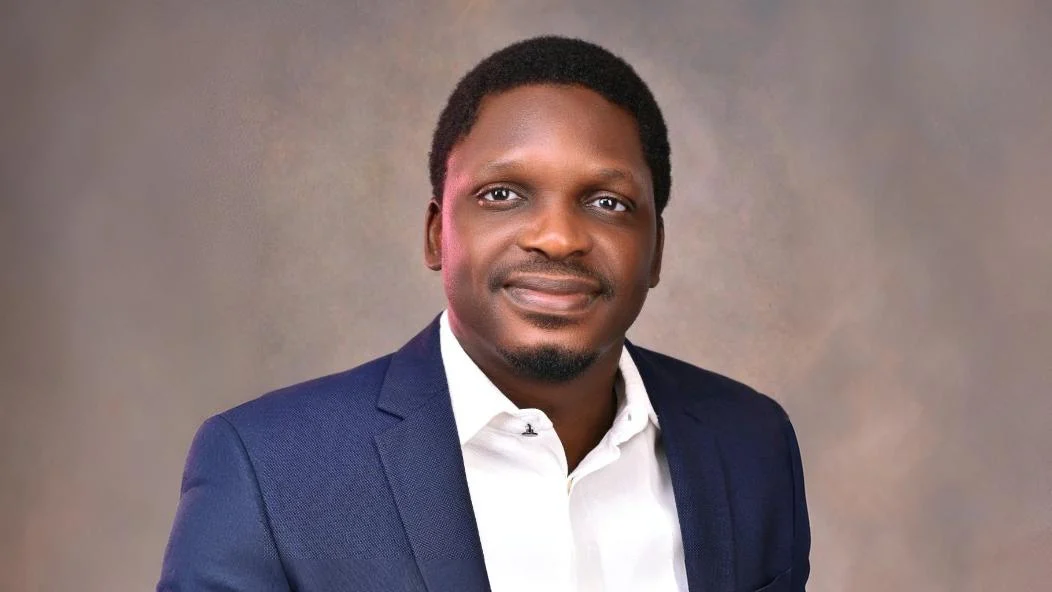
Victor Ekpo, Secretary General at Nigerian Association of Medical Physicists (NAMP), shared a post on LinkedIn:
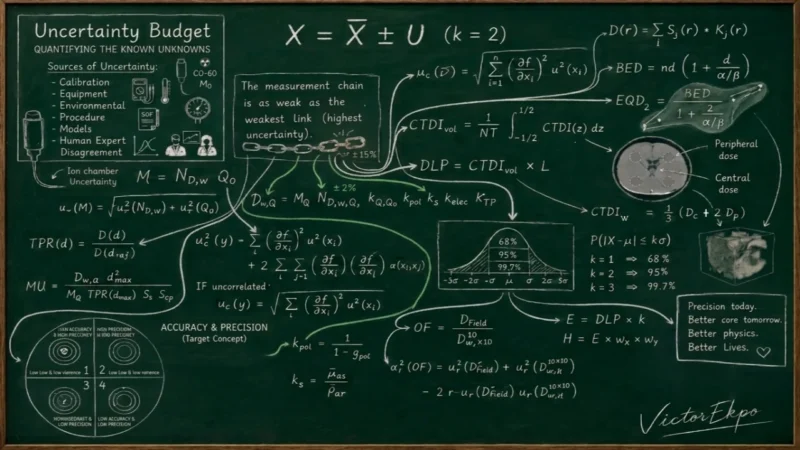
“EMBRACING UNCERTAINTY IN A PRECISION WORLD
In the pursuit of precision medicine, the true eye-opener isn’t just the accuracy we achieve, but the uncertainty we learn to embrace. Reflecting on my recent experience at the ICTP Workshop on Advanced Dosimetry in Italy, this article explores the fascinating paradox of Radiation Medicine: how deepening our expertise actually increases our awareness of the ‘known unknowns’.
From the technical rigors of an ‘Uncertainty Budget’ to the ethical necessity of transparent communication, I delve into why understanding the limits of our measurements, as highlighted in standards like IEC 61674:2024, is essential for building trust and advancing 21st-century science.
As we strive to increase precision while reducing uncertainty, we must remember that our ‘measurement chain is only as strong as its weakest link’, and acknowledging that link is the first step toward better Physics and better lives.
One of modern medicine’s great ambitions is precision medicine. As Medical Physicists, we spend our careers on improving accuracy and precision, so that every patient receives the right diagnosis, the right dose, and the right treatment.
That is why one of the most striking lessons from my recent Advanced Dosimetry in Diagnostic and Interventional Radiology workshop at the ICTP in Trieste, Italy was not only about achieving perfect precision – it was about ’embracing’ and communicating uncertainty.
At first, it sounded almost contradictory.
But uncertainty in science is not ignorance, nor a sign of poor quality or lack of knowledge. It is an honest, quantitative expression of how confident we are in a measurement or model.
A concept that particularly resonated with me was the uncertainty budget. Every reported measurement is influenced by many contributors: the measuring equipment, calibration, environmental conditions, procedure, mathematical models, operator technique, and even differences in expert interpretation. Rather than ignoring these factors, an uncertainty budget identifies and quantifies each one.
Thus, the goal is not to eliminate uncertainty – that is near-impossible. Human senses and instruments always have a margin of error. Science is open to being challenged and refined. The goal is to understand it, communicate it, and continually reduce it.
A paper by van der Bles et al. (2019) made an observation that extends well beyond science. The study argued that communicating uncertainty demonstrates transparency and honesty, even though people naturally prefer precise answers. The challenge for scientists is therefore twofold: produce precise measurements and communicate uncertainty in ways that foster understanding and trust.
One framework from the paper has stayed with me:
‘Who is communicating what, in what form, to whom, and to what effect?’
That simple question applies just as much to a conversation with a patient or clinician as it does to a scientific publication.
Since returning from the IAEA-ICTP Workshop, I find myself noticing uncertainty everywhere. It appears on ion chamber calibration certificates accompanying the calibration coefficient. It is sometimes reported in journal publications alongside confidence intervals and standard deviations. It is embedded in standards such as IEC 61674:2024 and underpins every meaningful measurement we make in radiation medicine.
Uncertainty has always been there. I am simply seeing it more clearly now.
It reminds me of a quote on the first page of Bushberg’s The Essential Physics of Medical Imaging, where he humorously reflects that ‘there has been an alarming increase in the number of things I know nothing about.’ That captures the scientist’s journey – the more we learn, the more we see the limits of our knowledge. Curiosity is ever-expanding!
As Dr. Paula Toroi oi remarked during the workshop:
‘The measurement chain is only as strong as its weakest link (the highest uncertainty).’
That is one of the most valuable lessons I’ve learned this year.
My sincere thanks to the IAEA for sponsoring my participation, and to the outstanding faculty at the ICTP for delivering such an insightful and thought-provoking Workshop.”
Other articles featuring Victor Ekpo on OncoDaily.