






Valsamo Anagnostou, Co-Director of Thoracic Oncology Precision Medicine Center of Excellence and Division of Upper Aerodigestive Malignancies and Alex Grass Professor of Oncology at Johns Hopkins University School of Medicine, shared a post on LinkedIn:
“As we wrap up 2025, we share our collective insights on liquid biopsies, emphasizing cell-free DNA biology, both established and emerging technologies, and their clinical utility.
Here’s the key questions addressed:
- How is cfDNA biology leveraged for the development of fit-for-purpose liquid biopsy assays?
- What are clinically validated assays for early cancer detection, and how do single-cancer tests differ from multi-cancer early detection liquid biopsy assays, especially with respect to their clinical implementation?
- What are the challenges with cancer early detection (different for fragmentation vs methylation-based assays)?
- What is the role of AI integration in overcoming those?
- How is plasma comprehensive genomic profiling (pCGP) guiding therapy?
- What are the technical and biological challenges with pCGP?
- What is hybrid capture NGS, and what are the different flavors of tumor-informed MRD assays from a technical standpoint?
- How about residual disease detection in the early and metastatic setting?
- What have we learned re: clinical sensitivity of ctDNA residual disease in predicting clinical endpoints (pathological response, disease recurrence)?
- What is the emerging role of ctDNA dynamics or landmark status assessment in predicting immunotherapy response?
- What would a ctDNA-interventional clinical trial design look like?
- How is/will ctDNA guide therapy optimization across cancers, stages and therapy settings?
Importantly, we aggregated patient-level data (where available) from clinical trials in early-stage cancers and specifically computed the concordance and discordance rates between ctDNA residual disease and clinical endpoints. These analyses showed that while individuals with detectable ctDNA residual disease most frequently recur, there is a large fraction of individuals with undetectable ctDNA residual disease that also recur, highlighting the issues with the analytical sensitivity of currently used liquid biopsies.
Fortunate to work with Blair Landon Akshaya Annapragada Noushin Niknafs and Victor Velculescu!”
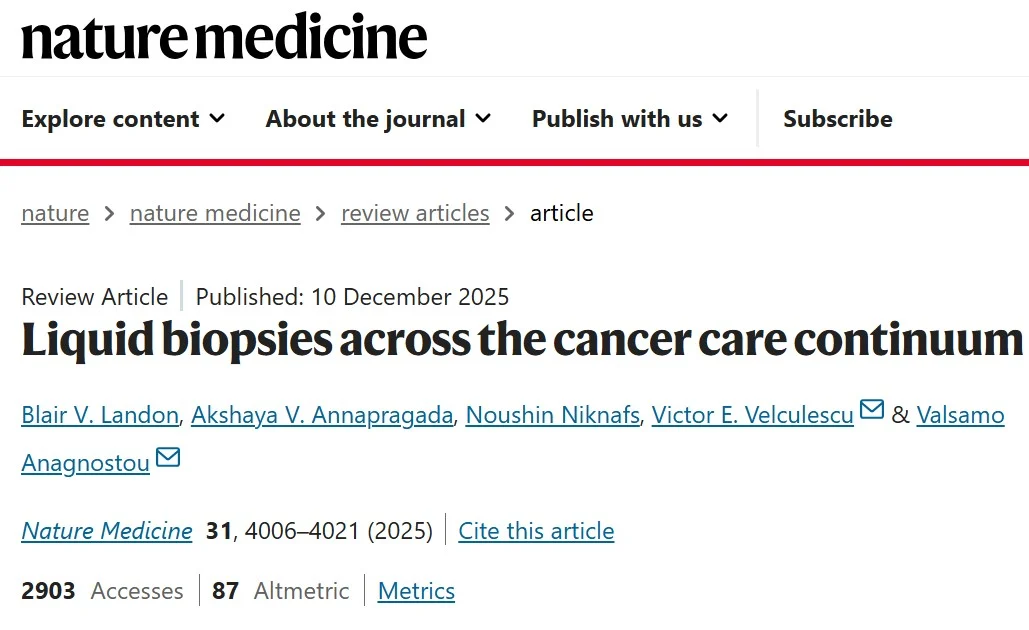
Title: Liquid biopsies across the cancer care continuum
Authors: Blair V. Landon, Akshaya V. Annapragada, Noushin Niknafs, Victor E. Velculescu, Valsamo Anagnostou
You can read the full article in Nature Medicine.
More posts featuring Valsamo Anagnostou.