





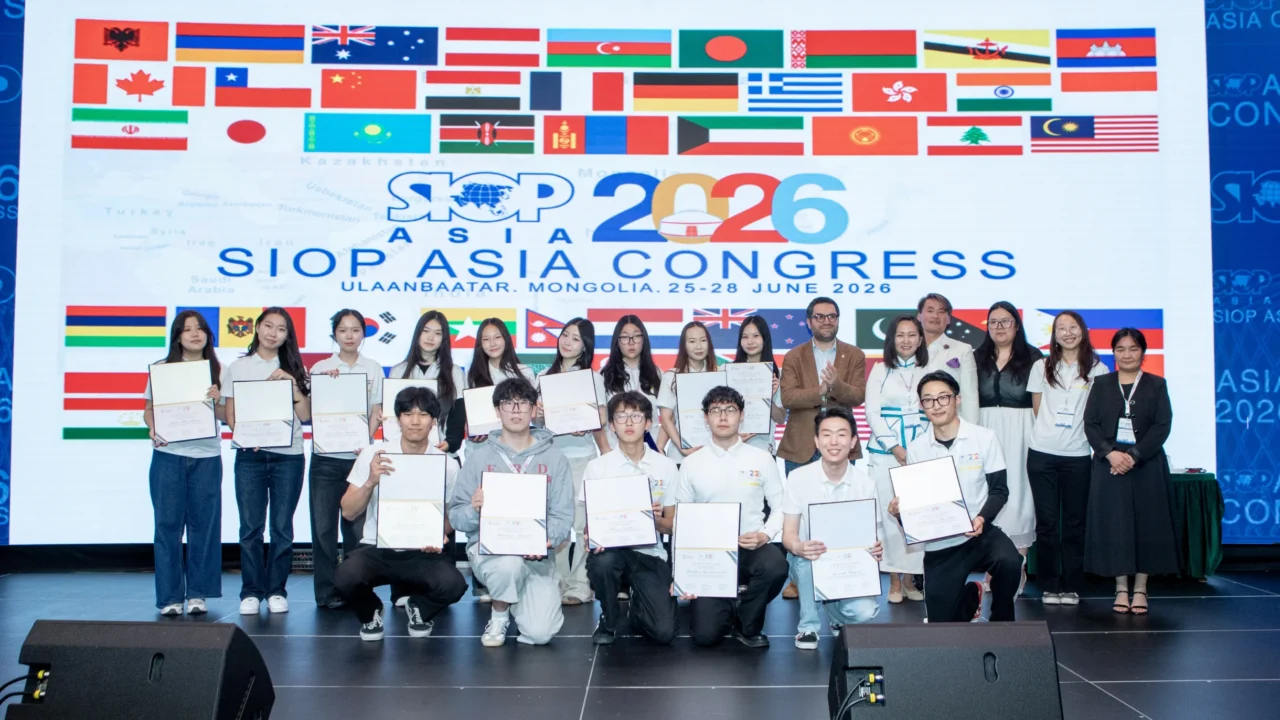
Unurbayasgalan Buyanjargal is a second-year medical student at the Mongolian National University of Medical Sciences with a strong interest in dermatologic oncology and global health, and a genuine love for volunteering. She recently volunteered at SIOP Asia 2026 in Mongolia, where she supported conference logistics and connected with doctors, specialists, and cancer survivors from around the world. She hopes to continue contributing to initiatives that bring together medical education and patient-centered care.
“I’m glad to share a few reflections from my time volunteering at SIOP ASIA 2026, held here in Mongolia.
Volunteering was never really about the certificate or the hours for me. It was about ending up in the right rooms with the right people and learning from them. That’s probably why I kept making time for it throughout school, squeezing it in between exams, late nights of studying, and everything else that comes with trying to become a doctor.
I’d volunteered plenty of times before, in middle school and high school: community clean-ups, school events, the usual. But this conference was different. It was the first time I did it in a field that’s actually mine, medicine, and I think that’s part of why it left such an impression. There’s a difference between helping out somewhere and helping out somewhere you can picture your future self-standing.
The first thing I noticed was how much goes into running an international conference. Over 360 people came from 55 countries, and watching it all happen, the hall logistics, helping people find their way around, registration, troubleshooting whatever came up, taught me more about event coordination than I expected. I hadn’t thought before about how much invisible work sits underneath a single well-run panel discussion, down to the badge that has to be ready and the microphone that has to work.
But the part that stayed with me most was something else entirely: the doctors, specialists, and cancer survivors who spoke, and what they had to say.
A few days before the conference started, I got to guide five cancer survivors visiting from Brunei, along with a doctor from India. We talked about healthcare systems, what cancer treatment and recovery actually look like where they’re from, how it compares to here. It taught me things no textbook could. I remember realizing, mid-conversation, that the gap between what I’d read about “healthcare access” on a lecture slide and what it actually meant for someone’s day-to-day treatment was much bigger than I’d assumed.
What struck me most, though, were the presentations themselves: the research, the findings, and how each country’s social and healthcare context shapes both the problems people face and the ways they’re trying to solve them. Listening to specialists from completely different countries compare notes during the panels, I kept thinking more of my classmates should’ve been in that room. Not because the material was hard to follow, but because it’s the kind of thing you don’t realize you’re missing until you’ve sat through it.
That thought came into sharper focus during one talk in particular, a needs assessment out of the Lebanese American University on palliative care education among medical students. The number that got me: out of 240 students surveyed, only 8% felt confident in their own palliative care knowledge, even though nearly half rated their overall academic performance as very good to excellent. A student can be doing well by every conventional measure of medical school and still feel unprepared for one of the most human parts of the job: sitting with a patient and family through an ending.
And then there were the people I volunteered alongside. Most were studying medicine, already in the field, or headed there, and honestly, their advice turned out to be just as valuable as anything I learned from the speakers. Which parts of a talk are worth remembering for coursework later. How to read a research poster quickly. Which questions are worth asking a specialist when you only get five minutes with them. It was also good to meet people I might end up working alongside someday, the kind of connections that don’t show up on a CV line but matter more than most things that do.
If there’s one thing I’d want to leave people with, it’s this: if you ever get a chance to volunteer at an international conference in a field you actually care about, take it. Not for the certificate, not for the hours, but for the conversations you won’t get anywhere else, the ones that quietly end up shaping how you think about the work you’re headed into.”