





The Babak Lab shared a post on LinkedIn:
“Scientific Wednesdays: Molecular glue degrader of HuR suppresses BRAF-mutant colorectal cancer.
A new study published in Nature explores a new strategy for one of the most difficult colorectal cancer subtypes: BRAF-mutant CRC.
Why have previous therapies struggled?
In BRAF-mutant CRC, BRAF inhibitors often fail because the MAPK pathway can quickly switch back on, especially through EGFR feedback and BRAF dimerization. Even BRAF + EGFR combinations usually provide only limited benefit, and resistance remains a major problem.
Key Insights
- BRAF mutations occur in roughly 10% of colorectal cancers and are linked to poor prognosis
- The study identifies dHuR, a molecular glue degrader targeting the RNA-binding protein HuR
- dHuR brings HuR to the CRBN ubiquitin ligase, triggering HuR degradation
- HuR degradation disrupts BRAF RNA splicing, induces exon 18 skipping, and lowers oncogenic BRAF protein levels
- This suppresses MAPK signaling and slows BRAF-mutant CRC growth
- dHuR also showed activity in BRAF inhibitor-resistant CRC models
- The study suggests that combining HuR degradation with EGFR or MEK inhibition could strengthen the therapeutic effect
Why Nature?
This paper goes beyond finding another inhibitor. It connects molecular glue chemistry, structural biology, RNA splicing, CRISPR screening, resistant cancer models, and combination therapy logic into one clear mechanism.
Conclusion
Instead of only blocking BRAF signaling, this study targets the RNA-level machinery that helps BRAF-mutant CRC survive and escape treatment.”
To which Maria Babak, Head of the Lab at The Babak Lab, added:
“I like how this paper connects chemistry, RNA biology, exon skipping, and resistant tumor models into one cohesive story.”
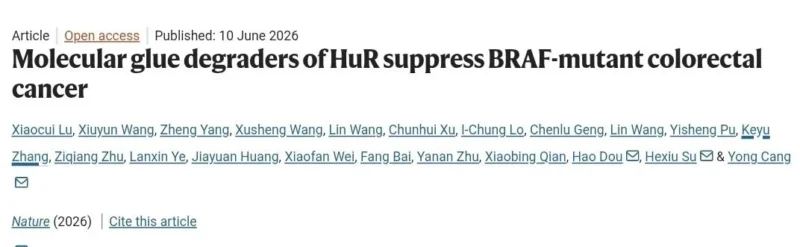
Title: Molecular glue degraders of HuR suppress BRAF-mutant colorectal cancer
Authors: Xiaocui Lu, Xiuyun Wang, Zheng Yang, Xusheng Wang, Lin Wang, Chunhui Xu, I-Chung Lo, Chenlu Geng, Lin Wang, Yisheng Pu, Keyu Zhang, Ziqiang Zhu, Lanxin Ye, Jiayuan Huang, Xiaofan Wei, Fang Bai, Yanan Zhu, Xiaobing Qian, Hao Dou, Hexiu Su and Yong Cang.
Other articles about The Babak Lab on OncoDaily.