





The Babak Lab shared a post on LinkedIn about a recent article by Qiangqiang Shi et al. published in Nature Nanotechnology:
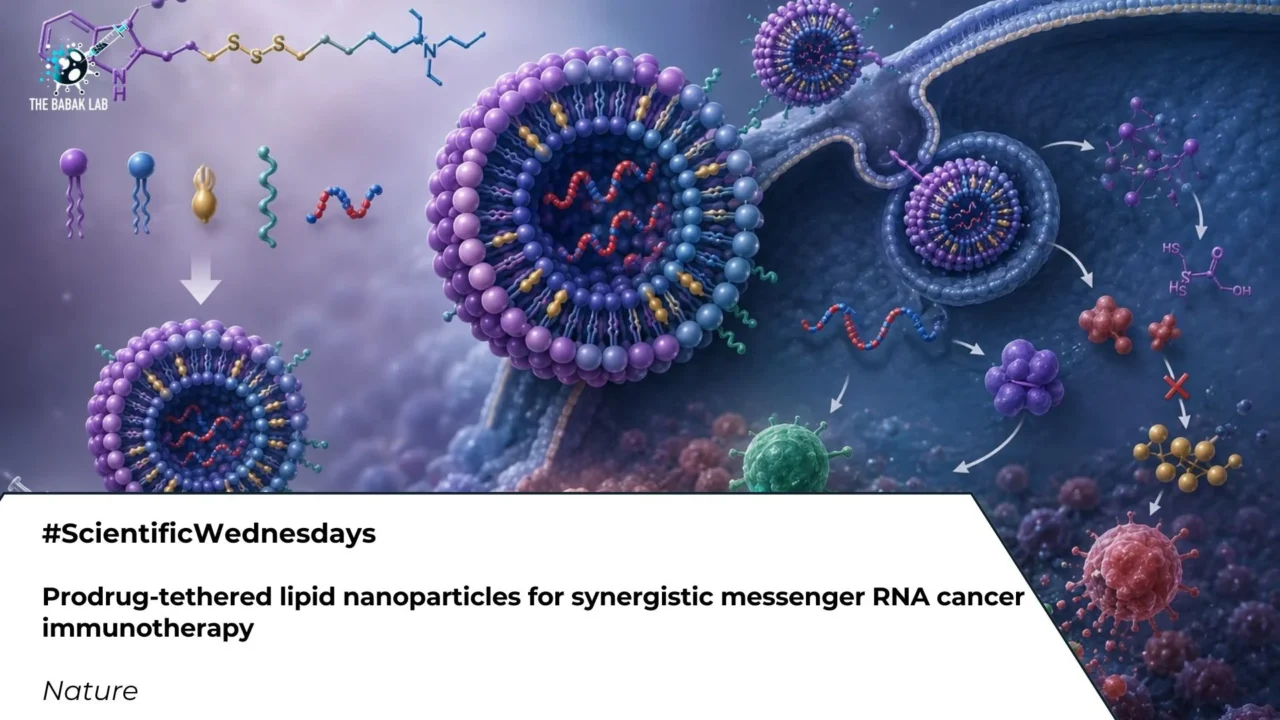
“Scientific Wednesdays: Prodrug-tethered LNPs for synergistic mRNA cancer immunotherapy
A new study published in Nature Nanotechnology introduces prodrug-tethered lipid nanoparticles, or pLNPs, designed to co-deliver IL-12 mRNA and an IDO inhibitor prodrug directly into the tumor microenvironment.
Key Insights
- The platform combines two complementary immune strategies: IL-12 mRNA activates effector T cells, while the IDO inhibitor helps reduce T cell exhaustion
- The IDO inhibitor is built into the ionizable lipid itself and released intracellularly through a glutathione-cleavable linker
- The lead pLNP achieved stronger IL-12 mRNA delivery than the clinically used MC3-based LNP platform
- In a mouse colon cancer model, intratumoral pLNP treatment induced complete regression of primary tumors
- The therapy increased CD8+ T cell infiltration, reduced PD-1 expression, and shifted the tumor microenvironment from “cold” to ‘hot’
- Treated mice developed memory T cell responses and resisted tumor rechallenge
- The approach also triggered systemic anti-tumor immunity, leading to regression of untreated distal tumors
Conclusion
By linking a small-molecule prodrug directly to the lipid carrier, pLNPs enable synchronized delivery of immune activation and exhaustion blockade within the tumor.
Image generated using Sora by OpenAI.”
Title: Prodrug-tethered lipid nanoparticles for synergistic messenger RNA cancer immunotherapy
Authors: Qiangqiang Shi, Ningqiang Gong, Jinjin Wang, Rohan Palanki, Qiuxian Zheng, Mohamad-Gabriel Alameh, Garima Dwivedi, Benjamin Davis, Jilian Melamed, Zhangyi Luo, Junchao Xu, Christian G. Figueroa-Espada, Lulu Xue, Ye Zeng, Xuexiang Han, Dongyoon Kim, Qinyuan Chen, Hannah Yamagata, Hannah C. Geisler, Rakan El-Mayta, Il-Chul Yoon, Drew Weissman, Michael J. Mitchell
Read the Full Article on Nature Nanotechnology
Maria Babak, Head of the Babak Lab and Assistant Professor at City University of Hong Kong, shared this post, adding:
“Smart engineering: using the lipid itself as a prodrug rather than simply loading an additional drug.”
More posts about The Babak Lab.